

The most useful post-storm discussion is not “Did everyone do a good job?” It is “Which entrance decisions were clear, which handoffs failed and what evidence shows the next change is needed?” A focused review can improve coordination without turning every repeated observation into an accusation against an employee or contractor.
Use this review to close the winter entrance readiness plan after an event. Keep unresolved hazards on the active response path; a retrospective meeting must not postpone work still needed at the property. The review is an operational improvement exercise, not a legal compliance certification.
Build a small factual timeline
Gather the activation decision, entrance observations, acknowledgments, contractor arrival and reported completion, and shift handoffs. Use the original records and identify their source. If a time is missing, mark it unknown rather than inserting a plausible value.
Separate the sequence into decisions and conditions. A manager can activate the plan before a surface problem exists. A crew can report completion before an officer observes the result. Keeping those events separate helps explain a gap without assuming bad intent.

Look at the entrance rather than the department
Choose one recurring issue and follow it across organizational boundaries. For example, fictional reports may show that tracked-in moisture repeatedly extended beyond the vestibule while the exterior clearing task was complete. The review question is whether the interior response had an owner and sufficient information, not whether snow removal “failed.”
Compare the wet-lobby reports with the contractor handoff records. Ask where the receiving owner became unclear. A location that appears in several reports may need a focused facilities assessment, but the number of reports alone does not establish a defect or its cause.

Measure what the records can actually support
A simple review can compare observation-to-acknowledgment and acknowledgment-to-reported-completion intervals where both timestamps exist. Define those terms before calculating them. Exclude missing pairs and explain the limitation rather than presenting a misleading average.
Useful questions include:
- Did the report identify the correct entrance?
- Was the receiving contact reachable during that shift?
- Was acknowledgment recorded separately from completion?
- Did an unresolved issue survive the shift change?
- Was the final visible condition checked within the approved process?
These are process checks, not injury-risk scores. Do not use them to claim that a building is safe or that a provider meets every legal obligation.
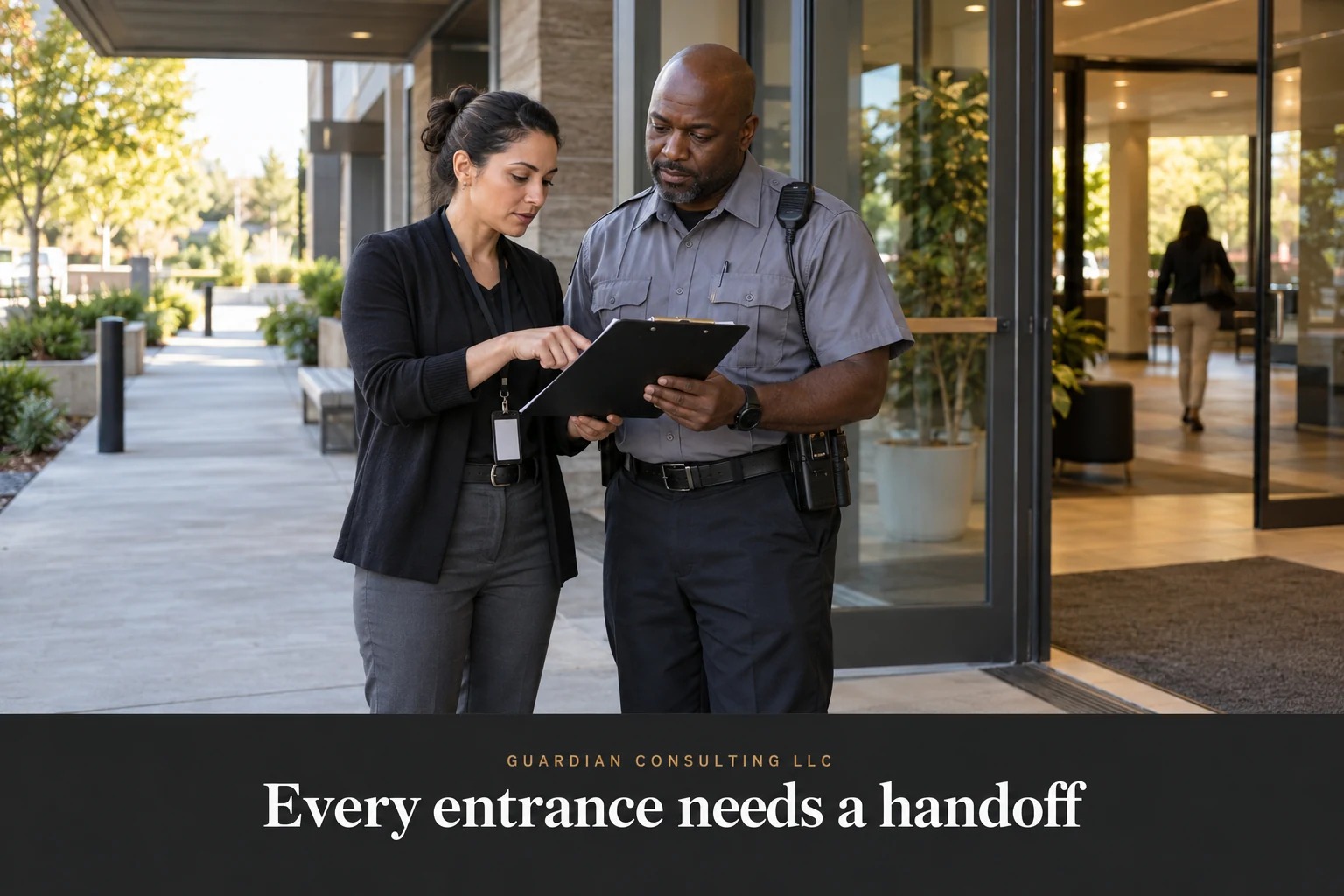
Assign a correction with a clear boundary
Write one action for each verified gap. “Improve communication” is too broad. “Update the overnight escalation card with the approved backup contact and confirm the incoming shift can locate it” gives a responsible owner something demonstrable to complete.
A change to chemicals, mat systems, drainage or entrance equipment requires the appropriate facilities or specialist review. A change to required egress or the building's emergency arrangements requires the responsible qualified personnel. Security reporting should inform those decisions, not substitute for them.

Test the revised handoff with fictional information
Run a short tabletop using an invented entrance condition and sample times. Ask participants to locate the current contact, describe the approved action and hand the unresolved item to another shift. Do not create a real obstruction or stage a slip hazard to make the exercise realistic.
NYC Emergency Management offers business preparedness and tabletop resources. Use that structured exercise approach to check the change. The exercise outcome should state what was demonstrated and what remains untested.
Keep the seasonal plan current
Record the revised instruction's date and owner, remove superseded working copies through the approved document process and confirm the relevant teams receive the update. Preserve incident and maintenance records under the property's retention rules; do not delete inconvenient entries as part of a cleanup.
The National Weather Service's preparation guidance is a reminder to plan before conditions deteriorate. The practical outcome of this review is a better-defined next action, not a promise that the next storm will be disruption-free. Guardian Consulting's security services can support a discussion of security-team coordination within the building's broader operations plan.