
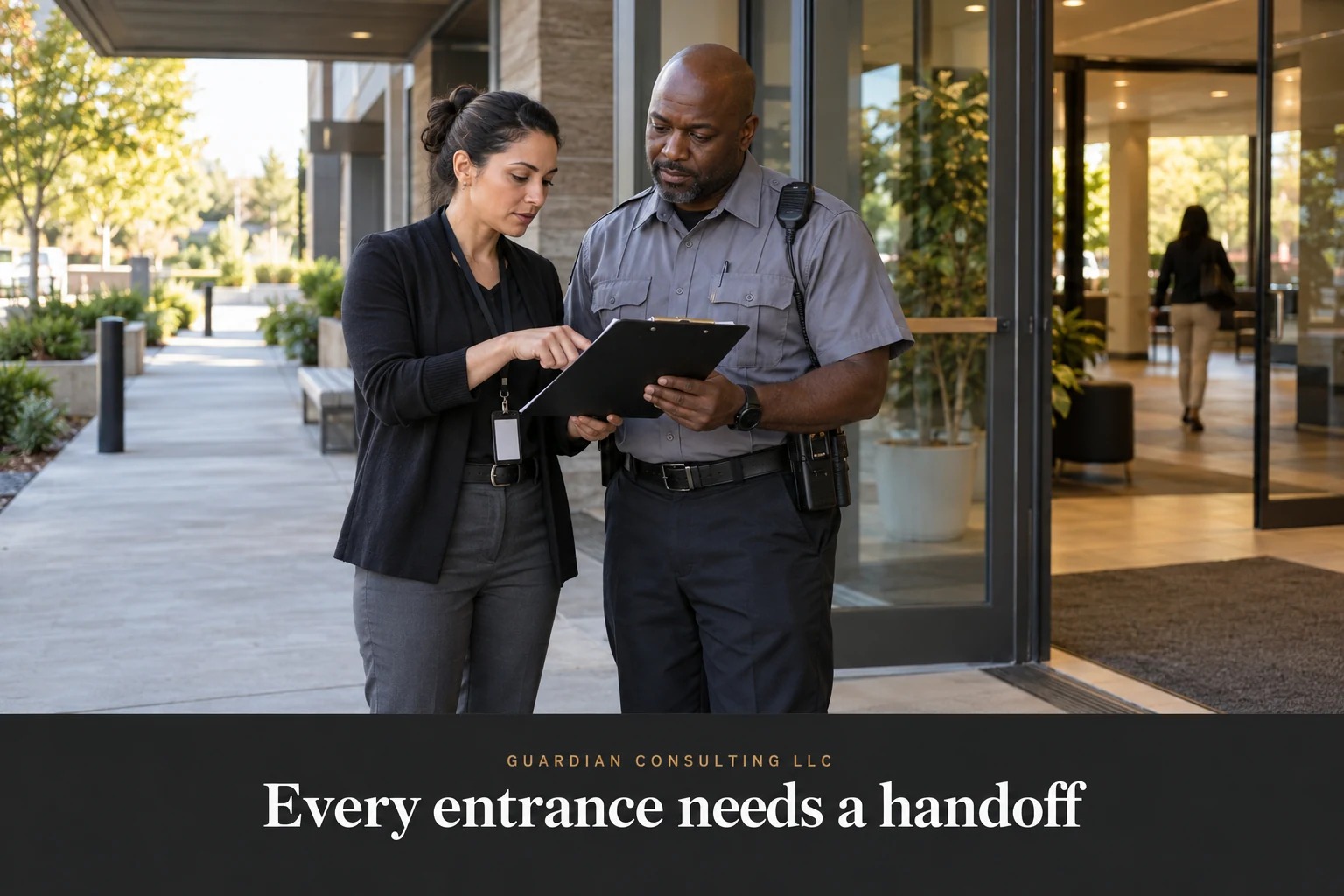
A snow crew signing in does not establish that every required area has been cleared. A crew leaving does not establish that management has accepted the work. The security desk can help preserve those distinctions without becoming the contractor's supervisor or changing the agreed service scope.
Use this handoff alongside the winter entrance readiness plan. It is a communication workflow for an existing authorized provider, not permission to hire a contractor, approve extra charges or certify legal compliance.
Prepare a short service boundary brief
Before the weather event, management should identify the provider, authorized contact route, expected access point and areas covered by the arrangement. Include the person who can resolve an unclear scope. Do not ask officers to decide from memory whether a curb ramp, adjoining frontage or secondary entrance belongs to the contractor's assignment.
The brief should identify relevant locations without distributing unnecessary sensitive building information. If access to a supply area or controlled space is needed, use the normal authorized access procedure. Winter urgency does not turn an unfamiliar worker's assertion into approval.

Verify arrival through the existing process
Record the actual arrival time and identify the expected company or crew contact using the site's approved verification method. If an unexpected replacement crew arrives, contact the designated manager through a trusted number rather than accepting a new number supplied at the door as the only proof.
Keep these statuses separate:
- Expected but not arrived.
- Arrived and awaiting authorization or instruction.
- Work underway, as reported or directly observed.
- Completion reported by the contractor.
- Management review complete, with any exceptions retained.
The distinction helps management respond to a delay without incorrectly telling tenants that work is finished. An observation from a desk window covers only what is visible from that position.

Make exclusions and obstacles visible
Ask the crew's authorized contact to report any area it cannot address, access restriction or changed condition to the responsible manager. Record the report neutrally. “Crew reports a vehicle obstructing part of the approach” is different from concluding that the contractor has completed everything possible.
DSNY's snow and ice rules identify sidewalk, hydrant and curb-ramp responsibilities and prohibit moving snow into the street. Management should review those requirements against the property's scope. The security brief should not imply that a private contractor agreement eliminates the responsibilities described by the city.

Request a specific completion handoff
The completion report should identify the locations addressed, the time, any exceptions and the manager receiving the report. A generic “all done” text is difficult to reconcile with an unresolved secondary entrance.
If a follow-up visit is proposed, distinguish a request from a confirmed appointment. If additional work or payment is needed, direct the request to the authorized decision maker. The desk should not create a new financial commitment merely by acknowledging the message.
OSHA's winter-weather guidance identifies risks associated with snow-removal tasks and elevated surfaces. Keep task assignment and safety planning with the employer and qualified personnel, not with a hurried lobby handoff.

Join the exterior and interior records
After a crew reports exterior completion, check whether the cleaning team still has an open wet-lobby observation. Interior moisture can remain after exterior work ends. Conversely, interior cleaning does not establish that the sidewalk approach is usable.
Give the next shift the last confirmed contractor status, open locations, management contact and any confirmed return plan. Use the deadline record for the separately verified timing information. Do not silently change the snowfall-end time to match the crew's arrival.
Close the administrative loop
Retain the acknowledgment and completion information according to the property's record policy. A supervisor can then review whether the communication chain worked and whether the service brief needs revision before another storm.
The outcome to seek is an accountable handoff: who reported what, which areas remained open and who accepted the next action. That is useful operational evidence without making a claim that a brief desk observation proves every obligation was met.