

Managing a New York City property means dealing with constant change. Tenants move in and out, vendors rotate, construction alters access routes, security systems age, and neighborhood conditions evolve. A security plan that worked last year may no longer reflect how a building operates today.
Regular NYC property security assessments help managers identify vulnerabilities before they contribute to theft, unauthorized access, workplace disruption, or an ineffective emergency response. The goal is not to create an alarmist list of worst-case scenarios. It is to understand current conditions, prioritize realistic improvements, and make sure people, procedures, and technology work together.
What Is a Property Security Assessment?
A property security assessment is a structured review of a building’s physical conditions, daily operations, staffing, and security procedures. It examines how people enter, move through, and leave the property—and how staff respond when something unusual happens.
Depending on the building, an assessment may review:
- Public, tenant, staff, loading, and service entrances
- Lobby and reception procedures
- Visitor registration and credentialing
- Access cards, keys, intercoms, and elevator controls
- Camera placement, coverage, retention practices, and monitoring responsibilities
- Package, delivery, contractor, and vendor procedures
- Garage, loading dock, roof, stairwell, and mechanical-area access
- Lighting, doors, locks, gates, and perimeter conditions
- Security officer post orders and patrol routes
- Incident reporting, escalation, and management notification
- Coordination with building emergency and fire-life-safety plans
A useful assessment should produce practical recommendations organized by risk and priority. It should not simply recommend purchasing more equipment or adding personnel without explaining the operational need.
Why Regular Reviews Matter in New York City
Building conditions change quickly
A vacant floor may become a busy office. A new retail tenant may add customer traffic and deliveries. Renovation work may create temporary entrances, obstruct camera views, or bring unfamiliar contractors into controlled areas.
These changes can create gaps even when the building’s original security design was sound. Regular reviews allow property managers to adjust procedures as the property changes rather than waiting for an incident to reveal a weakness.
Access control depends on daily behavior
Electronic access systems are important, but they are only one part of access control. Doors may be propped open, former employees may retain credentials, vendors may be admitted without verification, and staff may make inconsistent exceptions during busy periods.
An assessment looks beyond whether the system works technically. It also considers how credentials are issued and deactivated, who authorizes after-hours access, how visitors are handled, and whether staff follow the same process across shifts.
Security technology can develop blind spots
Cameras, alarms, intercoms, and access-control devices require maintenance and periodic review. A camera may still be operational but no longer capture a useful view because a partition, scaffold, sign, or seasonal display blocks the scene. An alarm may generate notifications without a clear response protocol.
Managers should confirm not only that equipment functions, but also that someone is responsible for reviewing alerts, documenting problems, arranging repairs, and escalating urgent events.
Staffing must match the current risk profile
Security coverage should reflect actual building activity. A fixed lobby post may be appropriate for one property, while another may require patrols, loading-dock oversight, tenant-floor checks, or overnight coverage.
A review can help determine whether existing assignments address current priorities. If officers are used, their post orders should be site-specific, current, and clear about responsibilities, prohibited activities, communications, and escalation procedures. Learn more about professional security guard services for Manhattan properties.
Areas Every Assessment Should Examine
Entrances and the building perimeter
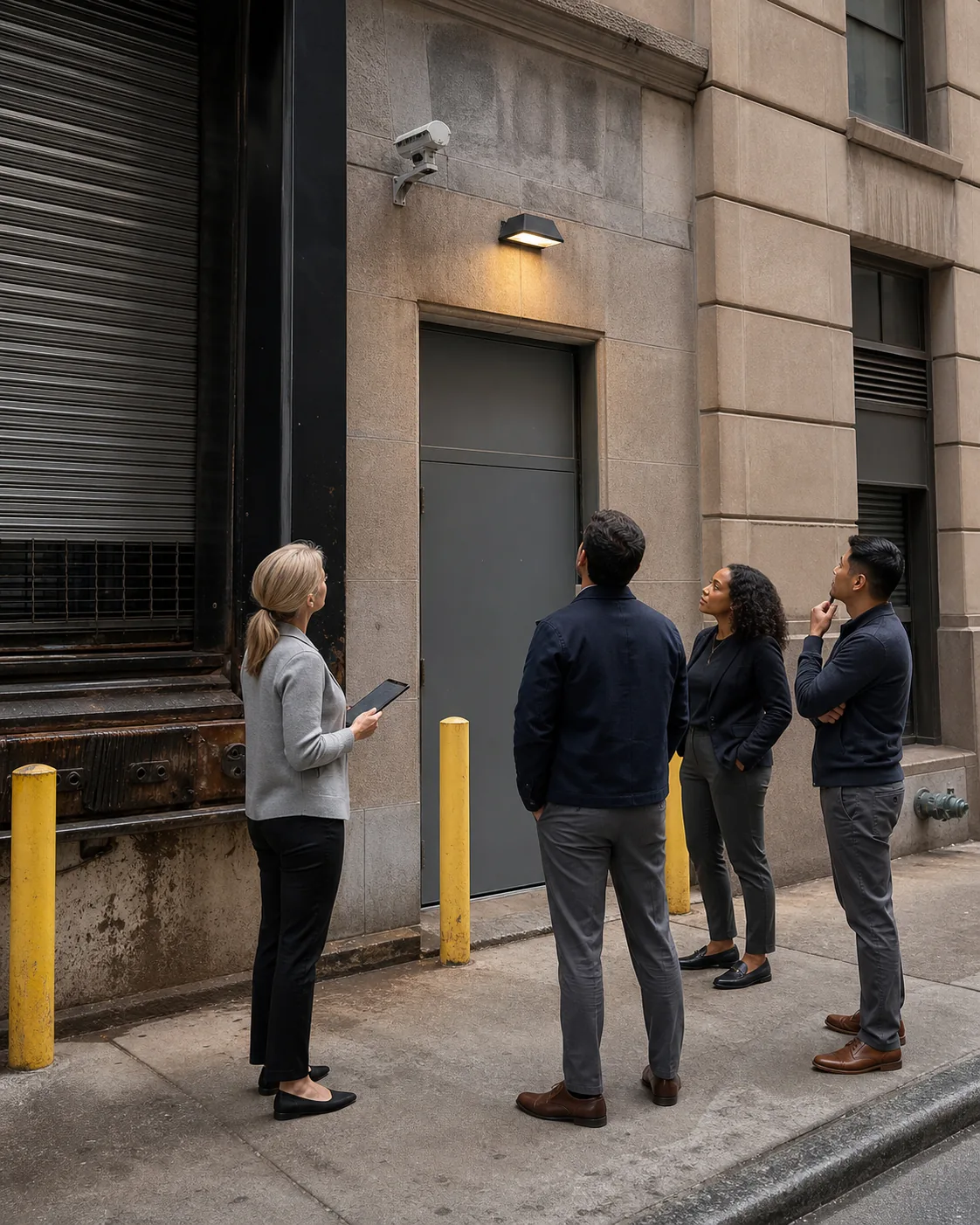
Start with every route into the property, not only the main lobby. Review side doors, emergency exits, loading areas, garages, adjoining spaces, roof access, and any entrance shared with another tenant or property.

Questions to consider include:
- Do exterior doors close and latch reliably?
- Are service entrances controlled when deliveries are not scheduled?
- Can staff clearly see and communicate with people requesting entry?
- Are exits being misused as informal entrances?
- Does lighting support safe observation without creating excessive glare?
- Are temporary construction routes separated from tenant and public circulation?
The assessment should also consider the streetscape immediately around the property, including sidewalk congestion, scaffolding, neighboring construction, recurring demonstrations, and vehicle activity near loading zones.
Lobby and visitor management
The lobby is where customer service and security often overlap. Procedures should be consistent without creating unnecessary friction for tenants and legitimate visitors.
Review how staff verify visitors, contact tenants, issue temporary credentials, handle large groups, and respond when a visitor cannot be confirmed. Buildings should also have a defined process for food deliveries, couriers, messengers, prospective tenants, and after-hours guests.
For office properties, these issues can be examined as part of a broader commercial office security plan.
Deliveries, vendors, and contractors
Vendors often need access to areas that visitors do not, including freight elevators, storage rooms, mechanical spaces, tenant floors, and rooftops. An assessment should examine how vendor identities and work orders are verified, how access is limited, and whether credentials are recovered or deactivated when work ends.
Construction activity deserves particular attention because work can change circulation patterns and introduce tools, materials, temporary barriers, and multiple subcontractors. Properties with active renovations may benefit from dedicated construction security procedures and coverage.
Cameras and monitoring practices
Camera reviews should focus on operational value rather than camera count. Managers should identify what each camera is intended to observe and whether the recorded view supports that purpose.
Key considerations include:
- Coverage of entrances, transaction points, loading areas, and other priority locations
- Image quality under daytime and nighttime conditions
- Accurate date and time settings
- Authorized access to live and recorded footage
- A process for preserving relevant footage after an incident
- Defined responsibility for responding to system failures
Property managers should coordinate camera and recording practices with ownership, legal counsel, and applicable policies, particularly where privacy or labor issues may be involved.
Incident reporting and escalation
Even experienced personnel need clear instructions. Staff should know whom to contact, what facts to document, when to notify management, and when emergency services are appropriate.
Reports should capture objective information such as times, locations, people involved, observed behavior, actions taken, witnesses, and available video. Periodic report reviews can reveal patterns that isolated incidents may not show, including repeated door problems, recurring trespass attempts, package losses, or activity concentrated during a particular shift.
Security and Fire-Life-Safety Must Be Coordinated
Security procedures should support—not conflict with—approved fire-life-safety plans and emergency operations. Access-control decisions, locked areas, lobby procedures, and staff assignments can affect how occupants and responders move through a building during an emergency.
Property managers should have qualified professionals review fire-life-safety responsibilities, required staffing, plans, and systems for the specific occupancy. A general security assessment is not a substitute for an inspection or compliance review by the appropriate licensed professionals or authorities.
Where applicable, managers can also evaluate whether their property needs qualified fire and life safety director coverage or temporary fire guard services under the direction of the responsible parties.
How Often Should a Security Assessment Be Conducted?
There is no single schedule suitable for every NYC property. Many managers benefit from a comprehensive review on a recurring basis, supported by shorter checks throughout the year.
An additional assessment may be appropriate after:
- A theft, unauthorized entry, threat, or serious disturbance
- A major tenant move-in or move-out
- Renovation, construction, or a change in building circulation
- Installation or replacement of access-control or camera systems
- A change in security staffing or building management
- Repeated incidents in the building or immediate area
- A significant change in operating hours or property use
Managers should also verify corrective actions after an assessment. A recommendation is only useful if responsibility, timing, and completion can be tracked.
Turning Findings Into an Action Plan
Assessment results should be divided into manageable priorities rather than treated as one large capital project.
Address immediate operational gaps
Examples may include repairing a door that does not latch, deactivating old credentials, clarifying an after-hours access rule, updating emergency contact lists, or changing a patrol route to cover an overlooked area.
Plan short-term improvements
These may involve revising post orders, retraining lobby staff, improving visitor procedures, adjusting camera views, or formalizing vendor-access controls.
Budget for longer-term needs
Larger projects could include replacing aging systems, redesigning a security desk, improving loading-dock controls, or adding staffing during high-risk periods. Recommendations should explain the problem being addressed so ownership can compare costs and operational benefits.
Assign ownership and deadlines
Each action item should identify who is responsible, the target completion date, and how the improvement will be verified. Property management, engineering, security, ownership, tenants, and vendors may each have a role.
What to Expect From a Professional Security Review
A professional assessment should begin with a discussion of the property’s use, operating hours, tenant profile, known concerns, and recent incidents. The reviewer may then conduct a walkthrough, speak with relevant staff, examine procedures and post orders, and observe operations at meaningful times of day.
The final recommendations should be specific to the property. A residential tower, hotel, retail location, construction site, and Class A office building should not receive identical plans. Recommendations should also distinguish between immediate corrections, procedural improvements, technology needs, and potential staffing options.
Build a Security Program That Keeps Pace With Your Property
Regular security assessments give NYC property managers a clearer picture of how their buildings operate today—not how they operated when the original plan was written. By reviewing entrances, staffing, technology, vendor access, reporting, and emergency coordination, managers can make informed improvements before small gaps become larger problems.
Guardian ISI can help Manhattan property managers evaluate current security needs, identify practical priorities, and arrange appropriate coverage. Call or text [(212) 602-1695](tel:+12126021695) or request coverage online.
Frequently asked questions
How often should an NYC property receive a security assessment?
The right schedule depends on the property’s use, size, traffic, incident history, and rate of change. Managers should also request a review after major construction, tenant changes, security incidents, system upgrades, or staffing changes.
What is the difference between a security assessment and a system inspection?
A system inspection usually focuses on whether specific equipment functions properly. A security assessment considers the broader program, including physical conditions, staffing, procedures, access practices, technology, reporting, and emergency coordination.
Does every security assessment recommend adding guards?
No. Appropriate recommendations may include procedural changes, repairs, training, adjusted patrols, technology improvements, or staffing. Any recommendation should be based on the property’s actual conditions and operating needs.
Should tenants participate in the assessment?
Tenant input can be valuable, especially regarding access, deliveries, after-hours activity, and recurring concerns. Property management should coordinate participation so the assessment also reflects building-wide responsibilities and policies.
Can a security assessment replace a fire or code inspection?
No. A general security assessment does not replace inspections, certifications, or compliance reviews performed by authorities or qualified professionals. Security and fire-life-safety planning should be coordinated without treating them as interchangeable.