
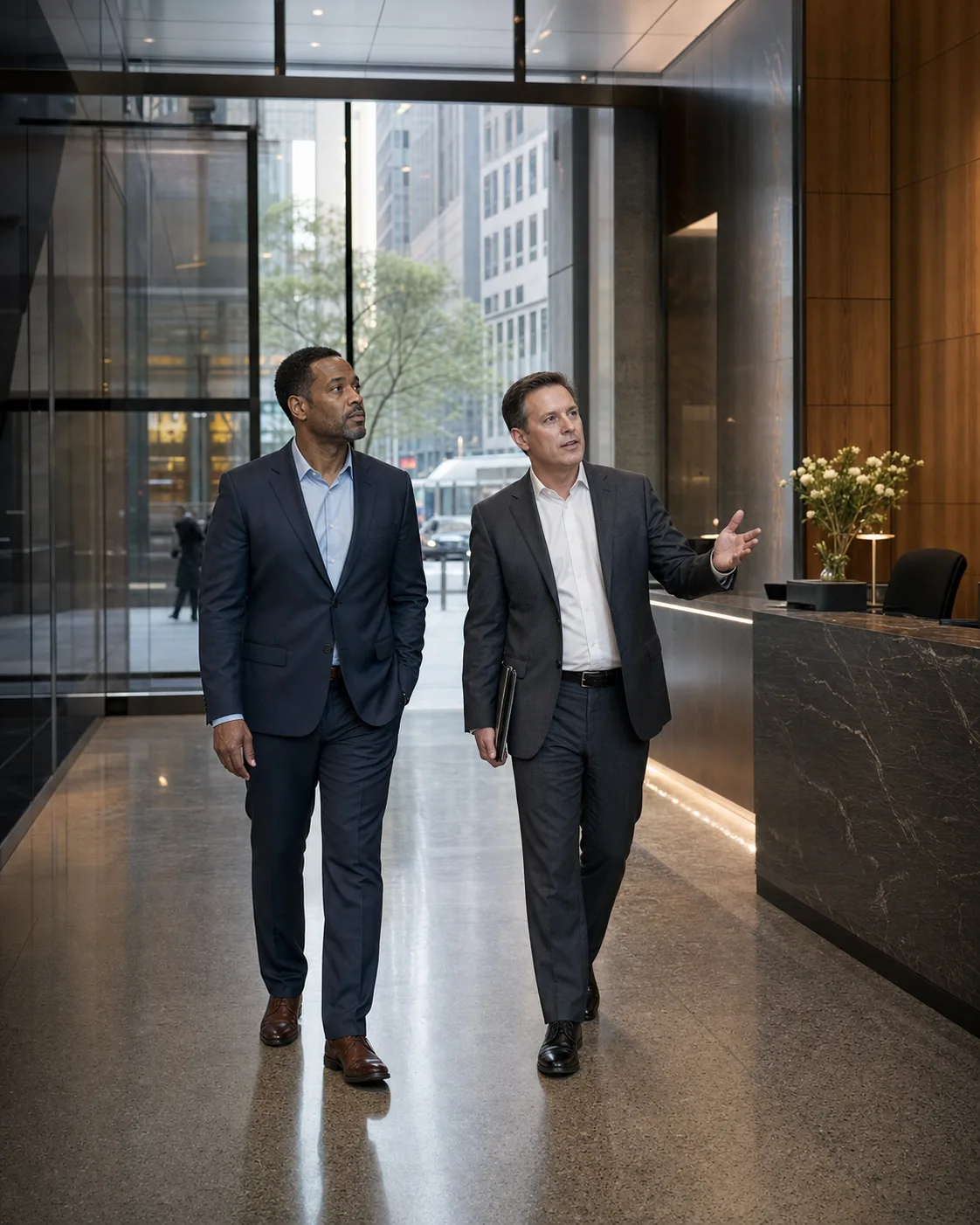
A security incident is not the only reason to review a building’s protective measures. For many Manhattan properties, the best time to conduct a security risk assessment is before a renovation, tenant change, system replacement, or shift in building use creates an avoidable gap.
A qualified security consultant can examine how people, procedures, technology, and the physical property work together. The resulting recommendations should help ownership and management prioritize realistic improvements—not simply produce a list of new equipment to buy.
What is a security risk assessment?
A security risk assessment is a structured review of a property’s reasonably foreseeable threats, vulnerabilities, existing safeguards, and operational needs. Depending on the building, it may evaluate:
- Lobby and visitor-management procedures
- Employee, tenant, resident, and vendor access
- Loading docks, service entrances, and delivery controls
- Keys, credentials, elevators, stairwells, and restricted areas
- Camera placement, coverage, retention practices, and monitoring
- Alarm response and after-hours escalation procedures
- Security officer staffing, posts, schedules, and written instructions
- Incident reporting and communication with property leadership
- Coordination between security and fire-life-safety personnel
- Exterior conditions, lighting, doors, gates, and adjacent public areas
The assessment should reflect the property’s actual operations. A Midtown office tower, SoHo retail location, Upper East Side residential building, hotel, and active construction site will not have the same risk profile.
When should a NYC building hire a security consultant?
After a security incident or recurring pattern
An unauthorized entry, theft, workplace confrontation, vandalism event, package loss, or repeated tailgating may expose a larger operational weakness. A consultant can help determine whether the issue involved staffing, procedures, physical design, technology, communication, or several factors at once.
Do not wait for a severe event if incident reports already show a pattern. Repeated “minor” problems can reveal inconsistent enforcement or unclear responsibility.
Before a major renovation or access-control upgrade
Security decisions are easier and less expensive to integrate while architects, engineers, contractors, and vendors are still planning the project. A pre-construction assessment can inform the location of doors, reception desks, turnstiles, cameras, package rooms, intercoms, and security workstations.
Consulting before purchasing technology can also reduce the risk of installing equipment that does not fit the building’s workflow.
When the building’s use or occupancy changes
A new anchor tenant, medical office, public-facing amenity, retail component, event space, or extended operating schedule can alter traffic patterns and security expectations. Mixed-use properties should pay particular attention to how different populations share entrances, elevators, loading areas, and back-of-house spaces.
An assessment is also useful when vacancy levels change. Partially occupied floors, inactive suites, and reduced after-hours staffing can create conditions that were not addressed in the original security plan.
When staffing costs are rising without clear results
Adding officers or overtime is not always the best response to a security concern. A consultant can review posts, schedules, patrol routes, supervision, and incident data to determine whether resources are assigned effectively.
The objective may be to strengthen a critical post, revise written procedures, improve training, or use technology to support—not automatically replace—on-site personnel. Buildings evaluating security guard services should define the problem and expected outcomes before setting staffing levels.

When procedures have not kept pace with operations
Even good equipment can fail when procedures are inconsistent. Warning signs include:
- Different visitor rules depending on who is at the desk
- Shared credentials or poorly controlled keys
- Deliveries entering through unintended areas
- Outdated emergency contact lists
- Unclear after-hours authorization procedures
- Incident reports that are incomplete or not reviewed
- Camera footage that is difficult to retrieve when needed
- No clear process for escalating threats to management or emergency services
A risk assessment can convert informal practices into practical, property-specific procedures.
Before renewing an important vendor contract
A contract renewal is an opportunity to confirm whether the current scope still matches the property. This is particularly useful before renewing guard services, access-control maintenance, alarm monitoring, or camera-system support.
An assessment can help management write clearer service requirements, establish measurable expectations, and compare proposals on more than price alone.
When ownership, management, or insurance stakeholders request documentation
New ownership, a management transition, lender review, or insurance discussion may prompt questions about current safeguards. A well-prepared assessment provides a documented snapshot of existing conditions and prioritized recommendations.
However, a general security assessment is not a guarantee against loss, an insurance certification, or a substitute for advice from an insurer, attorney, engineer, or other specialist.
What should the consultant examine in a Manhattan building?
Street-to-suite movement
Manhattan buildings must manage the transition from busy public sidewalks to controlled private spaces. The review should follow the path of visitors, workers, vendors, messengers, and contractors from the property line through the lobby, elevators, stairs, and tenant areas.
Particular attention should be given to side doors, interconnected retail areas, freight elevators, roof access, cellar spaces, and entrances that are used differently during nights or weekends.
Loading docks and service activity
Service areas often combine vehicles, deliveries, contractors, building staff, and temporary workers in a limited space. The consultant should evaluate scheduling, identification, package handling, vehicle controls, camera views, restricted doors, and communication with the lobby or security desk.
Security staffing and post orders
A staffing review should consider what officers are expected to accomplish at each location and whether those expectations are realistic. Effective post orders should address routine duties, prohibited activities, incident escalation, documentation, and foreseeable scenarios.
For an office property, this review can be coordinated with the building’s broader commercial office security plan.
Fire-life-safety coordination
Security and fire-life-safety functions often interact, but they are not interchangeable. The assessment should identify communication and responsibility gaps without assuming that a security officer can perform a designated fire-life-safety role.
Applicable requirements depend on factors such as building type, occupancy, systems, and current conditions. Questions about required staffing, plans, or code compliance should be reviewed with qualified fire-life-safety professionals and the appropriate authorities. Learn more about fire and life safety director coverage.
What should a useful risk assessment deliver?
Avoid reports that provide generic checklists without explaining priorities. A useful final deliverable should include:
- A clear description of the property and assessment scope
- Observed vulnerabilities and existing safeguards
- A practical explanation of risk and operational impact
- Prioritized recommendations, such as immediate, near-term, and capital-planning items
- Responsible parties or next steps for each recommendation
- Photographs or diagrams where appropriate, handled securely
- Assumptions and limitations so management understands what was and was not evaluated

Recommendations should distinguish between quick procedural corrections and improvements requiring design, procurement, or capital approval. Not every finding should receive the same urgency or budget.
How often should the assessment be updated?
There is no single schedule suitable for every NYC property. Management should consider a new assessment when conditions materially change and periodically review whether previous assumptions remain accurate.
At minimum, revisit the assessment after a significant incident, renovation, ownership or management change, major tenant turnover, new operating hours, or replacement of a critical security system. Between formal assessments, management should review incident trends, open recommendations, and temporary measures.
Choosing a security consultant
Ask prospective consultants about their experience with comparable New York City properties. A strong candidate should be able to explain:
- How the scope will be tailored to the property
- Who will perform the site work
- What stakeholders they need to interview
- What the final report will contain
- How they prioritize recommendations
- Whether they sell or benefit from recommended products
- How sensitive reports, photographs, and building information will be protected
- What follow-up support is available
Also confirm appropriate business credentials, insurance, references, and any qualifications relevant to the specific work. If the project includes legal, engineering, cybersecurity, fire-code, or insurance questions, determine whether separate specialists are needed.
Turn findings into action
The value of an assessment depends on implementation. Assign an owner to each accepted recommendation, establish realistic deadlines, and document interim measures when a permanent improvement will take time. Security leadership should also explain procedural changes to tenants, employees, vendors, and officers who must carry them out.
If your Manhattan property needs a security review, updated staffing plan, or immediate on-site support, call or text Guardian ISI at (212) 602-1695. You can also request coverage online. For urgent gaps caused by call-outs, incidents, or system disruptions, ask about emergency security coverage.
Frequently asked questions
Does every NYC building need a formal security risk assessment?
Not necessarily. The appropriate scope depends on the property, occupancy, operations, threat profile, and stakeholder requirements. Assessments are particularly valuable after incidents or significant operational changes.
How long does a building security assessment take?
Timing depends on the building’s size, complexity, operating hours, number of stakeholders, and requested deliverables. A meaningful review may require site visits during both normal and after-hours operations.
Is a risk assessment the same as a security survey?
The terms are sometimes used interchangeably. Confirm the actual scope: site observations, interviews, document review, risk analysis, prioritized recommendations, and a written report.
Will a consultant recommend more security guards?
Not automatically. Recommendations may involve staffing, training, procedures, physical improvements, technology, or a combination. The goal should be to match resources to identified risks.
Can a security assessment determine fire-code compliance?
A general security assessment may identify coordination concerns, but it does not replace a fire-code review by qualified professionals or direction from the relevant authorities.
What information should management prepare?
Useful materials may include floor plans, post orders, incident logs, staffing schedules, access policies, vendor procedures, system inventories, and planned renovation details. Sensitive information should be shared securely.