
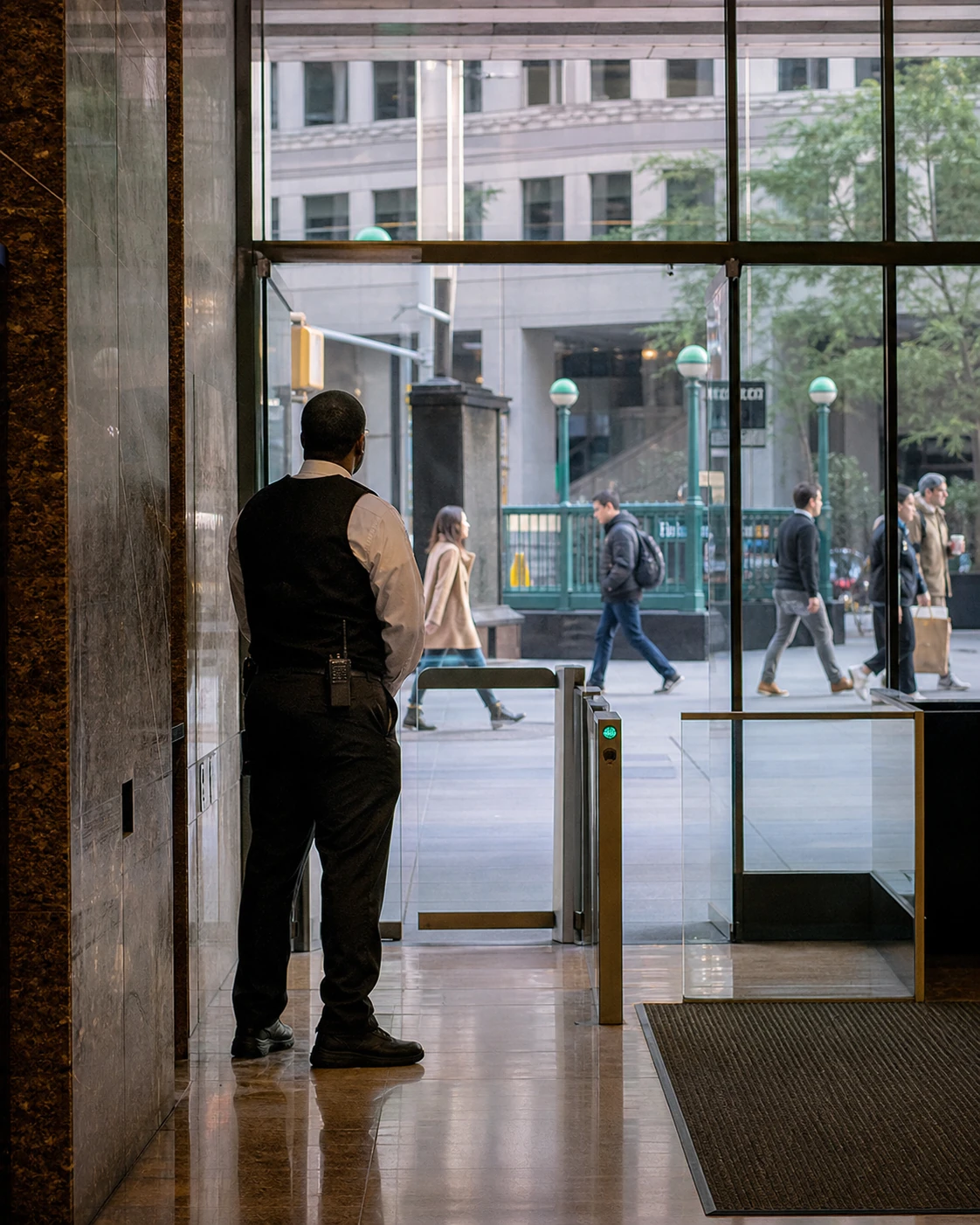
For Manhattan property managers, owners, and security directors, proximity to a subway entrance creates distinct operational questions. What should lobby personnel do when someone seeks help? When should doors be secured? Can a lockdown interfere with safe egress? Will relevant surveillance footage still be available when investigators request it?
A practical plan should protect occupants, give frontline staff clear instructions, and support first responders without asking building personnel to act as law enforcement.
Start With the Entrances Facing the Station
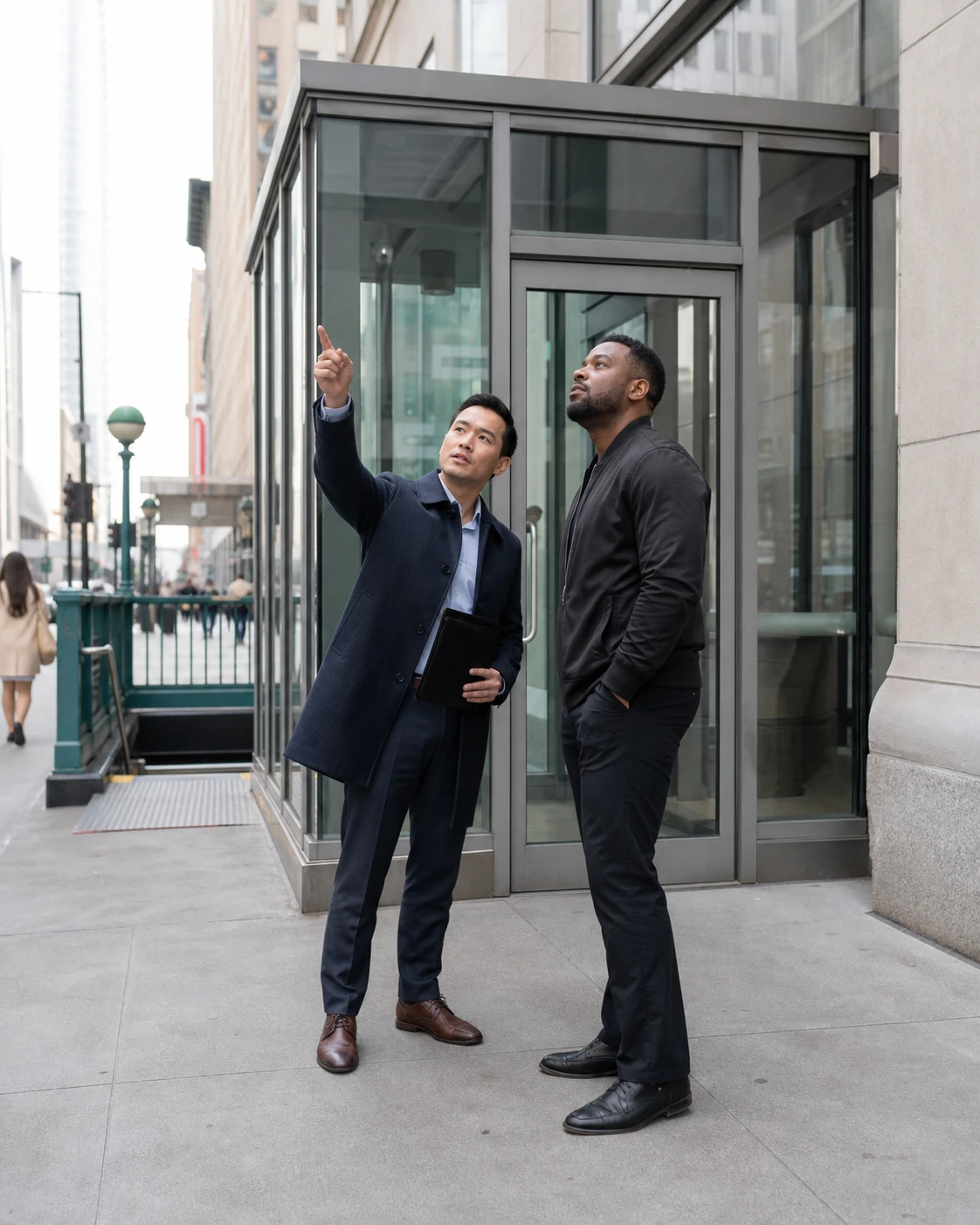
The entrance closest to a subway station will often receive the most pedestrian traffic and may become the first point of contact during an off-property emergency. Review that entrance separately from other sides of the building.
During a site assessment, document:
- The distance and sightline between the lobby and each station entrance
- Blind spots created by columns, scaffolding, newsstands, parked vehicles, or landscaping
- Whether the lobby desk can see someone approaching before the doors open
- How revolving doors, swing doors, vestibules, and accessible entrances can be controlled
- Whether exterior and vestibule cameras capture faces, clothing, and direction of travel
- The location of intercoms, duress buttons, access-control controls, and emergency phones
- Which entrance responders should use if the primary doors are secured
Conditions should also be reviewed at different times. Commuter rushes, overnight hours, service disruptions, severe weather, and nearby construction can change traffic patterns considerably.
Give the lobby team an unobstructed view
Posters, promotional displays, opaque window treatments, and delivery staging can prevent personnel from seeing a developing situation. Keep critical sightlines clear and verify that nighttime lighting does not create glare on lobby glass or camera images.
Camera coverage should provide context as well as identification. A tightly framed doorway image may show who entered but not where that person came from or whether others remained outside.
Plan for People Seeking Emergency Assistance
Someone fleeing danger, experiencing a medical emergency, or looking for a safe place may enter the nearest staffed building. Lobby personnel need a response procedure that does not depend on improvisation.
A useful protocol should instruct staff to:
- Assess from a protected position. Observe visible injuries, threats, weapons, or pursuing individuals without making assumptions.
- Contact 911 promptly. Do not delay an emergency call while trying to determine whether an event began on transit or private property.
- Create separation when feasible. A controlled vestibule, reception area, or other observable space may help separate the person seeking assistance from tenants and elevators.
- Avoid unnecessary physical intervention. Security personnel should work within their training, assigned duties, and site procedures.
- Request appropriate medical help. Follow the 911 call-taker’s instructions rather than attempting to diagnose the person.
- Protect privacy. Limit photography, internal messages, and discussion to legitimate operational needs.
- Preserve observations. Record times, exact statements, descriptions, and actions as soon as conditions permit.
The plan should distinguish between a person requesting assistance and a person presenting an immediate threat. Staff should not deny urgent help solely because an incident originated outside the building, but they also should not open controlled areas without assessing the risk to occupants.
Make Lobby Lockdown Decisions Before a Crisis
“Lock the lobby” sounds simple, but a real building may have revolving doors, accessible entrances, retail connections, loading areas, turnstiles, and required exit routes. A lockdown plan must account for all of them.
Define who has authority
Specify which roles can order restricted entry or a lobby lockdown. Depending on the property, that may include the property manager, security director, fire and life safety leadership, or a designated supervisor. The procedure should also explain what an officer may do when an immediate threat leaves no time to reach management.
Use levels instead of one all-or-nothing response
A graduated plan can be more practical than a single lockdown command:
- Heightened awareness: Staff monitor the station-facing entrance, confirm communications, and limit distractions.
- Controlled entry: Doors remain operational for exit, while entrants are screened or directed to a staffed access point.
- Restricted access: Selected entrances are secured against entry and occupants are directed away from exposed lobby areas.
- Immediate protective action: Staff secure controllable entry points, call 911, move people away from danger, and follow the site emergency plan.
Any procedure should preserve required egress and avoid obstructing emergency responders. Door hardware, access-control programming, and emergency roles should be reviewed with qualified fire-life-safety and building professionals rather than improvised during an event.
Establish the all-clear process
The plan should identify who can restore normal access. A social media post, a bystander’s statement, or the absence of visible activity is not a reliable all-clear. Management may need direct information from responding authorities or an authorized on-site leader.
Coordinate Security and Fire-Life-Safety Roles
Protective security decisions can affect evacuation, shelter-in-place procedures, elevator operations, and responder access. Security and fire-life-safety teams should therefore train from the same written plan.
A joint tabletop exercise can test questions such as:
- Who monitors the affected entrance while another employee calls 911?
- Who meets police, firefighters, or EMS?
- How are responders admitted if doors have been secured?
- Who protects required exit routes from crowding?
- How are tenants told to avoid the lobby without spreading rumors?
- What happens if a fire alarm or medical emergency occurs during restricted access?
- Who documents decisions and maintains the incident timeline?
Buildings with formal emergency action or fire-life-safety procedures should integrate transit-adjacent scenarios into those existing structures rather than create a conflicting standalone plan.
Preserve Surveillance Video Before It Is Overwritten
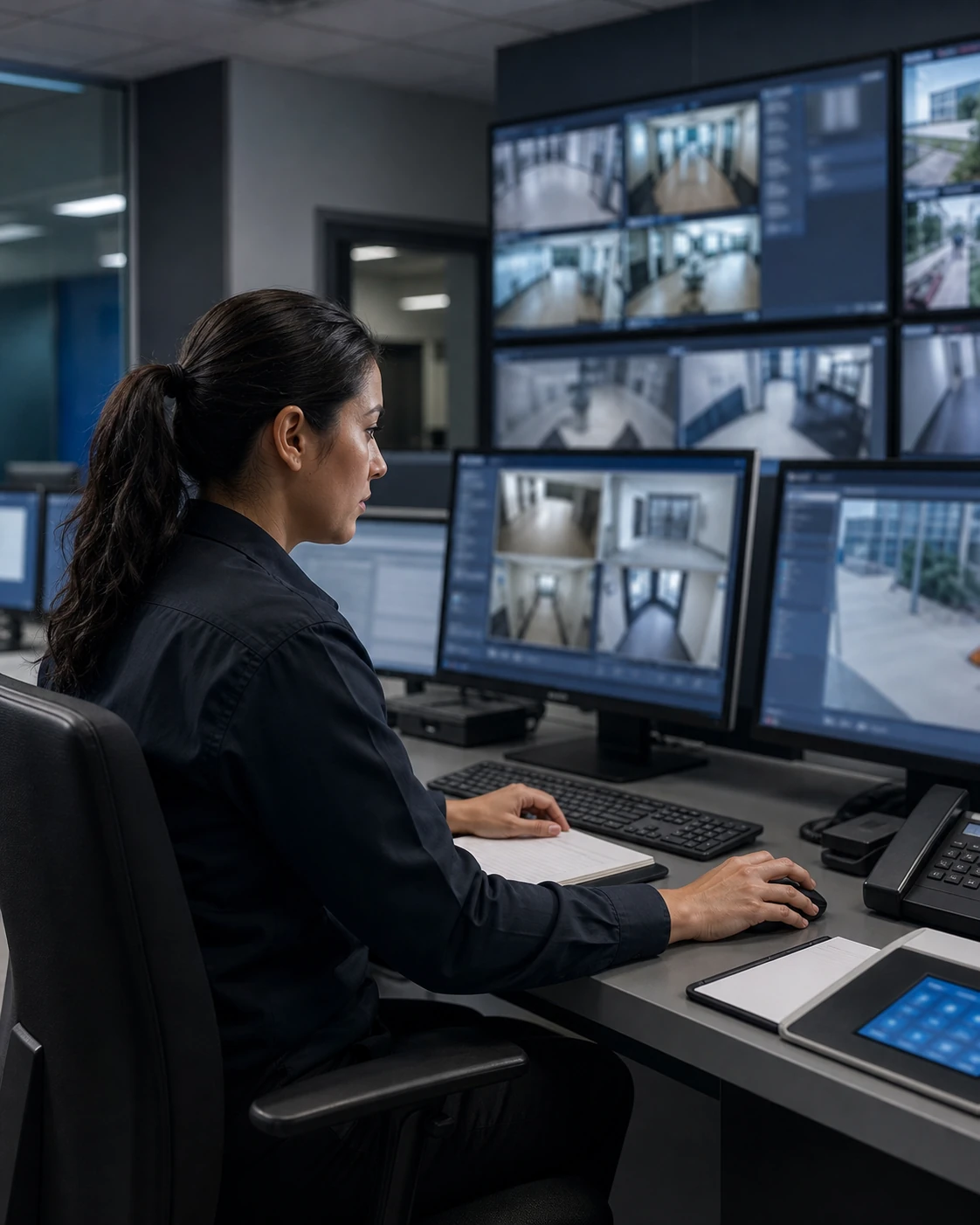
Footage from a nearby building may document approach routes, clothing, companions, vehicles, or direction of travel even when the original incident occurred on transit property. Relevant video can be lost if nobody initiates preservation before the system’s normal overwrite cycle.
Property teams should know:
- The building’s actual retention period for each recorder and camera
- Whether retention changes because of camera count, resolution, or storage conditions
- Who is authorized and trained to export footage
- How to isolate a time range without changing the original recording
- Whether exports include the necessary player or can be provided in a standard format
- Where preserved files and backup copies are stored
- Who records access, exports, transfers, and law-enforcement requests
There is no single retention period that fits every property. Establish a written schedule based on operational needs, system capacity, contractual requirements, and advice from appropriate legal or risk professionals.
Preserve a wider window than the obvious event
If an incident may relate to the building, save footage from before and after the known time. Include relevant exterior views, vestibules, lobby paths, loading areas, and adjacent corners. Keep the original export intact, document who created it and when, and avoid distributing footage through informal group chats.
If the building receives a preservation request, subpoena, or other legal demand, escalate it promptly under the property’s legal and records-handling procedures.
Give 911 Actionable Information
The clearest emergency calls are specific, observational, and organized. Frontline personnel should be ready to provide:
- The building’s exact address and entrance location
- The nearest cross streets and subway entrance
- Whether the event is inside, immediately outside, or visible across the street
- What is happening now, not just what happened earlier
- Descriptions based on direct observation
- Any visible weapon, stated threat, injury, or medical concern
- Direction of travel and whether the person entered the building
- The caller’s name, role, location, and callback number
- How responders can enter if access has been restricted
Staff should avoid guessing about identity, motive, medical condition, or whether an object is a weapon. If information changes, update the 911 call-taker. Unless remaining on the line creates immediate danger, follow the call-taker’s instructions about when to disconnect.
Assign someone to meet responders when safe. That person should have keys or credentials, understand the property layout, and know the location of the command center and surveillance system.
Control Internal and Tenant Communications
Unverified messages can create panic and complicate the response. Prepare short templates for common instructions, such as avoiding a particular entrance, remaining away from the lobby, or using an alternate exit approved under the building’s procedures.
Communications should:
- State only confirmed operational facts
- Tell recipients what action to take
- Identify the affected area and expected update process
- Avoid naming or describing victims unnecessarily
- Avoid publishing camera images without authorization
- Provide an all-clear through the same channel when appropriate
A designated manager should handle media questions and external communications. Guards, lobby attendants, and other frontline staff should know where to refer inquiries.
Use a Transit-Adjacent Building Checklist
Review the following items with management, security, engineering, and fire-life-safety personnel:
- Map every station-facing entrance and exterior camera view
- Verify door controls without compromising required egress
- Post the precise building address, cross streets, and station details at the security desk
- Define who can order restricted entry and who can issue the all-clear
- Create a procedure for people seeking emergency assistance
- Confirm how responders enter during restricted access
- Test radios, duress devices, intercoms, and mass-notification tools
- Document surveillance retention and export procedures
- Prepare tenant messages for entrance closures and protective actions
- Conduct a tabletop exercise across multiple shifts
- Review incidents and near misses for corrective action
Build a Site-Specific Security Plan
Transit-adjacent buildings do not all face the same conditions. A Class A office tower, hotel, residential property, and street-level retailer may share a subway corner but require different staffing, access-control, and communication procedures.
Guardian can assess exposed entrances, lobby operations, security-post instructions, emergency staffing, and coordination with existing fire-life-safety procedures. For planned support or urgent coverage, call or text (212) 602-1695 or request coverage online.
Related Guardian services
Review Commercial Office Security and Fire & Life Safety Directors to connect these procedures with the appropriate staffing and site responsibilities.
Frequently asked questions
Should a building let someone inside if they are fleeing an incident near a subway station?
Staff should follow a written emergency-assistance procedure that considers the immediate threat, occupant safety, controlled areas, and access for responders. Call 911 promptly and avoid making improvised decisions based on assumptions about the person.
Can lobby doors be locked during an external threat?
A building may use controlled-entry measures defined in its site procedures, but required egress and responder access must remain part of the plan. Door operations should be reviewed in advance with qualified building and fire-life-safety professionals.
How long should a building retain surveillance footage?
There is no universal period appropriate for every property. Retention should reflect system capacity, operational risks, contracts, and applicable legal guidance. Staff should know the actual overwrite period and how to preserve relevant footage immediately.
What information should security provide to 911?
Give the exact address and entrance, cross streets, current conditions, observed descriptions, injuries or visible weapons, direction of travel, callback information, and instructions for entering the building.
Should security personnel pursue someone leaving toward a subway station?
Personnel should operate within their training, assignment, and site procedures. In many situations, observing from a safe position, updating 911, protecting occupants, and preserving video are more appropriate than leaving the property to pursue someone.
How often should transit-adjacent emergency procedures be tested?
Review procedures whenever entrances, staffing, access control, construction, or nearby transit conditions change. Periodic tabletop exercises and drills should include daytime, overnight, and weekend personnel.