

Unauthorized access can begin with something as simple as tailgating through a lobby turnstile, using an expired credential, or entering a loading dock without authorization. It can also involve a person who refuses to leave after being directed to do so. In every case, the security guard’s response should be calm, consistent, and based on the property’s written procedures.
For Manhattan property managers, security directors, and business owners, the objective is not confrontation. It is to determine whether the person has a legitimate reason to be on the property, protect occupants, prevent unauthorized movement, and escalate the situation appropriately.
Unauthorized Person or Trespasser?
An unauthorized person is anyone whose identity, access rights, or purpose has not been verified. Examples include:
- A visitor without a confirmed appointment
- A former employee presenting an inactive credential
- A vendor arriving outside an approved service window
- A delivery worker attempting to enter a tenant-only area
- Someone following an authorized person through a secured entrance
- A person found in a mechanical room, stairwell, roof area, or back-of-house corridor without permission
Not every unauthorized person is intentionally trespassing. Visitors can enter through the wrong door, vendors may receive outdated instructions, and employees sometimes forget their credentials. Guards should begin with verification rather than assumptions.
A potential trespassing incident becomes more serious when a person has entered a restricted area, refuses to comply with access procedures, or remains after an authorized property representative has clearly directed them to leave. Site management should establish who is authorized to issue that direction and when law enforcement should be contacted.
A Step-by-Step Security Guard Response
1. Observe Before Approaching
The guard should quickly assess the person, location, and surrounding conditions. Relevant questions include:
- How did the person enter?
- Are they attempting to access a tenant suite or restricted area?
- Do they appear confused, agitated, intoxicated, or armed?
- Are occupants nearby?
- Is another guard or supervisor available?
- Can the person’s movements be monitored by camera?
Observation helps the guard select a safe approach. If there is an immediate threat, suspected weapon, active violence, fire, or medical emergency, the priority is moving people away from danger and calling 911—not conducting a prolonged interview.
2. Use a Professional, Non-Accusatory Introduction
When conditions allow a safe approach, the guard should maintain appropriate distance, keep an unobstructed path of retreat, and speak respectfully. A useful opening is:
“Good afternoon. I’m with building security. May I ask who you are visiting and how I can assist you?”
This approach identifies the guard’s role without immediately accusing the person of wrongdoing. The guard should avoid insults, threats, unnecessary physical contact, or language likely to escalate the encounter.
3. Verify Identity and Authorization
Verification should follow the building’s established visitor-management process. Depending on the property, that may involve:
- Reviewing a government-issued ID when required by site policy
- Checking a visitor list or work order
- Contacting the tenant, host, property manager, or building engineer
- Confirming a vendor’s company and service assignment
- Examining an access credential without allowing the person farther inside
- Checking whether an entry attempt appears on the access-control system
The guard should not rely solely on a uniform, delivery bag, confident demeanor, or claim of urgency. Social-engineering attempts often depend on persuading staff to bypass routine verification.
If authorization cannot be confirmed, the person should remain in a designated waiting area or outside the controlled perimeter, consistent with site procedures.
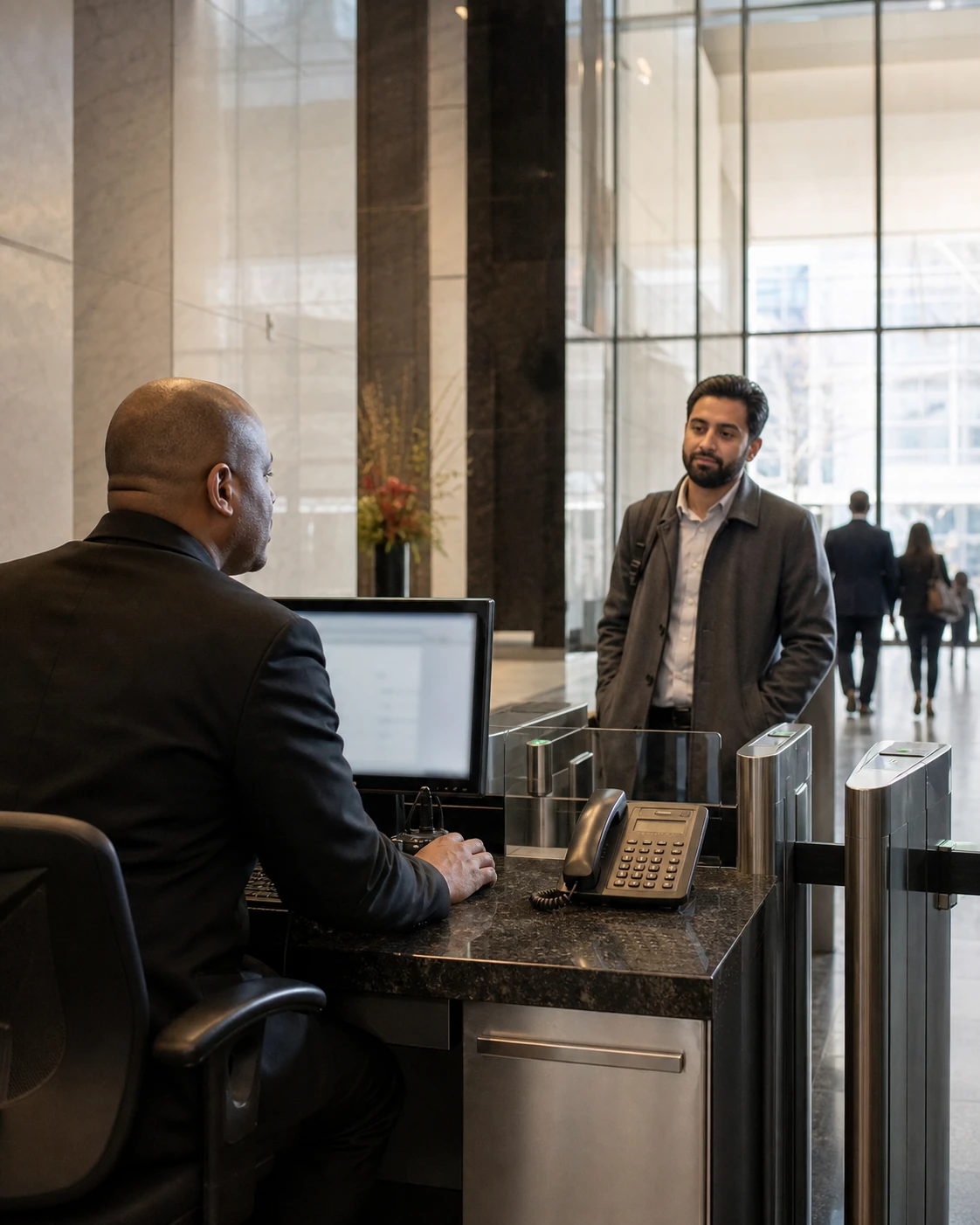
4. Clearly Explain the Access Decision
If access is denied, the guard should communicate the decision in neutral language:
“I’m unable to confirm authorization for entry. You’ll need to contact your host or building management before we can provide access.”
If the person is already inside a nonpublic area, the guard can direct them toward the appropriate exit or reception point. Instructions should be simple, specific, and repeated calmly if necessary.
The guard should avoid debating building policy. If the person disputes the decision, a supervisor or property representative can be requested while the guard continues to control access.
5. De-Escalate Resistance
A person who is embarrassed, frustrated, or angry may raise their voice without presenting an immediate physical threat. Effective de-escalation techniques include:
- Speaking slowly and maintaining a controlled tone
- Giving the person physical space
- Listening without agreeing to bypass security rules
- Offering a legitimate next step, such as calling the tenant contact
- Avoiding an audience when it is safe to move occupants away
- Requesting backup early rather than waiting for the situation to deteriorate
A guard should not make promises outside their authority. Consistent phrases such as “I understand, but I cannot permit access until authorization is confirmed” can help keep the interaction focused.
6. Escalate According to Risk and Site Policy
The appropriate escalation depends on behavior, location, and risk. A guard may need to notify the shift supervisor, property manager, security director, or tenant representative.
Law enforcement or emergency services may be appropriate when the person:
- Displays or threatens to use a weapon
- Assaults, threatens, or aggressively follows another person
- Forces entry or causes significant property damage
- Refuses to leave after a clear direction from an authorized representative
- Attempts to reach a highly sensitive or dangerous area
- Creates an immediate risk to occupants or staff
- Appears to need urgent medical or behavioral-health assistance
When calling 911, guards should provide the property address, exact location within the building, physical description, observed behavior, direction of travel, and information about any visible weapon. Guards should report what they actually observed rather than speculate about motives or diagnoses.
Any use of physical force must be governed by applicable law, employer training, and the property’s approved procedures. Physical intervention can increase the danger to guards, occupants, and bystanders, so it should never be treated as the default response to a routine access dispute.
Containing the Incident Without Creating New Risks
A lobby incident can quickly move into elevators, stairs, tenant spaces, or crowded sidewalks. Guards should consider how to contain movement while preserving safe exits.
Depending on the site plan and circumstances, appropriate actions may include:
- Positioning a second guard near elevator banks or access-controlled doors
- Alerting nearby posts with an accurate description
- Monitoring cameras to maintain visual awareness
- Preventing tailgating without physically trapping the person
- Moving employees or visitors away from the immediate area
- Preserving emergency egress routes
- Coordinating with building management before changing door or elevator settings
Security measures must not compromise fire-life-safety systems or required means of egress. Guards should follow the building’s emergency plans rather than improvising lockdown procedures.
Documentation After the Incident
A clear incident report allows management to evaluate the response, support follow-up, and correct security weaknesses. The report should include:
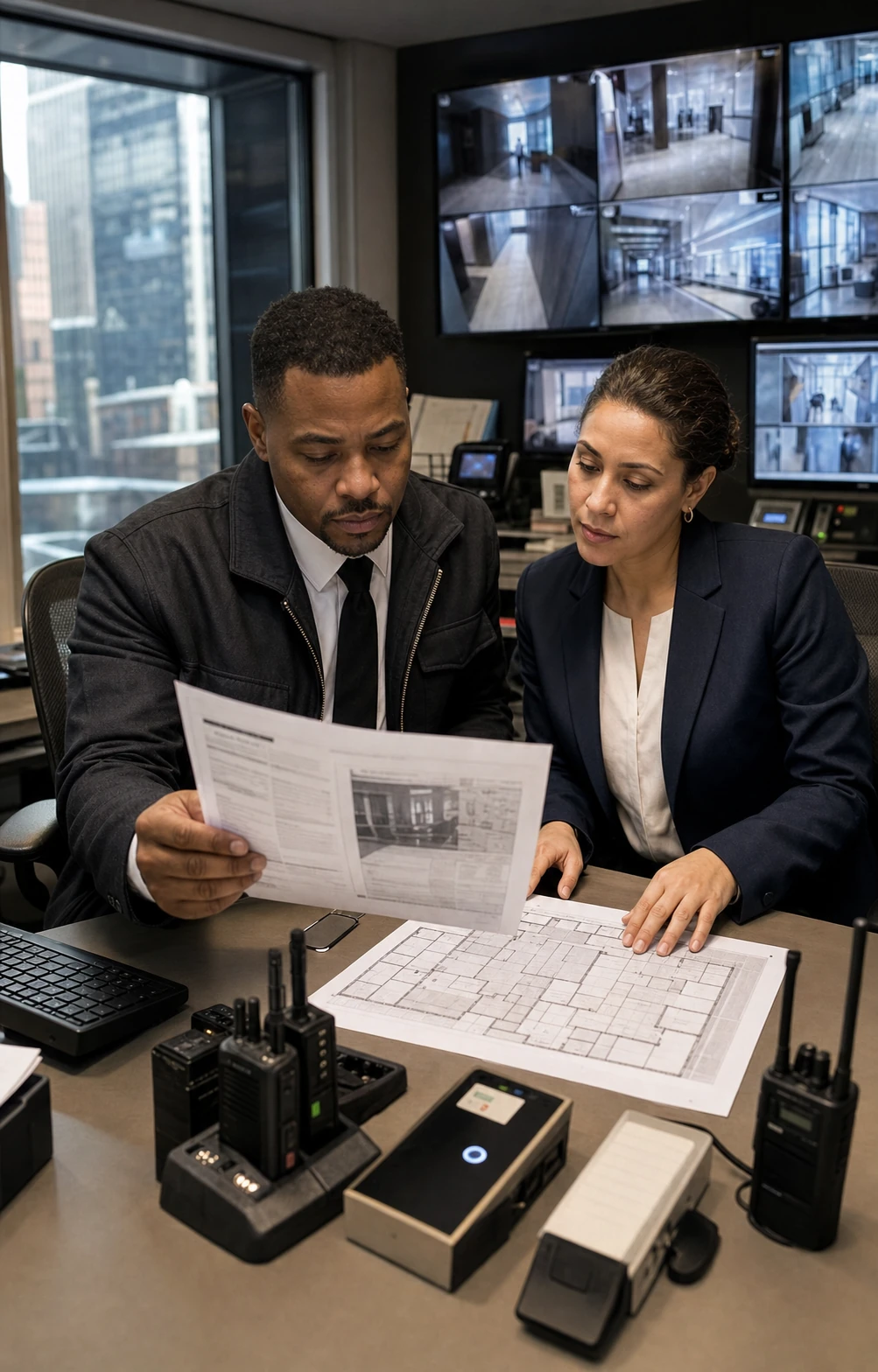
- Date, time, and exact location
- How the person entered or attempted to enter
- A factual physical and clothing description
- Statements made by the person and guard
- Verification steps performed
- Directions or warnings given
- Names of supervisors, tenants, or agencies notified
- Actions taken and the final outcome
- Relevant camera numbers, access-control events, or photographs
- Any reported injuries or property damage
Reports should distinguish observation from assumption. For example, “the person struck the locked door three times with an open hand” is more useful than “the person became dangerous.” Relevant video and access records should be preserved according to the property’s retention procedures.
How Property Managers Can Prepare Guards
A guard can only apply access rules consistently when management has defined them. Every commercial property should provide post orders addressing:
- Public, tenant-only, and restricted areas
- Visitor, contractor, delivery, and after-hours access
- Who can authorize entry or direct someone to leave
- Procedures for former employees and terminated vendors
- Duress alarms, radios, cameras, and access-control systems
- Supervisor and emergency notification thresholds
- Evidence preservation and incident reporting
- Accommodations and communication procedures for people who may need assistance
Scenario-based training is particularly valuable. Guards should practice responding to tailgating, unverified vendors, aggressive visitors, people sheltering in vestibules, and individuals found in restricted building areas.
Managers should also review recurring incidents. Repeated unauthorized access at the same door may indicate a staffing, lighting, hardware, credentialing, or tenant-education problem—not simply a guard-performance issue.
Professional Security Coverage for New York City Properties
A well-managed response protects people while preserving professionalism in the lobby and throughout the property. Guardian ISI provides security guard services for New York City properties, including commercial office security and emergency coverage when an urgent staffing need arises.
To discuss security coverage for a Manhattan property, call or text (212) 602-1695 or request coverage online.
Related Guardian services
Review Security Guard Services and Commercial Office Security when defining visitor procedures, staffing, supervision, and reporting.
Frequently asked questions
Should a security guard immediately call the police for an unauthorized person?
Not every access issue requires police involvement. Guards should first follow site verification and escalation procedures when it is safe to do so. Call 911 for immediate threats, violence, suspected weapons, forced entry, serious property damage, or other emergencies.
Can a guard physically remove a person who refuses to leave?
Physical intervention should not be the routine response to an access dispute. Guards must follow applicable law, their training, employer rules, and site procedures. A supervisor or law enforcement may need to handle a person who refuses to leave.
What should a guard say to someone without authorization?
The guard should remain neutral and explain that access cannot be provided until authorization is confirmed. The person can be directed to contact their host, wait in an approved area, or leave the controlled portion of the property.
How should guards handle tailgating into a secured building?
The guard should stop further movement when safe, identify the person, verify authorization, and review access-control or camera information if needed. The event should be documented, especially if the person intentionally bypassed the entry procedure.
What belongs in a trespassing incident report?
Include the time, location, observed behavior, description, statements, verification steps, instructions given, notifications, response actions, outcome, and relevant camera or access-control records. Record facts rather than assumptions.
How can property managers reduce recurring unauthorized-entry incidents?
Use clear post orders, reliable credentials, controlled visitor procedures, working doors and cameras, scenario-based guard training, and regular incident reviews. Repeated problems may reveal a physical-security or access-management weakness.