
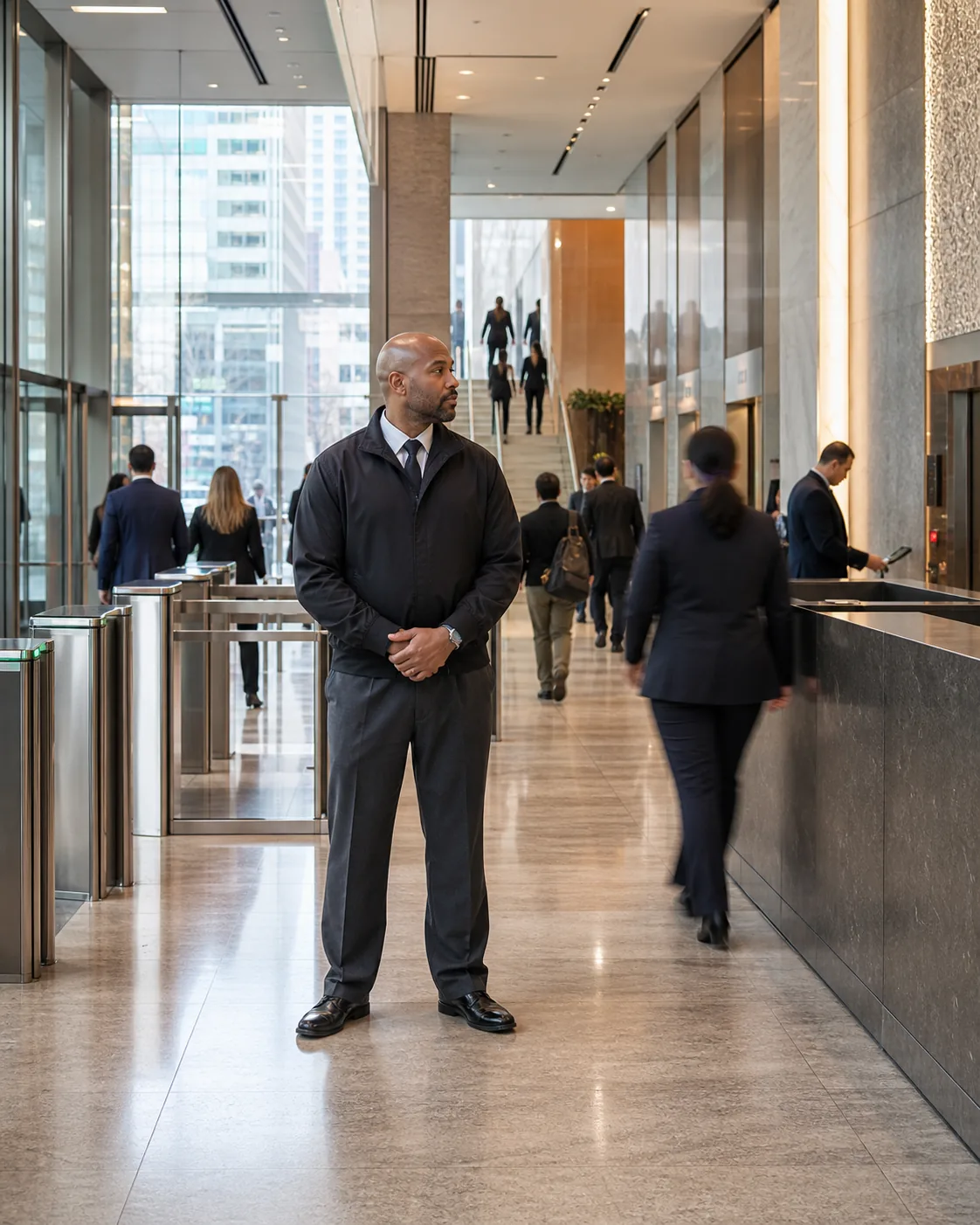
A person who refuses to leave a New York City lobby can create an uncertain and potentially volatile situation. The individual may be confused, frustrated, waiting for a tenant, experiencing a health crisis, or intentionally challenging building rules. A security guard’s response should prioritize safety, clear communication, and the property’s established procedures—not winning an argument or forcing an immediate confrontation.
The steps below provide a practical framework for Manhattan office buildings, residential properties, hotels, retail locations, and mixed-use facilities. Every site should adapt the approach to its written post orders, management policies, and emergency protocols.
1. Assess the Situation Before Approaching
Before initiating contact, the guard should quickly observe the person’s behavior and the surrounding area. Relevant questions include:
- Is the person simply refusing a request, or are they threatening anyone?
- Are weapons visible or mentioned?
- Does the person appear injured, disoriented, intoxicated, or in medical distress?
- Are occupants gathering nearby or attempting to intervene?
- Is there a safe path for occupants to enter and exit?
- Is another guard or supervisor available?
A verbal refusal alone is not the same as an immediate physical threat. Starting with an accurate assessment helps the guard choose a proportionate response.
If there is an immediate threat to life, suspected weapon, active violence, fire, or urgent medical emergency, the guard should call 911 and follow the site’s emergency procedures.
2. Use Calm, Direct Communication
The initial contact should be professional and non-confrontational. When practical, the guard should introduce themselves, explain the applicable rule, and provide a clear next step.
For example:
“This lobby is for authorized visitors and occupants. I can help contact the person you are here to see, but if your visit cannot be confirmed, building policy requires you to leave.”
Useful communication practices include:
- Speak at a normal volume and use short, clear sentences.
- Avoid insults, sarcasm, threats, or comments about appearance.
- Ask why the person is present rather than making assumptions.
- Acknowledge frustration without promising an exception.
- Explain available options, such as contacting a tenant or waiting in a permitted public area.
- Repeat the direction calmly if the person attempts to draw the guard into an argument.
The objective is voluntary cooperation. A guard should not crowd, taunt, touch, or attempt to intimidate someone merely because the person is being difficult.
3. Confirm the Building Policy and the Guard’s Authority
Before escalating, the guard should confirm that the request to leave is consistent with the property’s access rules and the guard’s post orders. This is particularly important when the person claims to be a tenant, employee, contractor, delivery worker, customer, or invited guest.
Depending on the property, verification may involve:
- Checking an approved visitor list or access-control system
- Calling the tenant, resident, host, or property contact
- Reviewing the site’s delivery and after-hours access procedures
- Asking management whether an exception or accommodation has been authorized
- Confirming whether the lobby or a particular portion of it is restricted
Guards should avoid inventing rules or giving legal conclusions. If the policy is unclear, a supervisor or authorized property representative should decide how the building wants to proceed.
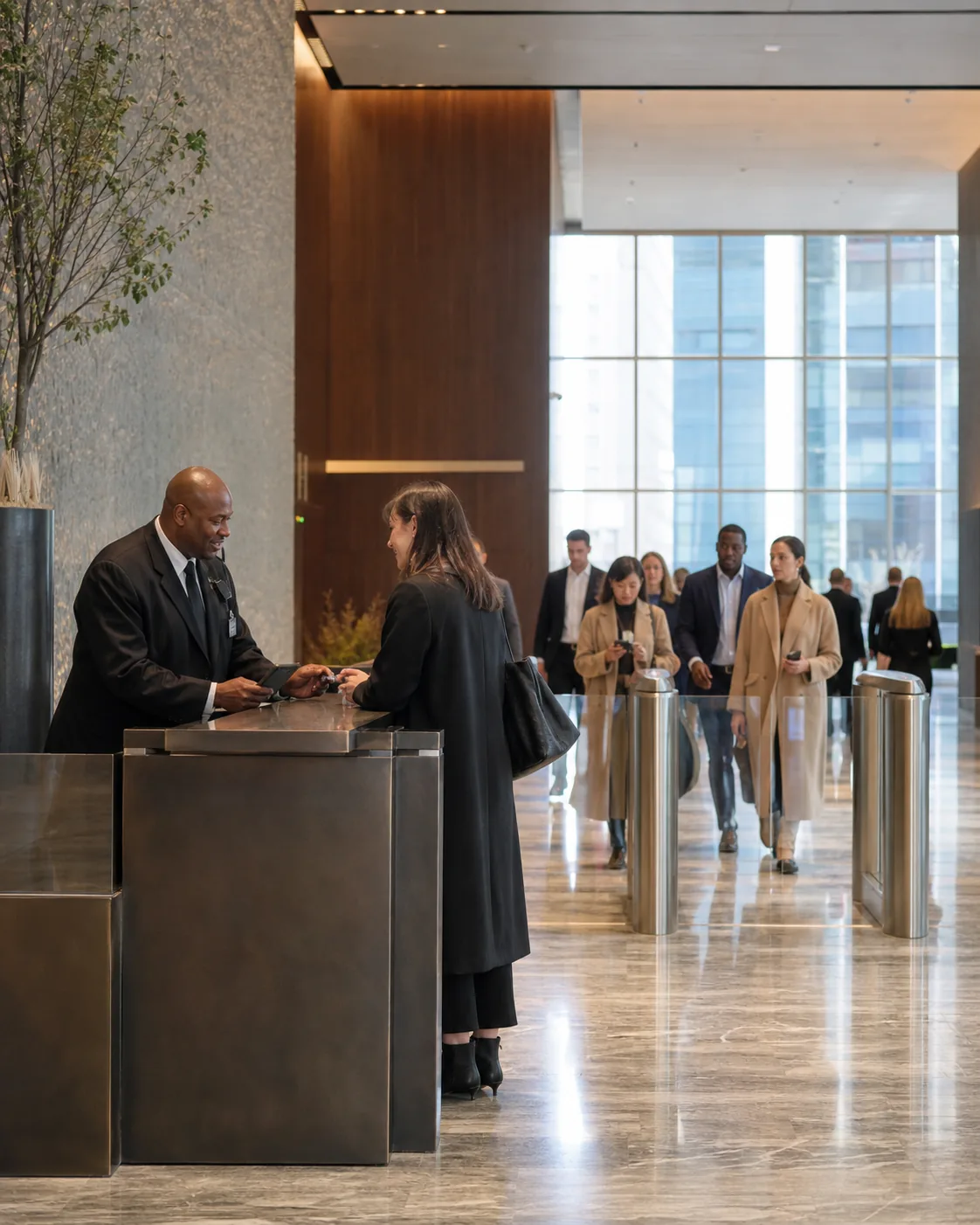
4. Maintain a Safe Distance and Preserve an Exit Path
Positioning can either reduce or increase tension. The guard should generally maintain a reactionary distance, avoid standing within arm’s reach when possible, and keep an unobstructed route to safety.
The guard should also avoid trapping the person in a corner or surrounding them with multiple staff members unless needed to address an immediate safety issue. Another officer can observe from a useful distance, monitor cameras, or manage occupants without creating an unnecessarily aggressive appearance.
Hands should remain visible and posture should stay neutral. If behavior escalates—such as clenched fists, sudden movement, threats, attempts to enter controlled areas, or reaching for an unknown object—the guard should increase distance and seek help rather than closing in.
5. Request Supervisory Assistance Early
A supervisor, building manager, or designated property representative should be notified when the person continues to refuse a valid direction. Early notification provides an additional witness, confirms management’s instructions, and prevents a single guard from making an avoidable high-stakes decision alone.
The notification should be concise:
- Exact location
- Brief description of the person
- Stated reason for being there
- Directions already given
- Current behavior and any threats
- Assistance needed
Radio communication should remain factual and discreet. Sensitive personal information should not be broadcast more widely than operationally necessary.
Properties can reduce confusion by giving security guards written escalation procedures and clear after-hours management contacts.
6. Protect Other Occupants and Maintain Lobby Operations
A refusal-to-leave incident should not be allowed to expose occupants, visitors, or front-desk personnel to unnecessary risk. If the person becomes disruptive, another team member may need to redirect pedestrian traffic, secure interior access points, or move employees away from the immediate area.
Practical measures may include:
- Keeping elevator banks and tenant-only doors controlled
- Asking bystanders not to intervene or gather around
- Moving reception personnel to a safer position
- Using an alternate entrance when authorized and practical
- Monitoring relevant cameras and preserving associated footage
- Notifying affected tenants without sharing unnecessary personal details
In a commercial office security setting, the goal is to contain disruption while preserving access for authorized occupants whenever it is safe to do so.
7. Contact Police When Appropriate
Police assistance may be appropriate when the person remains on private property after authorized representatives have clearly directed them to leave, especially when site procedures call for police involvement. Police should be contacted immediately if the behavior involves violence, credible threats, a suspected weapon, forced entry, serious property damage, or another emergency.
When calling, the guard should distinguish between refusal and active danger. Dispatchers need objective details, including:
- The property address and exact entrance or lobby location
- A current physical and clothing description
- What the person is doing—not assumptions about intent
- Whether threats, violence, injuries, or weapons are involved
- Whether the person is attempting to access restricted areas
- The safest entrance for responding officers
The guard should follow dispatcher instructions and update the dispatcher if circumstances change. Unless responding to an immediate safety necessity and acting within training, policy, and applicable law, the guard should not attempt a physical removal simply because police have been called.
8. Avoid Unnecessary Physical Intervention
Physical contact can quickly increase the risk of injury, legal exposure, and disruption. A refusal to follow instructions does not automatically justify placing hands on someone.

Guards should follow their employer’s training, the property’s post orders, and applicable law. They should never use force as punishment or to gain compliance with disrespectful language. If force becomes immediately necessary to protect someone from harm, the response must remain within the guard’s training and governing rules, with emergency assistance requested as soon as possible.
Site-specific procedures should clearly identify when guards must disengage, call a supervisor, or wait for police.
9. Prepare an Objective Incident Report
The incident report should enable management to understand what happened without relying on opinions or inflammatory language. It should be completed promptly while details are fresh.
Include:
- Date, time, and exact location
- Names and roles of involved staff, when known
- A factual description of the individual
- The stated reason for the visit
- How access or authorization was checked
- Exact or closely quoted statements that materially affected the response
- Each instruction given and the person’s observable response
- Supervisor, management, police, or emergency notifications
- Actions taken to protect occupants and secure access points
- Police incident information, if provided
- Injuries, property damage, witnesses, and available video
- The time and manner in which the incident ended
Use observable facts such as “the individual struck the reception counter with an open hand” rather than conclusions such as “the individual was crazy” or “obviously dangerous.” If the guard did not personally observe something, the report should identify who provided the information.
Relevant video, access-control records, visitor logs, and radio communications should be preserved according to building policy. Reports should be distributed only through authorized channels.
Prepare Before a Lobby Dispute Occurs
The best time to establish refusal-to-leave procedures is before an incident. Property managers should confirm that post orders address visitor verification, after-hours contacts, police notifications, emergency actions, report writing, and preservation of evidence. Scenario-based training can also help guards practice calm language and safe positioning.
If your Manhattan property needs planned guard coverage or help addressing an urgent staffing gap, call or text Guardian ISI at (212) 602-1695. You can also request coverage online. For a time-sensitive need, review our emergency security coverage options.
Official references
Frequently asked questions
Should a security guard physically remove someone who refuses to leave a lobby?
Not automatically. The guard should prioritize communication, distance, supervision, and the site’s escalation procedures. Physical action should never be used merely to punish noncompliance and must remain within training, policy, and applicable law.
When should an NYC lobby guard call 911?
Call 911 for an immediate threat to life, active violence, a suspected weapon, serious injury, fire, forced entry, or another urgent emergency. Give the dispatcher specific, observable details.
What if the person says they are visiting a tenant?
The guard should follow the building’s visitor-verification process, such as checking the visitor system or contacting the tenant. If authorization cannot be confirmed, the guard should explain the policy and obtain supervisory guidance when needed.
How can a guard protect other lobby occupants during the incident?
Control access to restricted areas, keep occupants away from the dispute, discourage bystander intervention, maintain clear exit routes, and assign another team member to monitor cameras or pedestrian traffic when available.
What belongs in the incident report?
Document the timeline, location, authorization checks, instructions given, observable behavior, material statements, notifications, witnesses, police response, injuries or damage, available video, and how the incident ended.