

Security guard pricing in New York City depends on the assignment: hours, duties, qualifications, supervision, relief arrangements, and how quickly service must begin. Obtain a current written quote for the specific property.
This guide uses hypothetical rates to explain budget calculations. The examples are not verified market averages or Guardian ISI price offers.
Compare what each proposal includes
| Proposal item | What to clarify |
|---|---|
| Staffing | Posts, hours, minimum shifts, and required qualifications |
| Supervision | Site visits, escalation contacts, and performance review |
| Relief | Coverage for absences, breaks, and schedule changes |
| Additional charges | Holidays, overtime, equipment, and urgent deployment |
What is included in an hourly guard rate?
A contract security rate is not the same as the guard’s hourly wage. The billed rate may account for:
- Guard wages and applicable payroll costs
- Recruiting, screening, and onboarding
- Scheduling and shift coordination
- Supervision and account management
- Uniforms and basic post equipment
- Insurance and administrative overhead
- Relief coverage when a regularly assigned guard is unavailable
- Incident reporting or workforce-management systems
- Agency operating costs
The exact package varies by provider. Ask for a written scope identifying what is included, what costs extra, and how overtime, holidays, training, equipment, and emergency changes are handled.
The biggest factors affecting security guard cost in NYC
1. Armed versus unarmed coverage
An armed guard generally costs more because the role requires additional qualifications, oversight, insurance, and risk management. Armed coverage is not automatically better for every property. Many office buildings, residential properties, hotels, and construction projects are well served by professional unarmed security guards with strong communication, access-control, and incident-reporting skills.
A security provider should evaluate the risks and operating environment before recommending an armed post.
2. Number of hours and schedule consistency
A recurring full-time post is usually easier to staff efficiently than scattered two- or three-hour shifts. Pricing can also change based on:
- Day, evening, or overnight hours
- Weekday versus weekend coverage
- Fixed schedules versus frequently changing shifts
- Minimum shift lengths
- Holiday coverage
- Overtime created by schedule changes
- The number of guards required at the same time
Consistent schedules can improve both cost predictability and guard familiarity with the property.
3. Property type and post duties
A guard observing a quiet lobby has a different assignment from a guard managing contractor access, package activity, vehicle flow, or a busy public entrance.
Common NYC assignments include:
- Lobby and front-desk security
- Visitor and vendor access control
- Employee credential checks
- Patrols of stairwells, roofs, mechanical areas, or perimeters
- Loading-dock monitoring
- Construction gate and delivery control
- Retail loss-deterrence support
- Hotel guest-area monitoring
- Residential lobby coverage
- Incident documentation and escalation
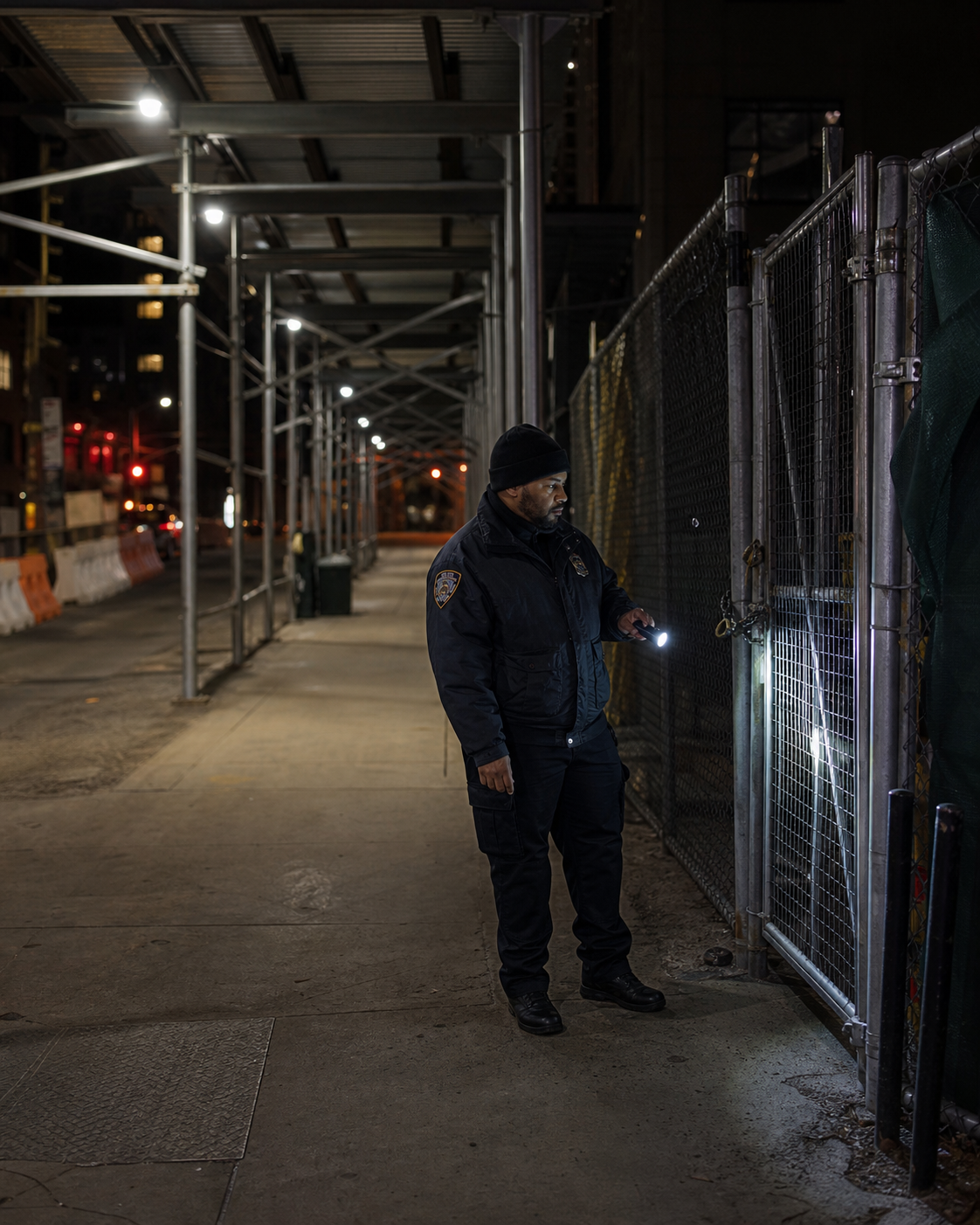
For example, commercial office security may require polished tenant interaction and building-system familiarity. Construction security may involve outdoor posts, changing site conditions, delivery coordination, and overnight perimeter patrols.
4. Training, credentials, and experience
Posts requiring additional experience or credentials typically cost more. Examples may include armed assignments, supervisory roles, fire-watch duties, command-center work, or environments requiring advanced customer-service and de-escalation skills.
New York security personnel and agencies must hold the registrations, licenses, or certifications applicable to their work. When requesting proposals, verify that the provider can supply properly qualified personnel for the specific post rather than assuming every guard can perform every assignment.
5. Emergency deployment
Same-day or next-day requests are often more expensive than planned coverage. The agency may need to reorganize schedules, authorize overtime, dispatch supervisors, or locate personnel with particular qualifications.
When a guard calls out, a building system is unexpectedly impaired, or an incident creates an immediate need, emergency security coverage can help stabilize the property while a longer-term plan is developed.

6. Supervision and technology
A lower hourly rate does not necessarily mean a lower total cost. Reliable supervision can reduce missed shifts, incomplete reports, inconsistent post performance, and management time spent resolving preventable problems.
Depending on the contract, useful support may include:
- Mobile or field-supervisor visits
- Electronic time and attendance records
- Tour or checkpoint verification
- Digital daily activity reports
- Incident notifications
- Escalation procedures
- Dedicated account management
Ask which tools and supervisory services are included in the base rate.
Monthly security guard cost examples
These hypothetical examples show how hours and rates affect a budget; they do not establish current market prices. Hourly rates become easier to evaluate when converted into approximate monthly totals. For planning purposes, an ongoing weekly schedule averages about 4.33 weeks per month.
Example 1: One guard for 40 hours per week
At an illustrative rate of $45 per hour:
40 hours × 4.33 weeks × $45 = approximately $7,794 per month
At $60 per hour, the same schedule would be approximately $10,392 per month.
Example 2: One guard for 12 hours every night
A 12-hour daily post requires about 365 guard-hours in an average month.
- At $45 per hour: approximately $16,425 per month
- At $60 per hour: approximately $21,900 per month
Long shifts can create staffing and overtime considerations, so an agency may divide the post between multiple guards.
Example 3: One continuously staffed 24/7 post
A single post that must always be occupied requires approximately 730 guard-hours per month—not one guard working continuously.
- At $45 per hour: approximately $32,850 per month
- At $60 per hour: approximately $43,800 per month
This estimate does not automatically include holiday premiums, overtime, additional supervisors, equipment, or taxes. It also assumes one guard on duty at a time. Meal-relief requirements, overlapping shifts, or a two-guard protocol can increase total hours.
Fire guard costs are assignment-specific
A fire guard is not interchangeable with a general security guard. NYC properties may need fire-watch coverage under circumstances involving fire-protection system impairments, certain construction activities, or other conditions determined by the relevant authority or site requirements.
The assigned individual must hold the appropriate FDNY Certificate of Fitness for the specific duties and premises when one is required. Pricing can depend on:
- The required Certificate of Fitness
- The number and size of patrol areas
- Patrol and log frequency
- Duration of the system impairment
- Whether coverage is needed around the clock
- How quickly qualified personnel must arrive
Do not select coverage based solely on the lowest hourly rate. Confirm that the provider understands the post and can deploy appropriately qualified fire guards.
Potential charges to clarify before signing
Request a transparent proposal and ask whether the quoted rate includes or excludes:
- Overtime and holiday premiums
- Short-notice deployment fees
- Minimum shift or weekly-hour requirements
- Supervisor or account-management fees
- Radios, scanners, body-worn equipment, or patrol devices
- Vehicle patrols
- Specialized uniforms or protective equipment
- Site-specific training
- Background screening beyond the provider’s standard process
- Parking, tolls, or transportation-related expenses
- Applicable taxes
- Contract cancellation or schedule-change charges
A proposal should also state the invoicing frequency, payment terms, rate-change provisions, and process for approving extra hours.
How to compare NYC security proposals
Comparing hourly rates alone can hide meaningful differences. Use the same written scope of work for every bidder and evaluate each proposal on the following points.
Licensing, registration, and insurance
Verify that the security agency is properly licensed and insured for the work it proposes to perform. Ask for current documentation rather than relying on verbal assurances.
Staffing and call-out coverage
Find out how the company handles lateness, absences, vacancies, and urgent schedule changes. Ask whether relief guards receive the post orders before arriving.
Supervision
Determine who checks performance, how frequently the site is visited, and who your building team can contact outside regular business hours.
Reporting
Review a sample daily activity report and incident report. Reports should be clear, timely, factual, and useful to property management.
Post orders
Effective post orders define guard responsibilities, prohibited activities, patrol schedules, emergency contacts, and escalation procedures. They should be specific to your property and updated when conditions change.
Relevant property experience
A provider’s experience should align with your setting. A Class A office tower, occupied residential building, luxury retailer, hotel, and active construction site present different operational challenges.
Ways to control security costs without weakening coverage
Cost control should focus on better deployment—not simply reducing the hourly rate.
- Document the actual risks. Identify vulnerable entrances, recurring incidents, peak traffic periods, and after-hours activity.
- Match hours to exposure. Full 24/7 coverage may be appropriate for some properties, while others need focused evening, overnight, or weekend shifts.
- Write precise post orders. Clear expectations reduce confusion and unproductive tasks.
- Avoid unnecessary credential requirements. Do not request armed or specialized personnel unless the risk assessment and duties justify them.
- Use consistent schedules. Predictable hours can support retention and reduce last-minute staffing problems.
- Review reports and incident trends. Adjust patrols and deployment based on evidence rather than habit.
- Separate security from unrelated duties. Excessive concierge, maintenance, or administrative tasks can distract guards from the purpose of the post.
Getting an accurate security guard quote in NYC
To receive a useful proposal, be ready to provide:
- Property address and type
- Desired start date
- Days and hours of coverage
- Number of simultaneous posts
- Armed or unarmed preference, if already determined
- Indoor and outdoor patrol requirements
- Access-control and visitor-management duties
- Known risks or recent incidents
- Required credentials or site training
- Uniform preferences
- Reporting and supervision expectations
- Whether the request is temporary, recurring, or emergency coverage
A site walkthrough may reveal blind spots, access points, staffing conflicts, and patrol needs that are difficult to identify over the phone.
Request NYC security coverage
The right security plan balances cost, staffing reliability, risk, and the actual duties required at your property. Guardian ISI can discuss recurring, temporary, and urgent coverage for commercial properties and active sites in New York City.
Call or text [(212) 602-1695](tel:+12126021695) or request coverage online to describe your property, schedule, and desired start date.
Frequently asked questions
How much does an unarmed security guard cost in NYC?
Request a written site-specific quote. Rates depend on the schedule, duties, qualifications, supervision, relief arrangements, contract terms, and start date.
How much does 24/7 security cost in New York City?
A continuously occupied single post averages about 730 hours per month over a 365-day year. Multiply the required hours by your quoted rate, then include any additional staffing or charges. Sample rates in this article are hypothetical.
Why does an armed guard cost more than an unarmed guard?
Armed assignments involve additional qualifications, oversight, insurance, and risk. Armed coverage should be based on a thoughtful assessment rather than selected automatically.
Are fire guards priced the same as security guards?
Not necessarily. Fire guard pricing depends on the required Certificate of Fitness, patrol area, duration, schedule, site conditions, and urgency. A fire guard is not interchangeable with a general security guard.
Does emergency guard coverage cost more?
It often does. Same-day, overnight, holiday, or short-notice deployment may require overtime, schedule changes, or specialized personnel, resulting in a premium.
What information is needed for an accurate security quote?
Provide the property address and type, start date, schedule, number of posts, post duties, patrol areas, known risks, required credentials, reporting expectations, and whether the assignment is temporary or ongoing.