

Many security failures are also communication failures. The guard sees a recurring door problem but records it only in a shift log. A supervisor corrects an officer but never tells the property manager. A tenant complaint reaches ownership before the site team knows it happened.
More messages do not necessarily solve the problem. A property can have group texts, emails, incident reports, daily logs, and weekly meetings while still failing to deliver the right information to the right decision-maker.
A security communication matrix gives officers, supervisors, consultants, and clients a shared answer to five questions:
- What happened?
- Who needs to know?
- How quickly do they need to know?
- Which communication channel should be used?
- Who owns the next action?
Why a Contact List Is Not Enough
A contact list says how to reach people. It does not explain when each person should be contacted.
Without routing rules, officers may:
- Call a senior executive about a minor maintenance issue
- Wait until morning to report an urgent access failure
- send sensitive incident details to a broad group chat
- Assume a supervisor informed the client
- Document a condition without assigning follow-up
- Notify several people but receive no clear decision
The matrix should reduce uncertainty without preventing officers from calling 911 or taking immediate protective action when circumstances require it.
Define Practical Communication Levels
The exact categories should reflect the property, but a four-level structure works as a starting point.
Level 1: Routine operating information
Examples include completed patrols, scheduled vendors, ordinary deliveries, relieved posts, and minor observations requiring no immediate action.
Typical channel:
- Daily activity report
- Shift pass-on log
- Scheduled supervisor review
Level 2: Correctable service or property exception
Examples include a late relief, repeated visitor confusion, malfunctioning camera, unsecured interior door, missed checkpoint, or minor tenant complaint.
Typical channel:
- Prompt supervisor notification
- Written log or service ticket
- Inclusion in the daily client summary when relevant
Level 3: Significant incident or active exposure
Examples include a failed exterior entrance, suspected unauthorized entry, serious confrontation, repeated alarm condition, injury requiring medical response, or a staffing gap affecting a critical post.
Typical channel:
- Immediate call or radio escalation
- Direct property-management notification
- Incident report
- Follow-up updates until controlled
Level 4: Emergency or critical event
Examples include fire, reported weapon, life-threatening medical emergency, active violence, or another condition requiring immediate public emergency response.
Typical channel:
- 911 or the applicable emergency procedure
- Building emergency chain
- Security management
- Time-stamped operational updates
The matrix should use site-specific examples so officers can recognize the categories under pressure.
Assign Audiences by Role, Not Personality
Communication systems become unstable when reporting depends on which individual happens to be working.
Define roles such as:
- On-duty security supervisor
- Account manager
- Property manager
- Chief engineer or superintendent
- FLSD or emergency-preparedness contact
- Tenant facilities contact
- Ownership representative
- Security consultant
- After-hours decision-maker
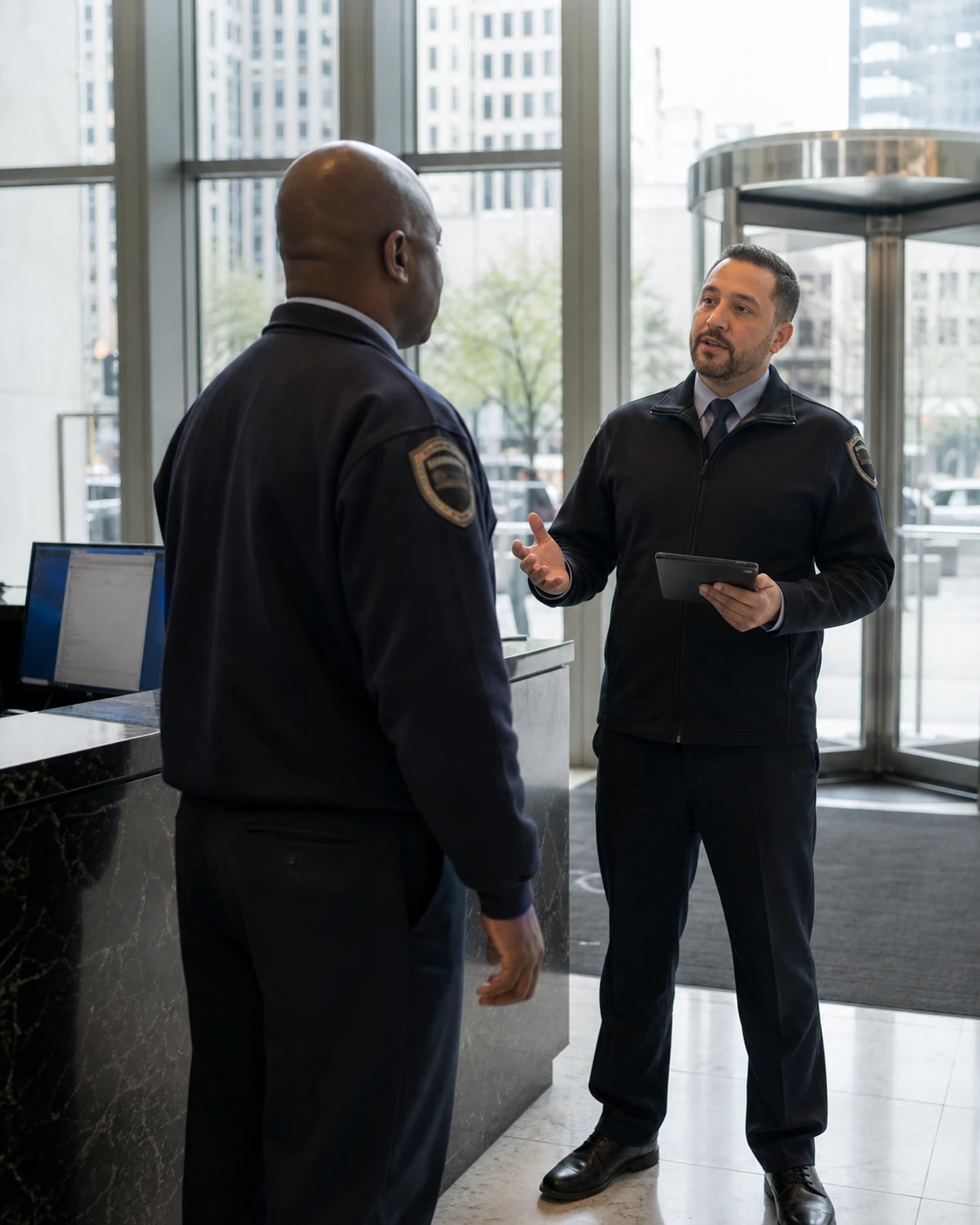
Then list primary and alternate contacts for each role. When personnel change, the routing logic remains intact.
Match the Channel to the Message
Each channel has strengths and limitations.
Radio
Use for immediate operational coordination among people actively working at the property. Avoid broadcasting sensitive personal details unnecessarily.
Telephone
Use when a decision or urgent acknowledgment is needed. A call should be followed by written documentation when the event affects operations or requires follow-up.
Text message
Useful for short alerts and status updates when approved by the client. It should not become the only record of a significant incident.
Useful for summaries, attachments, trend reports, and non-emergency decisions. It is generally a poor channel for an active threat requiring immediate attention.
Security report or management platform
Use as the durable record of events, actions, times, and open items. Reports should be accessible to authorized stakeholders who need them.
The matrix should state which channel starts the response and which creates the permanent record.
Give Daily Site Visits a Defined Reporting Purpose
A supervisory visit should produce more than a signature confirming that someone stopped by.
The visiting supervisor should test and communicate items such as:
- Officer presence, appearance, and assignment knowledge
- Post-order availability
- Patrol and log completion
- Radio, phone, key, and equipment status
- Unresolved incidents
- Recurring access or maintenance problems
- Tenant or client feedback
- Relief and scheduling risks
- Changes in property operations
The visit report should distinguish among:
- Corrected on site
- Assigned for follow-up
- Awaiting client decision
- Requiring vendor or building action
- Requiring a post-order change
This gives property management a usable view of conditions instead of an unfiltered list of observations.
Create an Acknowledgment Rule
Sending a message is not the same as completing communication.
For urgent or decision-dependent matters, the matrix should define:
- Who must acknowledge receipt
- How long the sender should wait
- Which alternate contact should be used next
- When the issue moves to a higher level
- Who records the acknowledgment and decision
For example, an officer reporting an unsecured exterior entrance should not assume an unanswered voicemail transferred responsibility to management.
Identify the Owner of Every Open Item
Communication often stops after notification because nobody is assigned to close the issue.
Each open item should have:
- Responsible role
- Required action
- Target time or date
- Current status
- Escalation point if overdue
- Evidence of completion
Security may observe and report a broken lock while engineering owns the repair. The security supervisor may still own the temporary control and the follow-up confirming that the opening was secured.
Separate Immediate Updates From Management Summaries
Executives and property managers need visibility, but they should not have to reconstruct the security program from dozens of disconnected messages.
A well-supervised account can use several communication rhythms:
Immediate
Active threats, emergencies, serious incidents, and exposures requiring decisions.
Daily
Staffing exceptions, tenant complaints, equipment failures, notable patrol findings, and open follow-up items.

Weekly
Recurring conditions, completion rates, staffing patterns, training needs, and unresolved client decisions.
Monthly or quarterly
Trend analysis, risk priorities, post-order changes, resource recommendations, and progress on larger corrective projects.
The content should become more analytical as the reporting period becomes longer.
Test the Matrix With Realistic Scenarios
A tabletop exercise can expose missing contacts and unclear authority. Ask the team how it would communicate:
- A relief officer who has not arrived
- A loading dock door that cannot be secured
- A tenant reporting repeated unwanted visits
- A camera outage at a critical entrance
- An ambulance response involving a visitor
- A protest forming near the property
- A fire protection system impairment
For each scenario, identify the first action, first recipient, backup recipient, written record, and action owner.
Review Communication Quality During Client Meetings
Do not measure communication only by message volume. Ask:
- Did the client learn important information early enough to act?
- Did reports distinguish facts from assumptions?
- Were open items assigned and closed?
- Did site visits reveal conditions not reported by the post?
- Are the same problems appearing repeatedly?
- Are owners receiving useful trends rather than operational noise?
- Do guards know when to escalate without waiting for permission?
These questions turn continuous communication into operational control.
Build a More Accountable Security Program
Guardian ISI combines security consulting, hands-on supervision, frequent site visits, and direct client communication to help NYC properties identify and address problems before they become normal operating conditions.
Call or text (212) 602-1695, or request security coverage to discuss a more responsive security program for your property.
A working communication matrix
| Situation | Initial recipient | Record and follow-up |
|---|---|---|
| Routine completed task | Shift supervisor through the approved log | Record completion and any exception |
| Equipment failure or missed task | Supervisor and responsible building contact | Assign an owner, interim control, and review time |
| Active access exposure | Immediate operational contact and management | Obtain acknowledgment and track updates until controlled |
| Emergency | Emergency services and the building emergency chain | Follow emergency procedures and document the timeline when safe |
Adapt the recipients and escalation timing to the property’s approved procedures.
Related Guardian services
Coordinate reporting responsibilities with Security Guard Services and the staffing needs of Commercial Office Security.
Frequently asked questions
What is a security communication matrix?
It is a site-specific guide defining what security personnel report, who receives it, how quickly it must be sent, which channel is used, and who owns follow-up.
Is a group text enough for client communication?
No. Texting can support alerts, but significant incidents and open actions also need a durable, authorized record.
What should a security supervisor report after a site visit?
Report officer and equipment status, post-order knowledge, unresolved incidents, recurring conditions, client feedback, and actions taken or assigned.
Should owners receive every security update?
Not necessarily. The matrix should route urgent or strategic information to ownership while routine operating details go to the appropriate site contacts.
How often should the matrix be reviewed?
Review it after personnel changes, major incidents, property operating changes, failed notifications, and at scheduled intervals.