
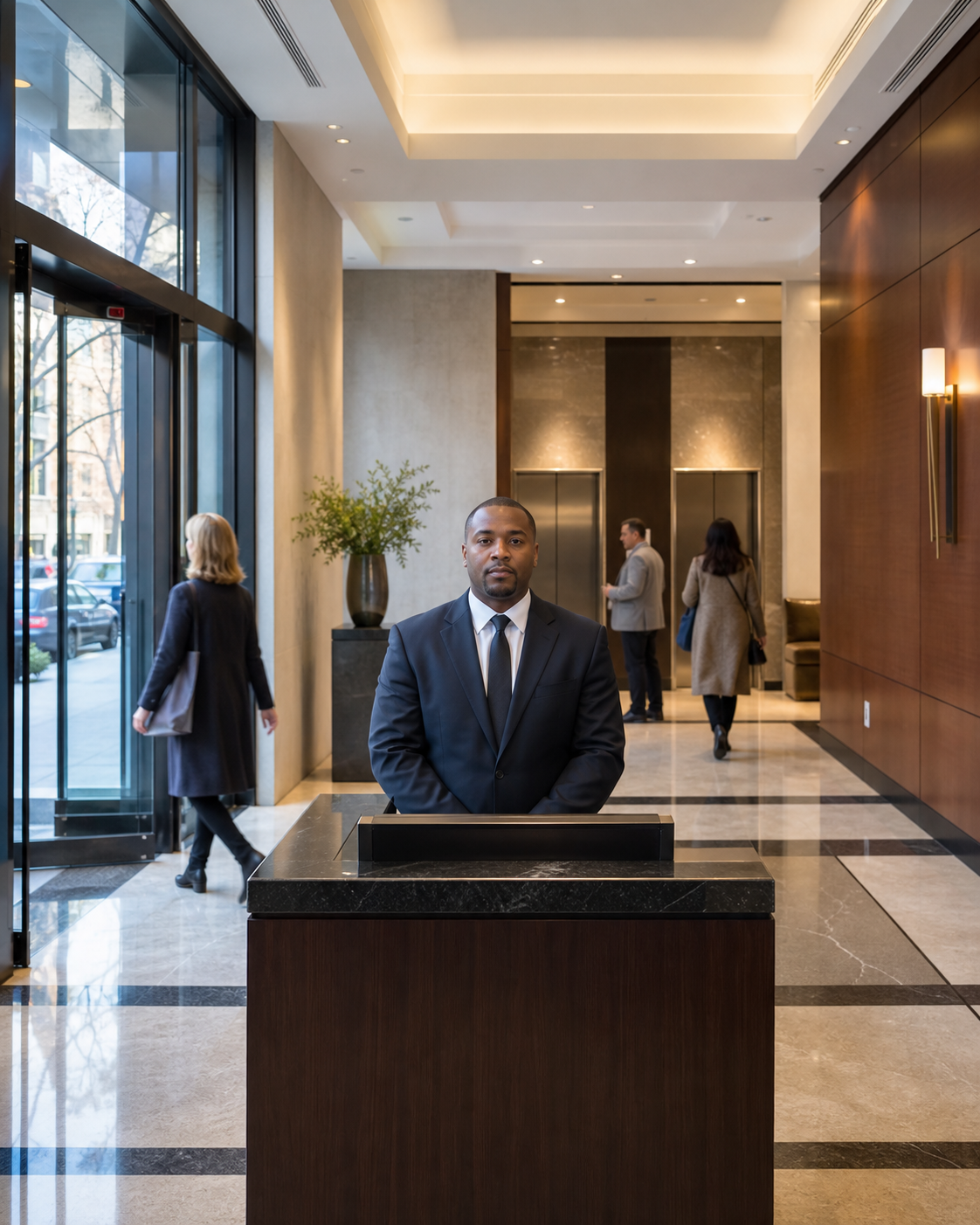
A residential lobby security officer may see hundreds of residents, visitors, delivery workers, contractors, and building employees during one shift. In a busy New York City apartment building, the officer must recognize familiar faces while still verifying access, watching for tailgating, responding to resident concerns, and protecting emergency egress.
That combination makes residential lobby access control more difficult than it appears. A strong program depends on more than placing an officer near the front door. The officer needs an effective workstation, clear authority, practical procedures, reliable technology, and visible support from property management.
Why residential lobby access control is challenging
Unlike an office building, a residential property is both a controlled environment and someone’s home. Residents expect convenience and may become frustrated when asked to follow a rule they believe should not apply to them. At the same time, management expects the security officer to identify unauthorized visitors and enforce building procedures consistently.
Common challenges include:
- Residents holding doors open for unknown people
- Visitors following residents into the building without checking in
- Food and package deliveries arriving in rapid succession
- Contractors requesting access without current authorization
- Residents refusing to present credentials or follow guest procedures
- Crowded vestibules that limit visibility
- Multiple entrances, service doors, or garage access points
- Pressure on officers to make exceptions for familiar residents
Familiarity can become a vulnerability. Seeing the same people every day may cause procedures to become informal, while repeated disputes with those residents can also wear officers down.
Consider moving the security desk back from the main entrance
Placing the lobby desk immediately beside the entrance may seem like the best way to control the door. In practice, being too close can reduce the officer’s effectiveness.
An officer stationed directly next to the entrance can become surrounded by people entering, exiting, waiting for rides, or receiving deliveries. The officer may have little time to observe a person’s behavior before that individual reaches the desk or passes into the building. Noise, weather exposure, door traffic, and face-to-face pressure can create further distractions.
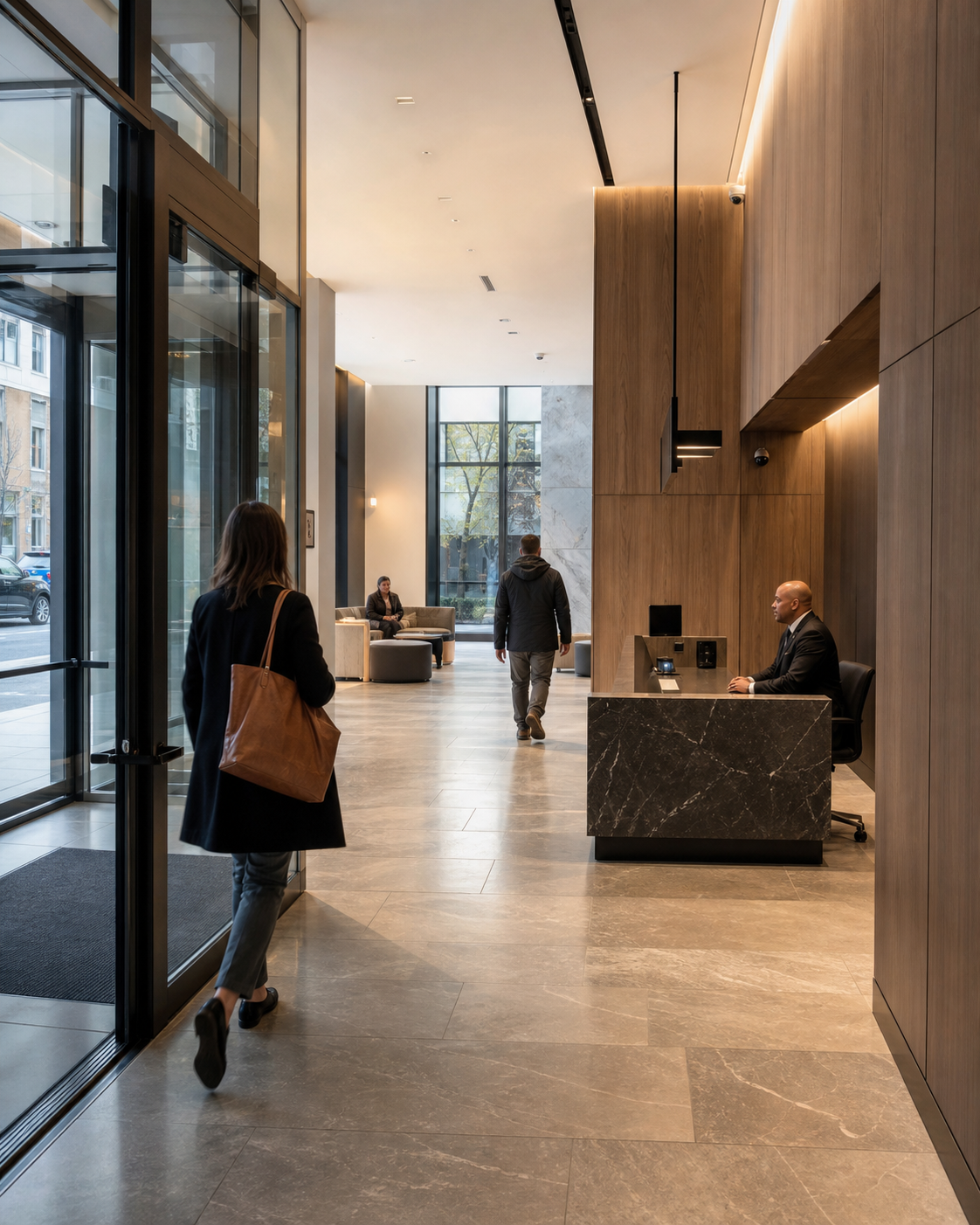
When the lobby layout permits, property managers should consider moving the security desk farther back from the main entrance. The goal is not to hide the officer or create distance for its own sake. It is to establish a useful observation zone between the door and the officer’s position.
A well-positioned desk can provide:
- A wider view of the entrance, vestibule, elevators, and lobby
- More time to observe people before they reach controlled areas
- Better awareness of tailgating and unusual behavior
- Less crowding around the officer
- A clearer distinction between the public entrance and the controlled interior
- A safer, more professional space for handling access questions
Desk placement should preserve clear sightlines and should not obstruct accessible routes, emergency egress, fire-safety equipment, or normal building operations. Before relocating a station, management should review the plan with appropriate building, fire-life-safety, accessibility, and security professionals.
Do not make a desk buzzer the default solution
Property managers should avoid installing a general door-release buzzer at the security desk as a substitute for a complete access control process. A buzzer can turn the officer into a door operator who is expected to release the entrance whenever someone knocks, gestures, or claims to be authorized.
This arrangement creates several problems:
- The officer may feel pressured to release the door before completing verification.
- Repeated buzzing interrupts observation, reporting, and other duties.
- Residents may expect immediate entry even when they lack a credential.
- A person outside can watch how and when the officer releases the door.
- The officer may become responsible for a system without adequate information or authority.
Access decisions should be based on defined credentials, visitor authorization, intercom confirmation, or another documented procedure—not on whether a person appears familiar or becomes impatient.
If an officer must control an electronic release as part of the building’s approved design, management should provide written procedures, suitable camera and intercom coverage, and clear verification standards. Door hardware and electronic access systems must also be configured without interfering with emergency egress or applicable safety requirements.
Repeated conflict can cause mental exhaustion
Residential security officers interact with many of the same residents every day. When those interactions repeatedly involve arguments about credentials, guest registration, deliveries, pets, smoking, amenity access, or other building rules, the emotional strain can accumulate.
This is different from a single difficult incident. An officer may have to enforce the same rule with the same resident several times each week, knowing that another confrontation could occur during the resident’s next trip through the lobby. Over time, constant conflict can produce mental exhaustion, reduced attention, inconsistent decisions, or avoidance of necessary interactions.
Management can reduce this pressure by:
- Publishing access and visitor rules directly to residents
- Avoiding informal exceptions that undermine officers
- Giving officers a clear escalation path
- Reviewing recurring disputes instead of leaving each shift to start over
- Rotating assignments when operationally appropriate
- Training officers in de-escalation and professional communication
- Addressing threats, harassment, and abusive conduct promptly
- Ensuring supervisors review reports and follow up
Security officers should remain calm and professional, but they should not be expected to absorb unlimited conflict without management support.
Use security as the building’s eyes and ears
A lobby officer is most effective as a trained observer, communicator, and first point of escalation. The officer’s role is to identify concerns, follow approved procedures, document relevant facts, and promptly notify the people authorized to act.
Useful observations may include:
- A resident repeatedly bypassing guest procedures
- An unauthorized person entering behind someone else
- A door that does not latch correctly
- Deliveries being left in a prohibited location
- Contractors attempting to enter outside approved hours
- Repeated smoking or other prohibited activity in a common area
- Damage to access control equipment
- Patterns that may not be apparent from a single incident
Reports should focus on objective facts: who was involved, what the officer observed, where and when it happened, what procedure was followed, and who was notified. Officers should avoid speculation, selective enforcement, or arguments about the meaning of a resident’s lease.
Connect officer reports to the lease-violation process
Security can document conduct that appears inconsistent with building rules, but property management should determine whether the incident constitutes a lease or house-rule violation and what action is appropriate. This division of responsibility protects the integrity of the process.
A practical workflow is:
- The officer observes or receives a report of an incident.
- The officer addresses any immediate security concern within established authority.
- The officer records objective details and preserves relevant evidence according to policy.
- A supervisor reviews the report for completeness.
- Property management evaluates the incident under the lease, house rules, and applicable requirements.
- Management documents any warning, notice, or other authorized response.
- Relevant operational guidance is provided to security without disclosing unnecessary resident information.

Consistent follow-through matters. If officers repeatedly document violations but never see an appropriate operational response, they may conclude that reporting has no value. That can lead to lower morale and less consistent performance.
When officers see that accurate observations are reviewed and that rules are addressed fairly, they are more likely to take pride in their craft. They understand that their reports contribute to a real property-management process rather than disappearing into a file. Management can then expect better documentation, stronger situational awareness, and more consistent results.
Create a unified management and security approach
The strongest residential access control programs align people, procedures, and technology. Property managers should give residential security officers written post orders that answer common questions, including:
- Which entrances the officer is responsible for monitoring
- How residents, guests, contractors, and deliveries are verified
- Who may authorize an exception
- When a supervisor or property manager must be contacted
- How denied-entry incidents should be handled
- Which events require an incident report
- How relevant video or access records are preserved
- What the officer should do when a resident becomes confrontational
Management should also periodically observe the lobby during busy periods. A desk location or procedure that appears reasonable on paper may fail during morning departures, evening deliveries, move-ins, or events.
Practical assessment checklist
When evaluating residential lobby access control, ask:
- Does the officer have a clear view of the entrance and elevator area?
- Is the desk too close to the door or exposed to crowding?
- Can the officer observe someone before that person reaches the controlled interior?
- Are residents able to pressure the officer into using a door-release buzzer?
- Are visitor and contractor authorizations easy to verify?
- Do cameras support the officer’s view rather than replace active observation?
- Are recurring resident conflicts escalated and reviewed?
- Do incident reports lead to documented management review?
- Are rules communicated by management, not only by security?
- Are officers recognized for accurate reporting and professional conduct?
Strengthen your residential lobby coverage
Guardian ISI can help New York City property teams evaluate lobby posts, access procedures, officer responsibilities, reporting practices, and coverage needs. We also provide emergency security coverage when a building needs additional support.
Call or text (212) 602-1695, or request coverage online to discuss your residential property.
Frequently asked questions
Should a residential security desk be placed next to the main entrance?
Not necessarily. Moving the desk farther back can create a better observation zone, reduce crowding, and improve sightlines. Any relocation should preserve accessibility, emergency egress, fire-safety equipment, and normal operations.
Why should a building avoid putting a buzzer at the security desk?
A general door-release buzzer can pressure the officer to open the entrance without completing verification and can distract from observation and reporting. Access should follow documented credential, visitor, intercom, and authorization procedures.
Can a security officer issue a lease violation?
Security officers should document objective facts and follow post orders. Property management should decide whether conduct violates a lease or house rule and determine the appropriate authorized response.
How can management reduce conflict between residents and lobby officers?
Management should communicate rules directly, apply them consistently, limit informal exceptions, provide an escalation process, review recurring disputes, and support officers facing threats or abusive behavior.
What does it mean to use security as the building’s eyes and ears?
It means officers actively observe conditions, identify access and safety concerns, document facts, report patterns, and quickly notify the people authorized to address them.