

Security guard costs are not determined only by hourly rates. They are also shaped by where officers are posted, when coverage is scheduled, how responsibilities are assigned, and whether technology supports—or duplicates—the guarding program.
A qualified security consultant can often identify opportunities to reduce security guard costs without simply cutting headcount across the board. The objective is to remove low-value activity and redirect resources toward the hours, locations, and incidents that present the greatest risk.
For Manhattan property owners, managers, and operators, this requires a careful site assessment rather than a generic staffing formula.
Start With Risk, Not the Existing Schedule
Many guarding programs develop gradually. A temporary post becomes permanent, a new patrol is added after an incident, or multiple departments begin monitoring the same area. Years later, the property may be paying for a schedule that no longer matches its operations.
A consultant should begin by examining current conditions, including:
- Building entrances, loading areas, garages, rooftops, and other access points
- Tenant, visitor, contractor, and delivery activity
- Incident reports and recurring complaints
- Access-control, alarm, intercom, and camera systems
- Officer schedules, patrol records, and post orders
- Opening, closing, overnight, and weekend procedures
- Special-event or construction activity
- Areas where employees work alone or valuable assets are stored
This creates a risk-based baseline. The consultant can then compare what officers are actually doing with what the property currently needs.
Identify Unnecessary or Low-Value Fixed Posts
A fixed post assigns an officer to remain at a particular location, such as a lobby desk, service entrance, loading dock, or elevator bank. Fixed posts are appropriate when continuous observation, access control, customer assistance, or immediate response is necessary. However, they are also a major source of recurring labor hours.
A consultant may find that a post has limited value because:
- The area is active only during certain hours
- Electronic access control already restricts entry
- The officer has little visibility beyond the immediate desk
- Two nearby posts monitor the same movement
- The post was created for a temporary condition that no longer exists
- The officer performs tasks that could be completed during scheduled patrols
The right recommendation is not automatically to eliminate the post. Alternatives may include reducing its hours, converting it to a roving assignment, combining compatible duties, or activating it only when traffic or risk increases.
For example, a service entrance may need continuous staffing during morning deliveries but only periodic checks after the loading dock closes. That change can preserve coverage when it matters while reducing low-value overnight hours.
Improve Patrol Routes and Timing
Patrols are effective only when they cover relevant locations at useful intervals. A long patrol that repeatedly passes low-risk areas may create the appearance of activity without addressing the building’s most likely problems.
A security consultant can review patrol routes for:
- Unnecessary backtracking
- Areas that are missed or checked too infrequently
- Predictable timing that makes patrols easy to anticipate
- Checkpoints that confirm presence but not meaningful observation
- Routes that prevent officers from responding quickly to the lobby or control desk
- Excessive travel between disconnected spaces
An improved patrol plan may use shorter, risk-specific routes. One route might emphasize street-level doors and retail frontage at closing time, while another focuses on mechanical areas, loading zones, or vacant floors overnight.
Patrol frequency should also follow actual exposure. A rear entrance with repeated door-propping incidents may need more attention than a secured interior corridor with no incident history.
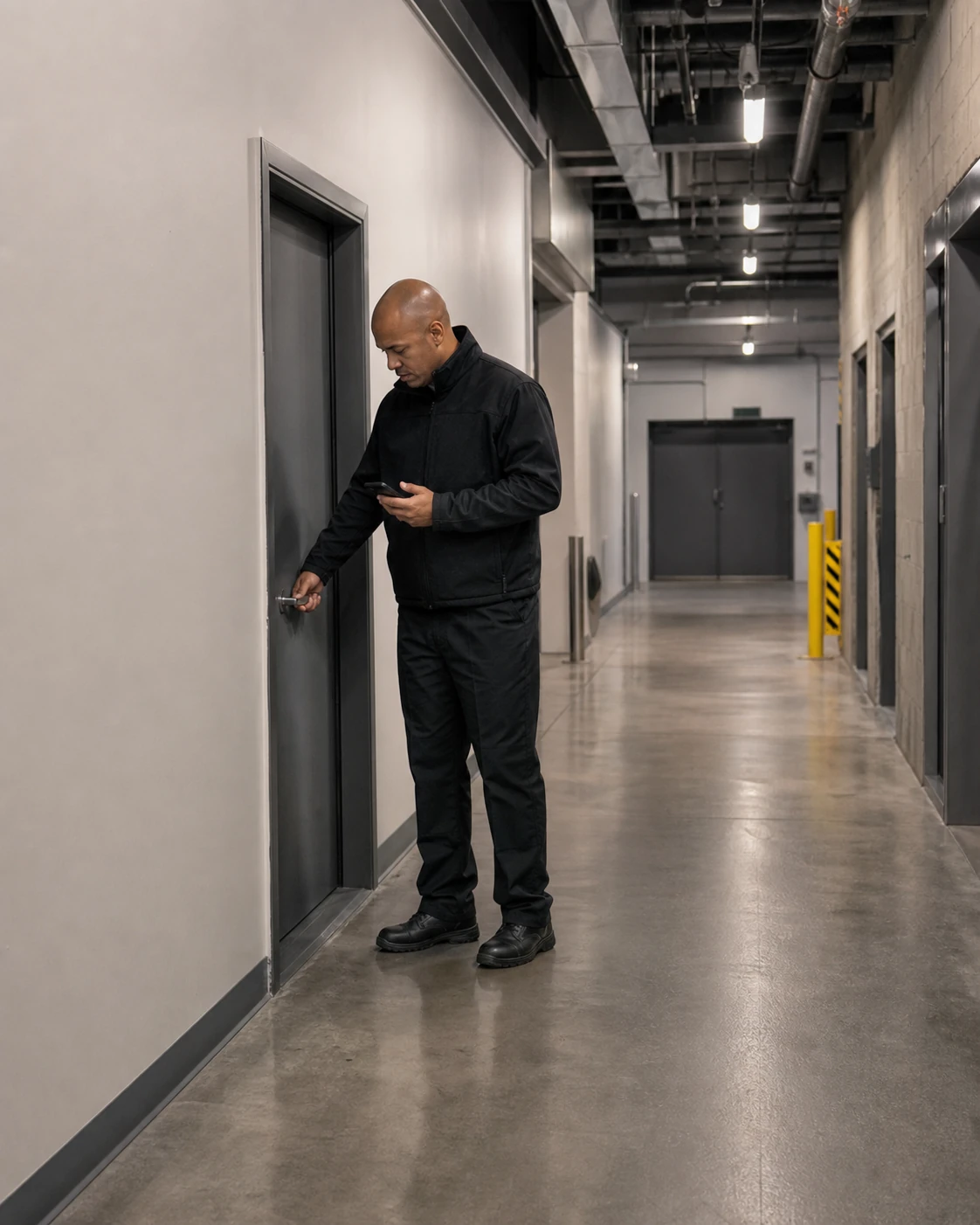
Well-designed patrols make better use of each officer’s time and can sometimes replace a low-activity fixed post without leaving the area unobserved.
Correct Overlapping Responsibilities
Guarding costs can increase when security officers, front-desk personnel, building staff, and outside vendors perform overlapping work. Duplication also creates confusion about who should act when something goes wrong.
Common examples include:
- Two employees separately checking the same visitor credentials
- Security and property staff both monitoring identical camera feeds
- Multiple posts logging the same delivery
- Officers performing administrative tasks that keep them from security duties
- A lobby officer and concierge independently handling the same tenant requests
- Unclear alarm-response duties between security, engineering, and management
A consultant can map each recurring task to a responsible role. Updated post orders should explain who monitors, verifies, documents, escalates, and responds.
This does not mean assigning every available task to a guard. Officers who are distracted by package handling, extensive reception work, or unrelated building errands may have less time to observe conditions and respond to incidents. The goal is to give each role clear, compatible responsibilities.
Properties evaluating their overall staffing approach can learn more about Guardian ISI’s commercial office security services and security guard coverage.
Use Technology to Support Officers, Not Automatically Replace Them
Technology can reduce manual work and extend an officer’s visibility, but it must be matched to a defined operational need. Installing more cameras does not improve security if no one reviews alerts or knows how to respond.
Depending on the property, a consultant may recommend:
- Access-control systems that create reliable entry records
- Video intercoms for low-volume secondary entrances
- Camera repositioning to address blind spots
- Remote or centralized video monitoring
- Door-position sensors and forced-door alerts
- Mobile patrol reporting and electronic checkpoints
- Visitor-management systems
- Analytics that flag specific events for human review
Technology may allow an officer to monitor several controlled areas from one location or respond to verified events rather than remain at a low-activity post. However, it should have clear ownership, testing procedures, maintenance plans, and response protocols.
A consultant should also account for operational limitations. Cameras cannot physically intervene, help a distressed occupant, manage an aggressive visitor, or safely coordinate activity during a developing incident. The strongest plan usually defines what technology detects and what trained personnel do next.
Redirect Coverage to Vulnerable Hours and Locations
A flat schedule can devote the same resources to quiet and busy periods even though risk changes throughout the day. Consultants can compare staffing with building activity and incident patterns to identify when protection provides the greatest value.
Higher-exposure periods may include:
- Morning arrival and evening departure times
- Loading and delivery windows
- Retail opening or closing
- Contractor work outside normal business hours
- Overnight periods with limited building staff
- Weekends, holidays, and tenant events
- Times when public access and employee traffic overlap
Locations also vary in vulnerability. Street-level doors, loading docks, parking areas, vacant spaces, and shared tenant amenities may require more attention than controlled interior areas.
A revised plan might reduce a quiet midday post while adding support during closing, concentrate patrols around recurring incidents, or schedule a supervisor during the busiest delivery period. This is targeted deployment—not an across-the-board reduction.
Protect Critical and Required Functions
Cost reviews should distinguish discretionary security assignments from functions connected to emergency procedures, building operations, contracts, insurance requirements, or applicable fire and life-safety obligations.
A consultant should not recommend removing a post solely because incident volume is low. The absence of incidents may reflect effective deterrence, and some assignments exist to manage high-consequence events rather than frequent problems.
Before changing coverage, management should confirm:
- What risk the post or patrol is intended to control
- Whether another measure controls that risk reliably
- How alarms and incidents will be detected
- Who will respond and how quickly
- Whether leases, contracts, internal policies, or insurance conditions affect staffing
- Whether the assignment involves a separately defined fire or life-safety function
Where fire watches or fire-life-safety staffing may be involved, the review should be handled separately from general guard optimization. Guardian ISI provides information about fire guard services and fire-life-safety director coverage.
Measure Results After Changes
A cost-saving recommendation should include a way to evaluate whether protection remains effective. Useful performance indicators can include:
- Security incidents by time and location
- Door, alarm, and access-control exceptions
- Patrol completion and response times
- Unauthorized-entry attempts
- Tenant or employee complaints
- Overtime and last-minute scheduling
- Time officers spend on security versus unrelated duties
- Supervisor observations and quality-assurance findings
Changes can be introduced in phases, followed by a documented review. If problems increase, management can adjust patrol frequency, post hours, procedures, or technology rather than waiting for a serious incident.
What a Useful Consulting Review Should Deliver
A practical security assessment should result in more than a recommendation to add or remove officers. Decision-makers should receive a clear explanation of:
- Current risks and operating conditions
- The purpose and value of each post
- Recommended staffing by day and time
- Revised patrol routes and priorities
- Responsibility gaps or duplication
- Technology opportunities and limitations
- Implementation steps and contingency measures
- Metrics for reviewing results
The best outcome is not necessarily the smallest guard force. It is a defensible security program in which each labor hour addresses a meaningful need.
Request a Guarding and Coverage Review
Guardian ISI helps New York City properties evaluate guard deployment, post responsibilities, patrols, and coverage priorities. If your current schedule has grown without a recent operational review, we can help identify where resources may be better used.
Call or text (212) 602-1695, or request security coverage online. For urgent or unexpected staffing needs, review our emergency security coverage.
Related Guardian services
Review Security Guard Services and Commercial Office Security to connect these procedures with the appropriate staffing and site responsibilities.
Frequently asked questions
Can a consultant guarantee lower security guard costs?
No responsible consultant should guarantee savings before reviewing the property. Opportunities depend on the current schedule, risk profile, operating hours, technology, contracts, and the purpose of each assignment.
Does reducing a fixed post always weaken security?
Not necessarily. A low-activity post may be converted to a scheduled patrol or staffed only during higher-risk hours. The property still needs a reliable way to detect, verify, and respond to incidents.
Can cameras replace security guards?
Cameras can extend visibility and help verify events, but they cannot physically respond, assist occupants, control a confrontation, or manage an emergency. Technology works best when paired with clear human response procedures.
How can a consultant improve patrols?
A consultant can remove backtracking, prioritize vulnerable areas, vary patrol timing, improve checkpoints, and create shorter routes based on specific risks and operating periods.
How often should a Manhattan property review guard coverage?
Coverage should be reviewed when occupancy, access points, operating hours, tenant activity, construction, incident patterns, or technology change. Periodic reviews are also useful when a longstanding schedule no longer has a documented rationale.
Should fire and life-safety positions be included in a guard cost review?
They should be identified but evaluated separately. Management should confirm the role’s purpose and any applicable building, contractual, insurance, or fire-life-safety requirements before making staffing changes.