
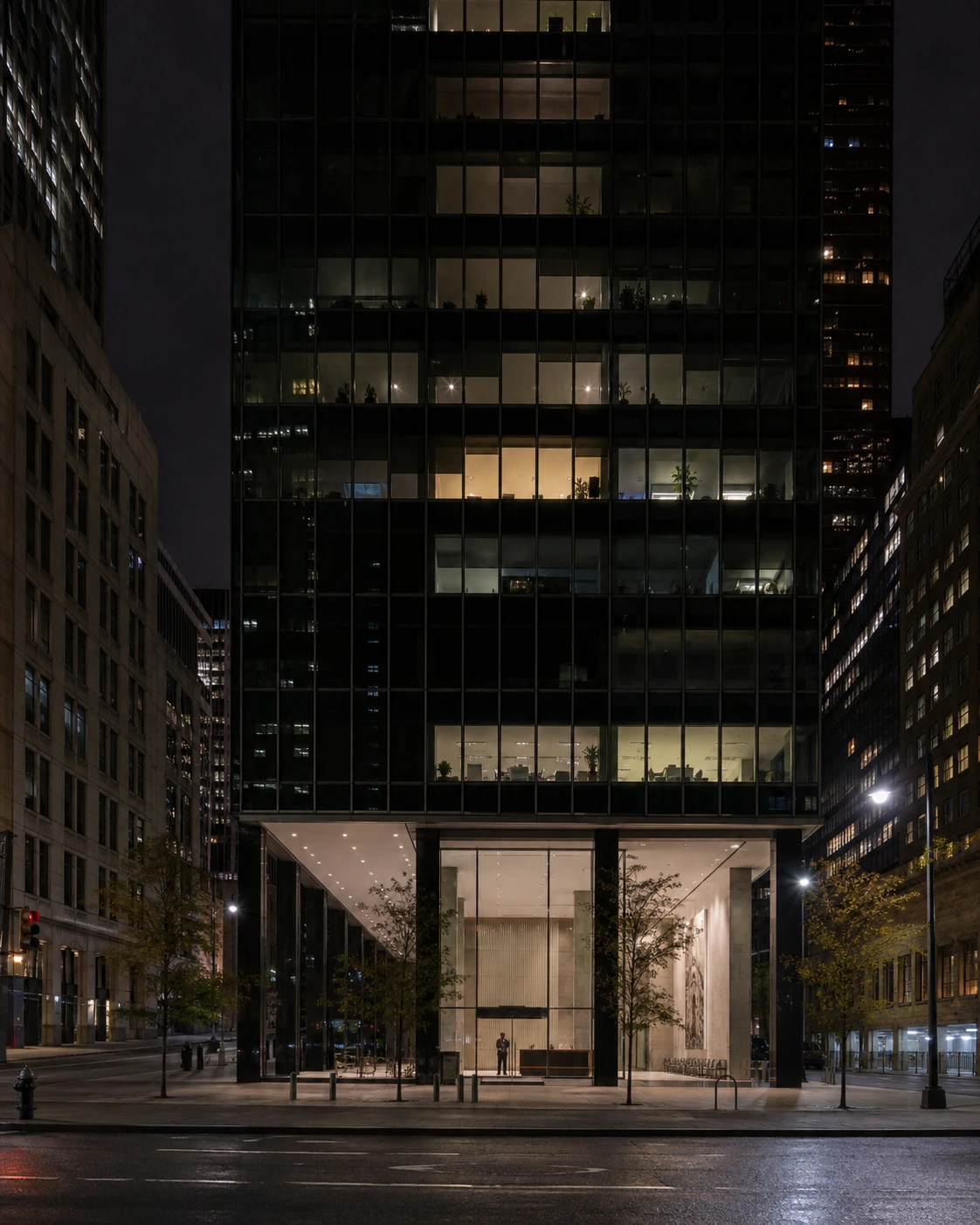
A partially occupied Manhattan office tower presents a distinct overnight security challenge. Some floors may be vacant, a handful of tenants may work late, and cleaning crews or contractors may move through areas that are normally controlled during business hours. At the same time, fewer occupants are available to notice an unlocked suite, water leak, mechanical alarm, or unusual activity.
An effective overnight plan should therefore do more than place someone in the lobby. It should establish clear access rules, scheduled patrols, reliable documentation, and escalation procedures tailored to the building.
Why partial occupancy changes the overnight risk profile
Low occupancy can create a false sense of security. Although fewer people are entering the building, the property may be more vulnerable because:
- Vacant floors receive less routine attention.
- Unlocked suites can remain unnoticed for hours.
- Cleaning crews and contractors may need access beyond the lobby.
- Loading docks and service entrances may operate on different schedules.
- Water leaks or mechanical problems can spread before someone reports them.
- A small number of late-working tenants can be difficult to distinguish from unauthorized visitors.
The overnight post orders should reflect the building's actual occupancy, tenant schedules, access-control systems, construction activity, and management contacts. Generic instructions are rarely enough for a mixed occupied-vacant environment.
Start each shift with a structured handoff
The incoming officer should receive a concise briefing rather than relying solely on the previous shift's incident log. The handoff should identify conditions that could affect overnight operations.
Confirm before assuming the post
- Which tenant floors are expected to remain occupied?
- Are any suites vacant, under renovation, or awaiting turnover?
- Which cleaners, engineers, vendors, and contractors are scheduled?
- Are there open work orders, active leaks, elevator issues, or mechanical alarms?
- Are any doors, cameras, card readers, or intercoms out of service?
- Is a loading-dock delivery or removal scheduled?
- Which manager, engineer, or vendor should be called for each type of issue?
Temporary instructions should be written, dated, and made available to every officer assigned during the affected period.
Overnight patrol checklist
Patrol frequency and routes should be based on the property's conditions rather than a one-size-fits-all schedule. Routes can be varied when appropriate, but critical areas should never be skipped.
Vacant floors
Vacant floors deserve deliberate inspection because there may be no tenant employees present to report problems. During authorized rounds, the officer should look and listen for:
- Doors that are open, unsecured, or show signs of tampering
- Lights or equipment operating unexpectedly
- Water, unusual odors, or sounds of running water
- Ceiling stains, wet carpet, or other signs of a leak
- Unscheduled workers or evidence that someone recently entered
- Construction materials obstructing corridors or designated access routes
Officers should not enter hazardous or restricted areas without authorization. If a condition appears unsafe, the correct response is to secure the immediate area when possible and notify the appropriate building contact.
Unlocked suites
An unlocked suite should not be treated as a minor housekeeping issue. The officer should follow site-specific instructions, which may include:
- Remaining outside and observing the doorway.
- Checking whether authorized occupants or cleaners are scheduled.
- Notifying the supervisor, property manager, or designated tenant contact.
- Recording the exact location, time, and condition found.
- Avoiding unnecessary entry or handling of tenant property.
The building should determine in advance who may authorize a suite search, closure, or lock-up. That decision should not be improvised in the middle of the night.
Cleaning crews and contractors
Cleaning teams often work across multiple floors, while contractors may arrive after hours to minimize tenant disruption. Access procedures should make it possible to verify each person without interfering with authorized work.
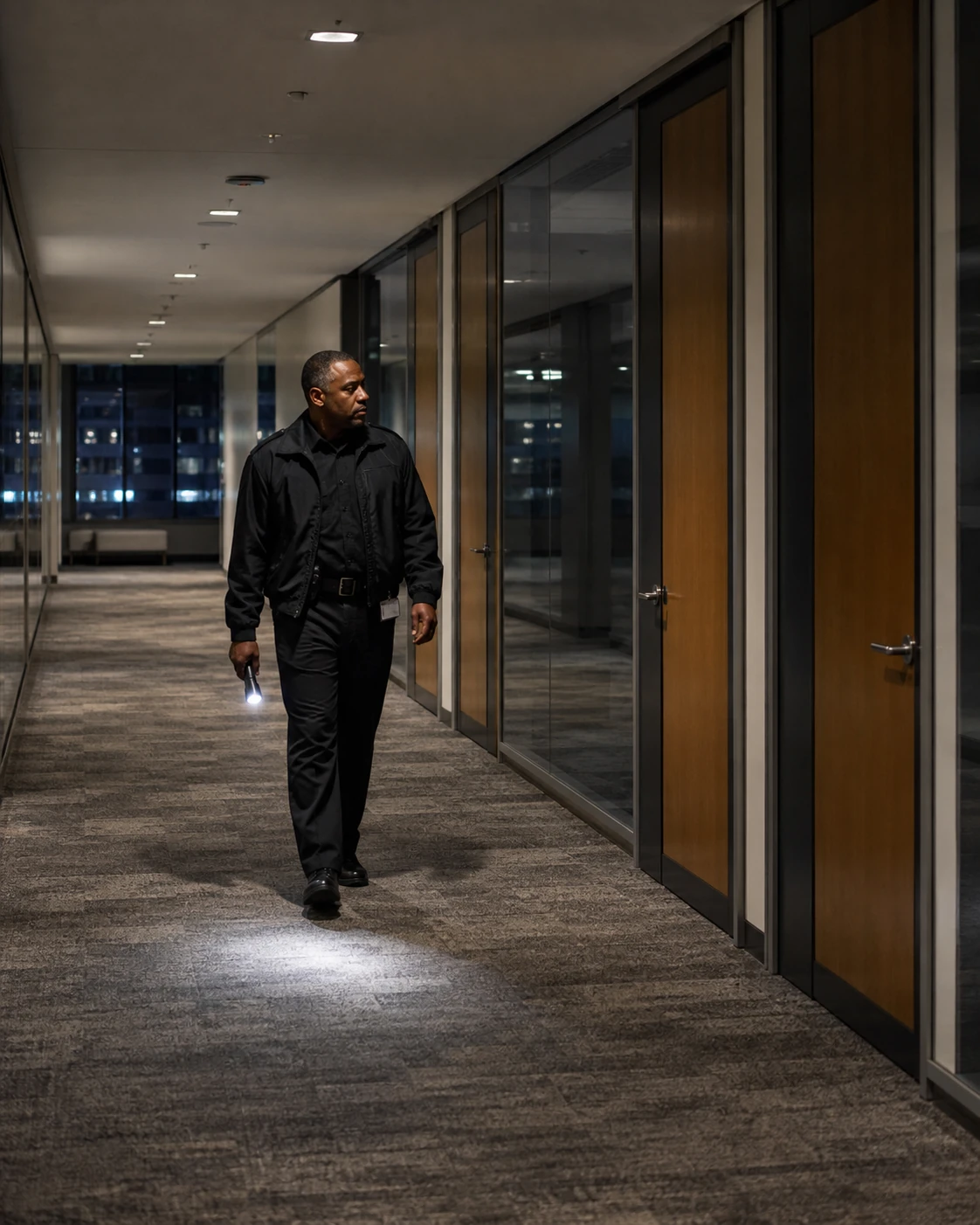
The overnight officer should be able to confirm:
- The worker's identity and employer
- The approved floor, suite, or work area
- The expected arrival and departure times
- Whether tools, equipment, or materials are being brought in or removed
- Whether an escort or building engineer is required under property policy
- Who authorized the work
Sign-in records should be legible and consistent. Unknown substitutions, unexpected work locations, or attempts to bypass access procedures should be escalated rather than casually approved.
For additional planning considerations, review Guardian's commercial office security services.
Check the building perimeter and service areas
Exterior and secondary doors
The main lobby may be controlled while a side entrance, stair discharge door, or service door remains vulnerable. Each exterior-door check should account for:
- Doors that do not latch completely
- Propped or obstructed doors
- Damaged locks, hinges, or panic hardware
- Card readers that appear unresponsive
- Unauthorized persons waiting near employee entrances
- Packages or objects placed in unusual locations
An officer should never disable a life-safety feature or make an improvised hardware repair. Door defects should be documented and reported through the building's established process.
Loading docks and freight areas
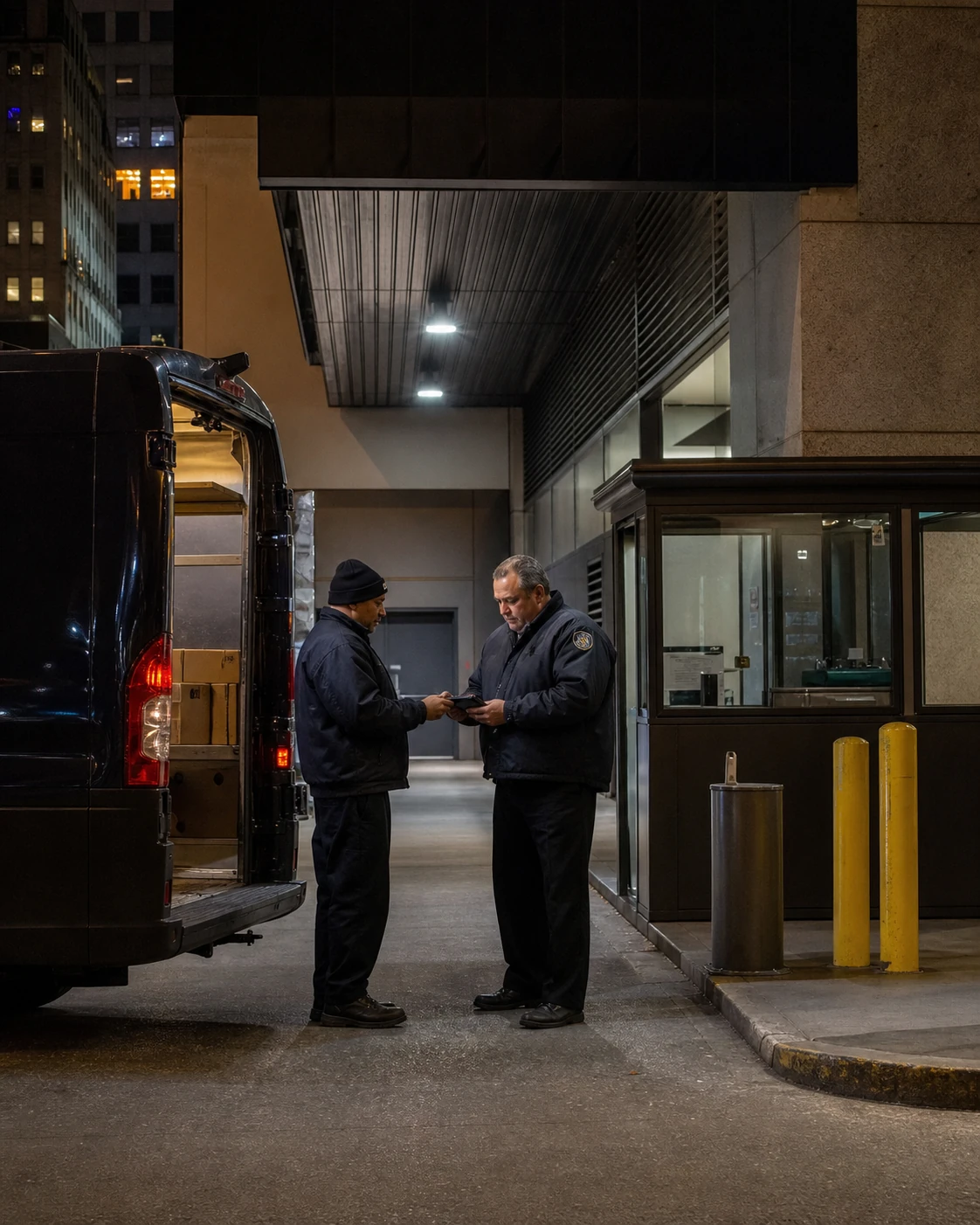
Loading docks combine vehicle access, deliveries, waste removal, contractors, and restricted building entrances. Overnight controls should include:
- Verifying scheduled vehicles and drivers
- Recording arrival and departure times
- Confirming the receiving tenant or building contact
- Monitoring freight-elevator use when required by site policy
- Challenging unscheduled removals of furniture, electronics, or equipment
- Checking that dock and service doors are secured after activity ends
- Keeping unauthorized individuals out of back-of-house areas
If an unexpected vehicle or removal cannot be verified, access should be paused while the officer contacts an authorized building representative.
Treat mechanical alarms and water leaks as time-sensitive
Security personnel are often the first people to notice an alarm or leak overnight, but they are not a substitute for engineers, alarm technicians, or emergency responders. Their role should be clearly defined: observe, protect the area, report accurate information, and follow the property's escalation plan.
Mechanical or building-system alarms
When a panel, monitoring station, or local device indicates a problem, the officer should record:
- The time the signal appeared
- The exact panel message or location, without guessing at its meaning
- Any related sounds, odors, loss of lighting, or visible damage
- Who was contacted and when
- Instructions received and actions taken
Alarm signals should not be silenced, reset, or disregarded unless the officer is trained and specifically authorized to take that action under the building's procedures.
Water leaks
A small leak can affect several floors, tenant equipment, ceilings, and elevator areas. Officers should know which building contacts can respond at night and where access restrictions apply.
When water is discovered:
- Identify the exact floor and nearest room, riser, or landmark.
- Keep people away from slip hazards or areas near electrical equipment.
- Notify building engineering and the designated management contact promptly.
- Call emergency services when conditions warrant it under the site's emergency plan.
- Document visible spread and changing conditions without entering an unsafe area.
- Continue monitoring from a safe location until relieved or instructed otherwise.
Photographs may support documentation if property policy permits them, but they should not delay reporting.
Recognize and report unusual activity
“Unusual activity” should be described through observable behavior rather than assumptions about a person's appearance. Examples may include:
- Repeated attempts to access several suites or floors
- Following an authorized person through a controlled door
- Remaining in a closed area without a clear business purpose
- Photographing access-control devices or restricted back-of-house areas
- Moving property without a matching work order or removal authorization
- Concealing identity from cameras or refusing routine sign-in procedures
- Testing exterior doors or entering through a loading area without approval
The officer's report should state what was seen, where it occurred, the time, direction of travel, and actions taken. Objective details are more useful than labels such as “suspicious person.” Officers should avoid unnecessary confrontation and follow the site's notification and emergency procedures.
Documentation the morning team can use
An overnight report should allow property management to understand what happened without tracking down the officer for basic facts. Each entry should include:
- Date and exact time
- Floor, suite, door, or equipment location
- People involved and how authorization was verified
- Observable conditions
- Notifications made and response times
- Temporary measures taken
- Whether follow-up remains open
Repeated findings—such as the same door failing to latch or recurring water near a mechanical room—should be highlighted for management review. A collection of vague entries such as “all clear” offers little operational value.
A practical supervisor review
Property teams should periodically walk the overnight route with the security supervisor. The review should ask:
- Can the officer reach every required checkpoint?
- Do vacant floors have access restrictions that affect patrols?
- Are emergency contacts current and available overnight?
- Can officers verify contractors without calling several disconnected numbers?
- Are loading-dock schedules shared with the security desk?
- Is there a clear process for unlocked tenant suites?
- Are recurring door, alarm, or leak issues being closed out?
- Does staffing match the size of the property and the number of active posts?
If staffing needs change because of a tenant move-out, renovation, system outage, or unexpected incident, emergency security coverage can help bridge a short-term gap.
Build an overnight plan around the property
The best overnight security checklist is specific enough to guide action but flexible enough to handle an unexpected condition. It connects lobby access, patrols, contractor verification, service-area control, incident reporting, and management escalation into one consistent process.
Guardian ISI provides security guard services and commercial-property coverage tailored to New York City operations. To discuss overnight coverage for a partially occupied office tower, call or text (212) 602-1695 or request coverage online.
A practical operating checklist
| Stage | What to confirm |
|---|---|
| Shift start | Occupancy, contractor roster, impairments, and contacts |
| During the shift | Authorized patrols, safe observations, and prompt escalation |
| Morning handoff | Open conditions, notifications, and responsible follow-up |
Related Guardian services
Review Commercial Office Security and Emergency Security Coverage to connect these procedures with the appropriate staffing and site responsibilities.
Frequently asked questions
How often should an officer patrol vacant office floors overnight?
Frequency should reflect the building's size, risks, active work, and management procedures. Critical areas should have defined checks, with times and findings documented.
What should an officer do after finding an unlocked tenant suite?
The officer should remain outside, verify scheduled activity, notify the designated contact, and document the condition. Entry or lock-up should follow written building authorization.
Should cleaning crews and contractors use the same sign-in process?
Both groups should be verified, but procedures may differ by contract and access level. Records should identify each worker, employer, approved work area, authorization, and arrival and departure times.
What is security's role when a mechanical alarm activates?
Security should accurately report the signal, observe related conditions, protect the area, and follow the escalation plan. Officers should not reset equipment unless trained and specifically authorized.
What details belong in an overnight incident report?
Include exact times and locations, observable facts, identities or authorizations checked, notifications made, actions taken, response times, and any unresolved follow-up.
Can temporary overnight security be added during a vacancy or system outage?
Yes, subject to staffing availability and the property's requirements. Temporary coverage may support tenant transitions, renovations, access-control outages, or other short-term needs.