
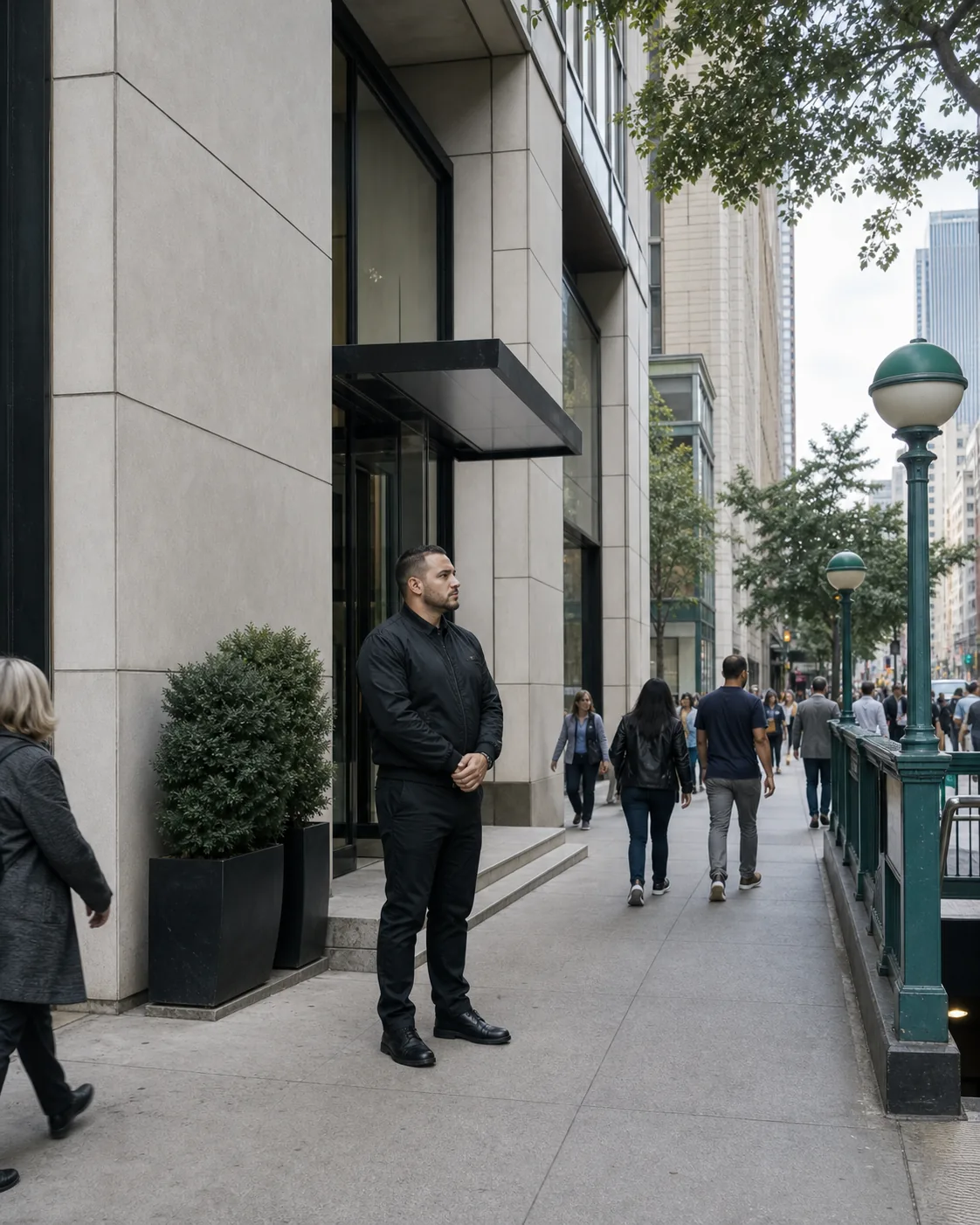
Citywide crime figures cannot describe every building’s exposure. Property leaders should evaluate verified local information, their own incident reports, and changing access conditions before adjusting security coverage.
Hotels, houses of worship, residential buildings, and businesses near subway stations can respond without creating unnecessary alarm. The most effective approach is usually measured and site-specific: examine recent incidents, improve staff communication, address access-control gaps, and define when additional coverage is warranted.
Read Crime Headlines in Context
Citywide statistics provide useful perspective, but they do not describe the risk at one building entrance. A property’s actual exposure may depend on:
- Distance from a subway entrance, bus stop, or late-night destination
- Pedestrian volume during opening, closing, service, or shift-change periods
- Lighting, visibility, scaffolding, and sidewalk congestion
- Whether unauthorized visitors can move from the lobby into private areas
- Previous incidents involving harassment, theft, trespassing, or disorder
- Events or public statements that may increase attention toward a particular organization or community
Monthly figures can also fluctuate, especially within narrowly defined offense categories. Before changing procedures based on a headline, decision-makers should confirm the comparison period, review their own incident records, and speak with staff who regularly work at the entrance or overnight.
This balanced review avoids two common mistakes: dismissing a legitimate pattern because overall crime is down, or treating every transit rider and passerby as a threat because one category rose.
Strengthen the Area Between the Subway and the Front Door
For properties near stations, risk does not begin at the lobby desk. Employees, residents, guests, and congregants may experience unwanted behavior while approaching the building, waiting for entry, or leaving after dark.
Map predictable pressure points
Walk the property during the hours that matter most. Look at the route from nearby subway exits, employee entrances, loading areas, parking facilities, and ride-share pickup points. Identify blind corners, doors that are routinely propped open, and places where lines or groups block a security officer’s view.
A daytime assessment alone may miss late-night conditions. Hotels and residential buildings should include overnight hours, while houses of worship should examine arrival and dismissal periods for services and events.
Establish a simple response ladder
Staff should know what to do when a concern develops. These steps are not waiting periods: call 911 promptly whenever an immediate threat or emergency arises. A practical response ladder might include:
- Observe and document behavior without making assumptions about intent.
- Notify the manager, front desk, or designated security contact.
- Use trained staff or security personnel to address building rules when it is safe to do so.
- Move employees, guests, or residents away from escalating activity.
- Call 911 when there is an immediate threat, violence, a weapon, or a medical emergency.
- Preserve video, access records, and witness information after the incident.
The response should be based on conduct—not appearance, religion, race, disability, housing status, or the fact that someone arrived from a subway station.
Adapt Procedures to the Property Type
Hotels
Hotels combine public-facing hospitality with round-the-clock access. Their lobbies may receive guests, delivery workers, event attendees, vendors, and people seeking directions.
Useful adjustments include:
- Positioning trained personnel where they can see both the entrance and elevator route
- Confirming after-hours visitor and key-control procedures
- Giving front-desk employees a discreet way to request assistance
- Reviewing luggage-storage, loading, and ride-share congestion points
- Offering an escort procedure for employees leaving on late shifts
- Recording objective descriptions of conduct rather than subjective labels

Visible security should support the guest experience, not make the lobby feel confrontational. A calm officer who can provide directions, recognize unusual activity, and de-escalate disputes is often more useful than an unnecessarily aggressive presence.
Houses of worship
Houses of worship may face concerns related to both general street activity and targeted hostility. Plans should protect the congregation while remaining welcoming.
Consider:
- Assigning trained greeters who can identify regular operations and summon help
- Keeping emergency contact information accessible to staff and event leaders
- Controlling access to offices, classrooms, and other nonpublic areas
- Reviewing security before major services, holidays, or publicized events
- Designating a safe interior location and clear communication method
- Preserving threatening messages, mail, voicemail, or online communications
Security screening and intervention should be behavior-based and consistently applied. If threatening language or symbols suggest possible bias motivation, document the details accurately and provide them to law enforcement rather than attempting to determine the offender’s motive internally.
Residential buildings
Residential security often depends on consistent everyday habits. Tailgating, unattended deliveries, malfunctioning doors, and unfamiliar contractors can create more routine exposure than dramatic incidents.
Property managers can:
- Reinforce visitor verification without asking residents to confront strangers
- Repair doors, locks, intercoms, cameras, and lighting promptly
- Separate package traffic from unrestricted access to residential floors
- Give doormen, concierges, and porters a shared escalation procedure
- Review coverage during school dismissal, evening commuting, and overnight hours
- Provide residents with a clear way to report recurring concerns
Logs should capture time, location, observable conduct, action taken, and outcome. This creates better information for management than vague entries such as “suspicious person.”
Retailers and other businesses
Subway-adjacent businesses may see rapid changes in foot traffic at rush hour, during service disruptions, or after nearby events. Managers should match staffing and security to those patterns.
Practical steps include:
- Adjusting opening and closing procedures so employees are not left alone outside
- Keeping high-value merchandise away from unmonitored exits
- Establishing who may issue a trespass warning or contact police
- Training employees not to physically pursue suspected shoplifters
- Checking camera views for sidewalk, vestibule, register, and exit coverage
- Using a code phrase or silent notification method to summon assistance
Policies should distinguish between conduct that violates business rules and activity that is merely unfamiliar or uncomfortable.
Address Hate-Crime Concerns Without Creating Panic
Hate-crime reports deserve careful attention, particularly for organizations associated with communities that have received threats or experienced harassment. At the same time, reported incidents, investigations, arrests, and final legal classifications are not interchangeable. Internal communications should avoid presenting unverified information as established fact.
A sound procedure focuses on actions the property can control:
- Encourage prompt reporting of threats, slurs, vandalism, or targeted harassment.
- Preserve original evidence, including video and electronic messages.
- Avoid cleaning or repairing vandalism until it has been documented and authorities advise that evidence collection is complete.
- Limit internal distribution of sensitive victim or witness information.
- Provide employees with a management contact for security concerns.
- Reassess public events, deliveries, and entrance coverage when a credible concern emerges.
An immediate threat should be reported to 911. Less urgent concerns can be documented and discussed with the appropriate local law-enforcement contact. Property managers should also consult qualified counsel when employment, privacy, lease, or discrimination issues are involved.
Use Flexible Coverage Instead of Permanent Overreaction
Not every change requires a permanent guard post. A tiered plan allows management to increase or reduce measures as conditions change.
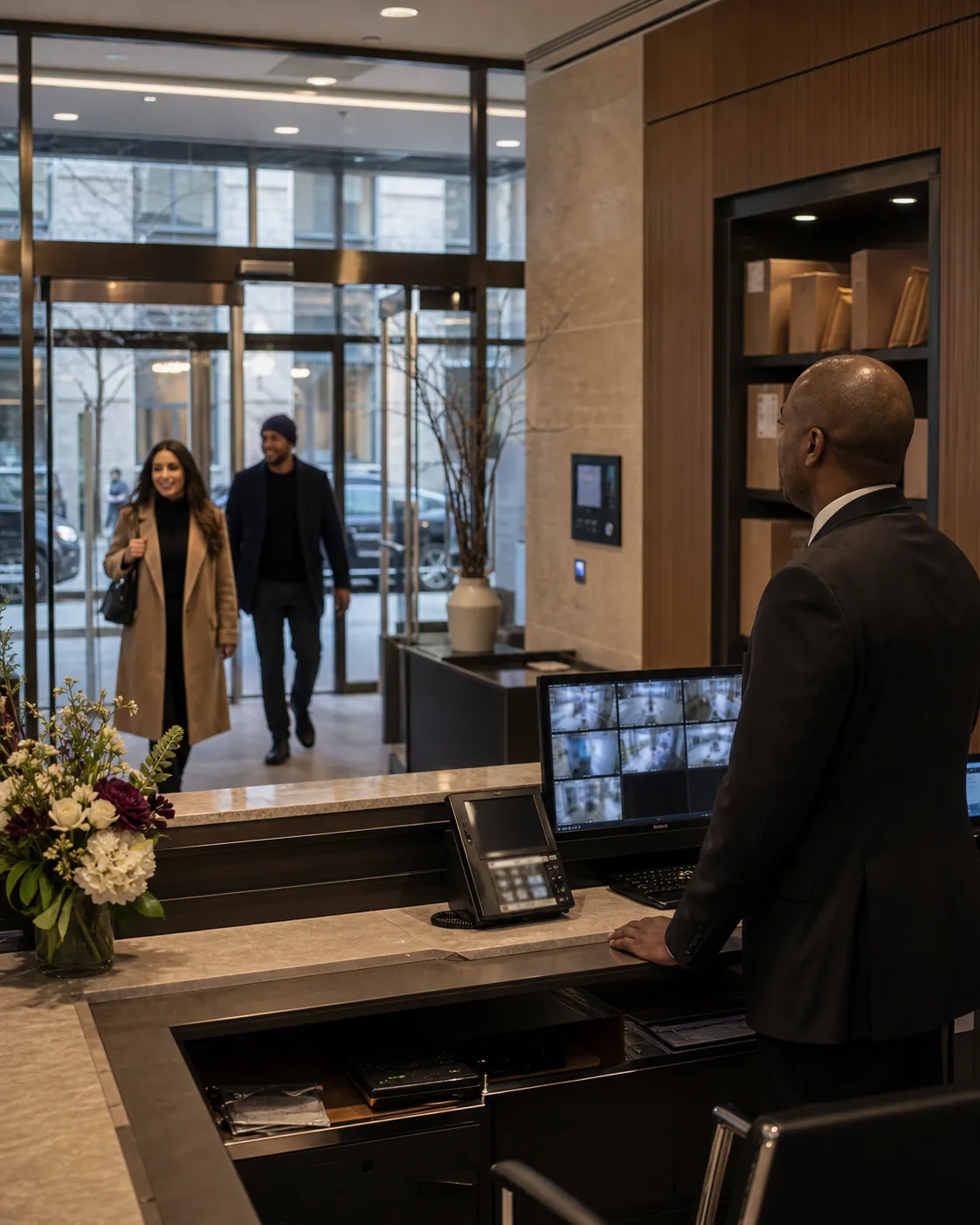
Routine level
Maintain working access controls, camera coverage, lighting, incident logs, and trained staff. Review patterns regularly rather than waiting for a serious event.
Elevated level
Add lobby or perimeter coverage during a public event, holiday, repeated incident pattern, nearby disruption, or period of heightened concern. Brief personnel on the specific reason for the adjustment and the conduct to watch for.
Immediate-response level
When there is a credible threat or active emergency, prioritize life safety, call 911, follow the building’s emergency procedures, and support responding authorities. Temporary security coverage may help protect an entrance or maintain operations, but it does not replace emergency services.
Each move between levels should have a reason, an approving manager, and a review date. This prevents temporary reactions from becoming expensive permanent measures without evidence that they remain useful.
Measure Whether the Plan Is Working
A security program should be evaluated through more than arrest or crime totals. Useful operational indicators include:
- Repeated incidents at the same door or time of day
- Unauthorized-entry attempts and successful access breaches
- Delays in notifying management or emergency services
- Camera or intercom failures discovered during an incident
- Employee confidence in escalation procedures
- Complaints about inconsistent or discriminatory treatment
- Guard activity reports and documented resolutions
Reviewing these measures monthly can reveal correctable issues even when no serious crime has occurred.
Build a Calm, Site-Specific Security Plan
Declining overall crime and rising concern in a particular category can both be true. Manhattan decision-makers do not need to choose between complacency and alarm. They can use current information, property-level records, and clearly defined procedures to protect people while maintaining a professional, welcoming environment.
Guardian ISI can help evaluate posts, schedules, access points, and temporary or ongoing security needs for hotels, residential properties, houses of worship, and commercial locations. Call or text (212) 602-1695 or request coverage online.
Quick planning checklist
| Review point | What to confirm |
|---|---|
| Information | Verify reports and distinguish observations from assumptions |
| Response | Protect people and escalate immediate threats promptly |
| Review | Record actions and reassess temporary measures |
Related Guardian services
Review Hotel Security and Residential Security to connect these procedures with the appropriate staffing and site responsibilities.
Frequently asked questions
Does a rise in transit crime mean every property near a subway station needs a guard?
No. Consider the building’s hours, access controls, incident history, pedestrian patterns, and staff capabilities. Some properties may need procedural changes or limited high-risk-hour coverage rather than a permanent post.
How often should a subway-adjacent property review its security plan?
Review it at least whenever operations, access points, hours, tenants, or local conditions change. Incident records and equipment failures should also be assessed regularly so recurring problems are addressed promptly.
What should staff document after a threatening or biased incident?
Record the time, location, exact words or actions, physical description, direction of travel, witnesses, and response taken. Preserve relevant video or messages and avoid adding assumptions about motive.
Can security personnel remove anyone who appears suspicious?
Security decisions should be based on observable conduct, access authorization, and clearly communicated property rules—not appearance or protected characteristics. Personnel should follow site policy and request police assistance when circumstances exceed their authority or safety training.
When is temporary security coverage appropriate?
Temporary coverage may be useful after repeated incidents, during major events or holidays, when access-control equipment fails, or while management evaluates a credible concern. The assignment should have a defined purpose, schedule, and review date.