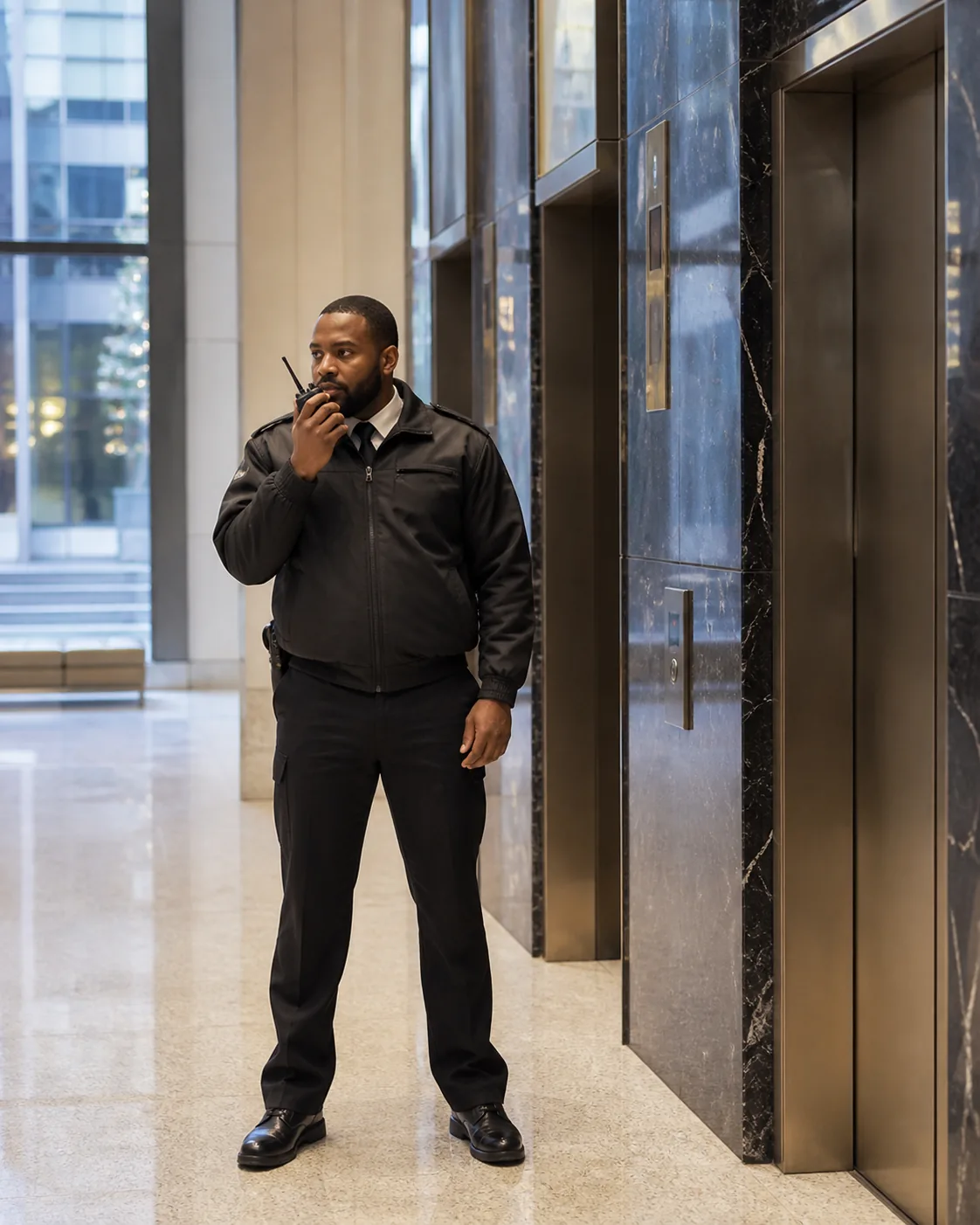
An elevator entrapment can quickly become frightening for occupants and disruptive for a Manhattan property. Security guards are often among the first people alerted, so their response can directly affect occupant safety, communication, and crowd control.
The guard’s role is to initiate the property’s emergency procedures, communicate calmly, notify the appropriate parties, and secure the area. Security personnel should never attempt a technical rescue, force open elevator doors, enter a shaft, climb onto a car, or manipulate elevator equipment. Rescue and repair work belongs to trained emergency responders and qualified elevator personnel.
Start With Calm, Clear Communication
Acknowledge the elevator alarm, intercom call, telephone call, or report immediately. If two-way communication is available, identify yourself and let the occupants know that assistance is being arranged.
Ask for essential information:
- The elevator car number or location, if known
- The floor shown on the car’s display
- The number of people inside
- Whether anyone is injured, having difficulty breathing, experiencing chest pain, or facing another medical problem
- Whether there is smoke, fire, unusual heat, water, or a burning odor
- Whether any occupant has a condition that may require urgent assistance
Keep questions brief and speak in a steady tone. Tell occupants to remain inside the car, stay clear of the doors, and avoid trying to climb out—even if the doors are partially open or the car appears close to a floor.
Do not promise a specific release time. Instead, explain what is happening in simple terms, such as: “Building management and emergency assistance have been notified. Please remain in the car and stay away from the doors. I will keep you updated.”
Maintain Contact Whenever Possible
Continue checking in through the elevator intercom, emergency phone, or another approved communication system. Regular updates can reduce anxiety even when there is no major change to report.
If communication is lost, tell building management and responding emergency personnel. Do not place yourself in danger trying to reestablish contact through a shaft or restricted elevator area.
Notify Building Management and Emergency Resources
Follow the building’s written post orders and elevator-entrapment procedure. Notifications will commonly include:
- Building management or the engineer on duty
- The elevator service company identified by the property
- The security supervisor or command center
- 911 when emergency response is required by the building’s plan or the circumstances
Call 911 immediately when there is a reported injury or medical emergency, smoke or fire, an occupant in severe distress, water affecting the elevator, or another condition that may present an immediate danger. Provide the building address, elevator or bank location, reported conditions, number of occupants, and the best entrance for responders.
Management’s notification should not delay an urgent 911 call. Guards should know in advance where emergency contact information, elevator identification details, keys controlled by authorized personnel, and response instructions are maintained.
Do Not Attempt a Technical Rescue
A security guard should not try to release occupants unless the guard is separately trained, authorized, and acting within an approved procedure under the direction of the responsible emergency authority. Routine security duties do not qualify someone to perform elevator rescue work.
Guards should not:
- Force or pry open elevator doors
- Reach into or enter the elevator shaft
- Climb onto the roof of an elevator car
- Encourage occupants to crawl or jump from the car
- Reset breakers, disconnects, controls, or elevator equipment
- Use keys or tools to move the car or defeat safety features
- Stand between an elevator car and landing
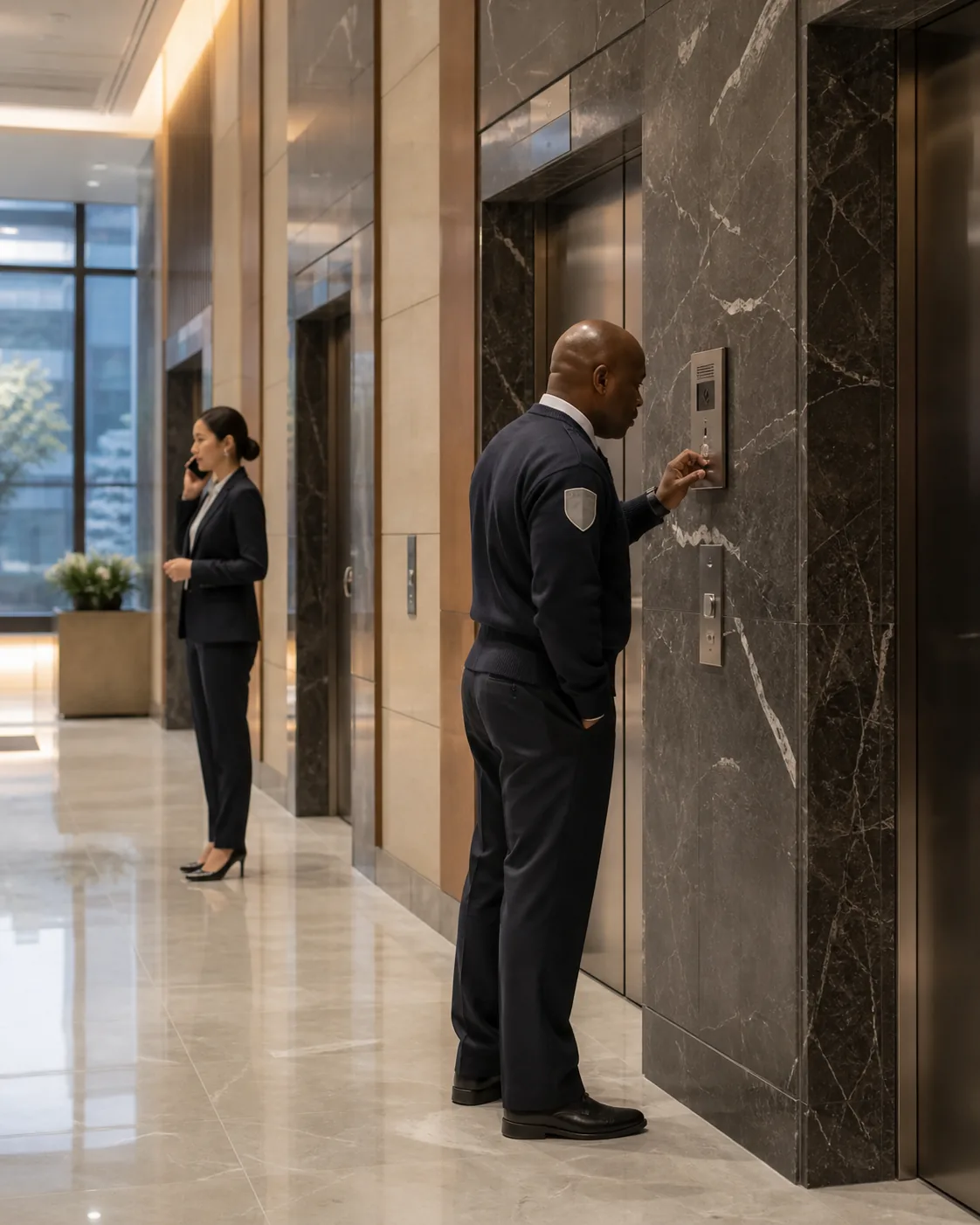
A car that appears level with a landing can move unexpectedly or may not be aligned as it seems. Wait for the Fire Department, qualified elevator personnel, or other properly authorized responders to manage access and release.
Secure the Elevator Bank and Affected Floors
Once notifications are underway, protect the area around the affected elevator. The exact perimeter will depend on the building layout and instructions from management or emergency responders.
Security personnel may need to:
- Keep people from calling or entering the affected elevator
- Place barriers or position a guard at the elevator bank
- Redirect tenants, residents, guests, contractors, and deliveries to safe alternatives
- Secure relevant landings on multiple floors when directed
- Preserve access for FDNY, EMS, elevator technicians, and building engineers
- Keep stairways, corridors, and lobby routes clear
Never block required exits while creating a perimeter. If other elevators remain in operation, confirm their status with building management before directing people to use them. During a broader fire, power, water, or mechanical incident, elevator use may be restricted under the building’s emergency plan.
Keep Bystanders Away
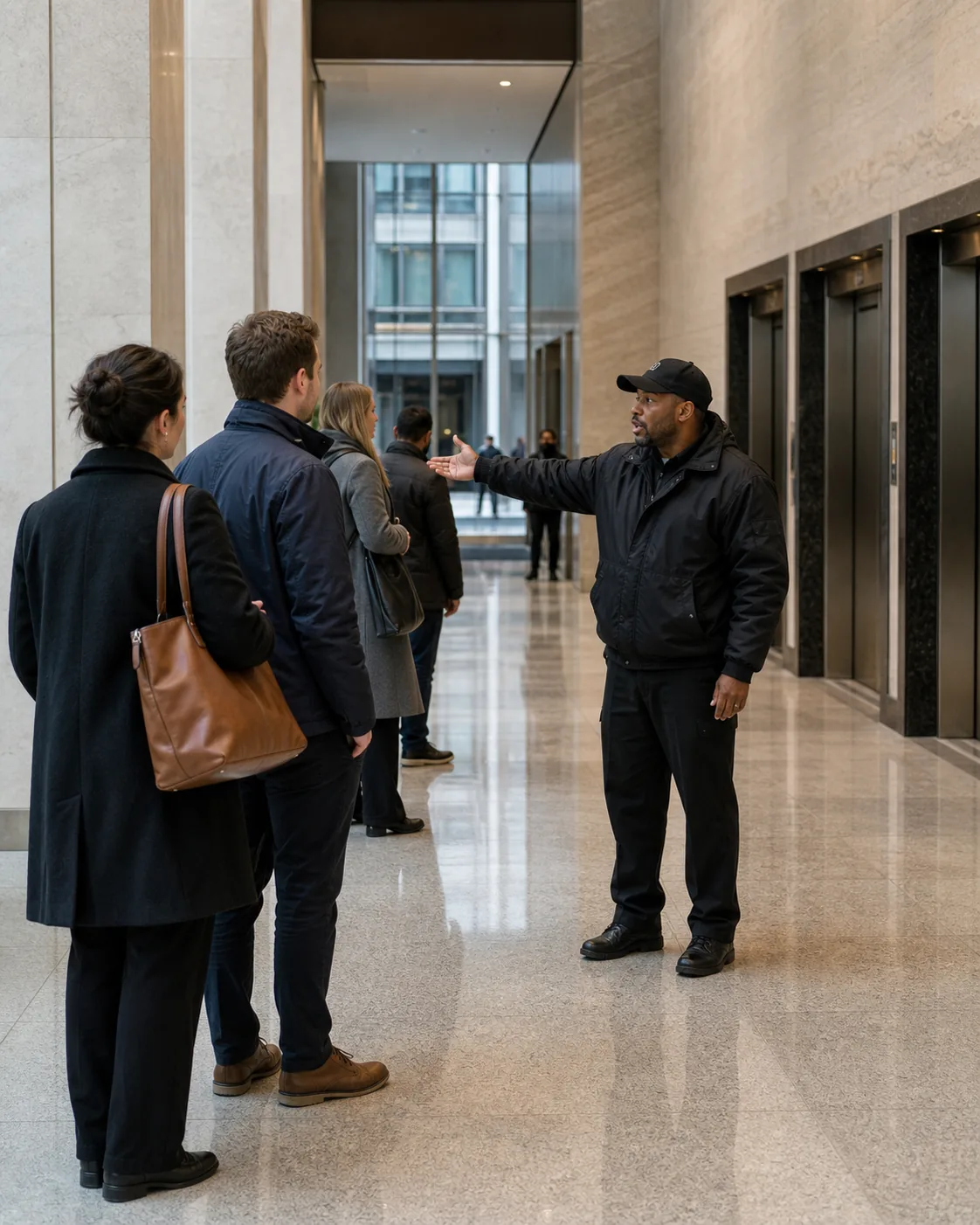
Crowds can interfere with responders, increase occupant anxiety, and expose bystanders to moving equipment or opening doors. Politely but firmly move onlookers away from the affected elevator and prevent unauthorized photography or attempts to communicate through the doors when doing so would disrupt operations.
Provide concise directions without sharing private medical information. A useful statement is: “This elevator is temporarily out of service. Please use the designated alternate route and keep this area clear for emergency personnel.”
Support Responding Personnel
A guard can make the response more efficient by meeting responders at the designated entrance and guiding them to the correct elevator bank or control location. Have available, when permitted by building procedure:
- The elevator car or bank identification
- The last known car location
- The number and reported condition of occupants
- The time the incident was first reported
- Details of smoke, water, power loss, noise, or other hazards
- Contact information for building engineering and the elevator contractor
- Access credentials or keys reserved for authorized responders
Relay facts rather than assumptions. For example, say that an occupant “reported smelling smoke” rather than declaring that an elevator motor is on fire.
Once responders take control, guards should maintain the perimeter, assist with access, and follow lawful directions. They should not crowd the working area or interfere with rescue decisions.
Document the Incident Carefully
Complete the property’s incident report and required log entries as soon as practical. Documentation should be objective, chronological, and limited to observed or reported facts.
Record:
- Date, location, elevator identification, and relevant floor numbers
- Time the alarm or report was received
- How the incident was reported
- Names or descriptions of involved occupants when available and appropriate
- Reported injuries, medical concerns, smoke, odors, water, or other hazards
- Times building management, the elevator company, supervisors, 911, or other parties were notified
- Arrival and departure times of responders and technicians
- Actions taken to secure floors and redirect building traffic
- Time occupants were released and by whom
- Whether the elevator remained out of service or was returned to service by authorized personnel
- Relevant witness information and preserved video references, according to property policy
Avoid speculation about the cause, assigning blame, or offering medical conclusions. If facts are learned from someone else, attribute them—for example, “Occupant stated…” or “Elevator technician advised…”
Preserve radio traffic, access records, surveillance video, photographs, and other materials according to management instructions and the property’s retention procedures. Do not distribute incident images or occupant information through personal messaging or social-media accounts.
Prepare Before an Entrapment Happens
A strong response depends on preparation. Property managers should ensure guards receive site-specific post orders covering elevator banks, car numbering, emergency contacts, communication systems, responder entrances, restricted keys, alternate routes, and documentation requirements.
Teams should periodically confirm that posted contact lists are current and that guards understand the limits of their role. Drills or tabletop reviews can help reveal simple problems, such as inconsistent elevator labels or uncertainty about who meets emergency responders.
For properties with complex fire and life-safety operations, security procedures should also be coordinated with building management, engineering staff, and the site’s designated fire and life safety personnel.
Strengthen Your Property’s Front-Line Response
Guardian ISI provides security guard services for commercial properties in New York City, including planned assignments and emergency coverage. We can help Manhattan decision-makers establish clear post orders, escalation paths, access-control duties, and incident-reporting expectations for their security teams.
Call or text (212) 602-1695 or request security coverage online.
Quick planning checklist
| Review point | What to confirm |
|---|---|
| Notify | Call for appropriate help; emergencies take priority |
| Protect | Maintain contact and keep access clear for responders |
| Record | Document notifications, responder arrival, and authorized release |
Related Guardian services
Review Security Guard Services and Fire & Life Safety Directors to connect these procedures with the appropriate staffing and site responsibilities.
Official references
Frequently asked questions
Should a security guard open elevator doors during an entrapment?
No. Guards should not force, pry, or use elevator keys to open doors as part of a technical rescue. They should keep occupants calm, secure the area, make required notifications, and wait for properly trained and authorized responders.
When should a guard call 911 for an elevator entrapment?
Guards should follow the building’s emergency procedure and call 911 immediately for a reported injury, medical emergency, smoke, fire, severe distress, water affecting the elevator, or another potentially dangerous condition. An urgent call should not be delayed while waiting for management approval.
What should trapped occupants be told?
Tell them that assistance is being arranged, to remain inside the car, and to stay clear of the doors. Ask about injuries and hazards, provide regular updates, and avoid promising a specific release time.
How should guards control the elevator area?
Keep bystanders away, prevent use of the affected elevator, preserve clear access for responders, and redirect building traffic to an approved alternate route without blocking exits.
What belongs in an elevator-entrapment incident report?
Record the elevator and location, relevant times, occupant information when appropriate, reported conditions, notifications, responder actions, crowd-control measures, release details, and the elevator’s final known status. Use factual language and avoid guessing about the cause.
Can a guard reset the elevator to release occupants?
A guard should not reset breakers, disconnects, controls, or elevator equipment. Manipulating the system may create additional risk and should be left to qualified, authorized personnel.