
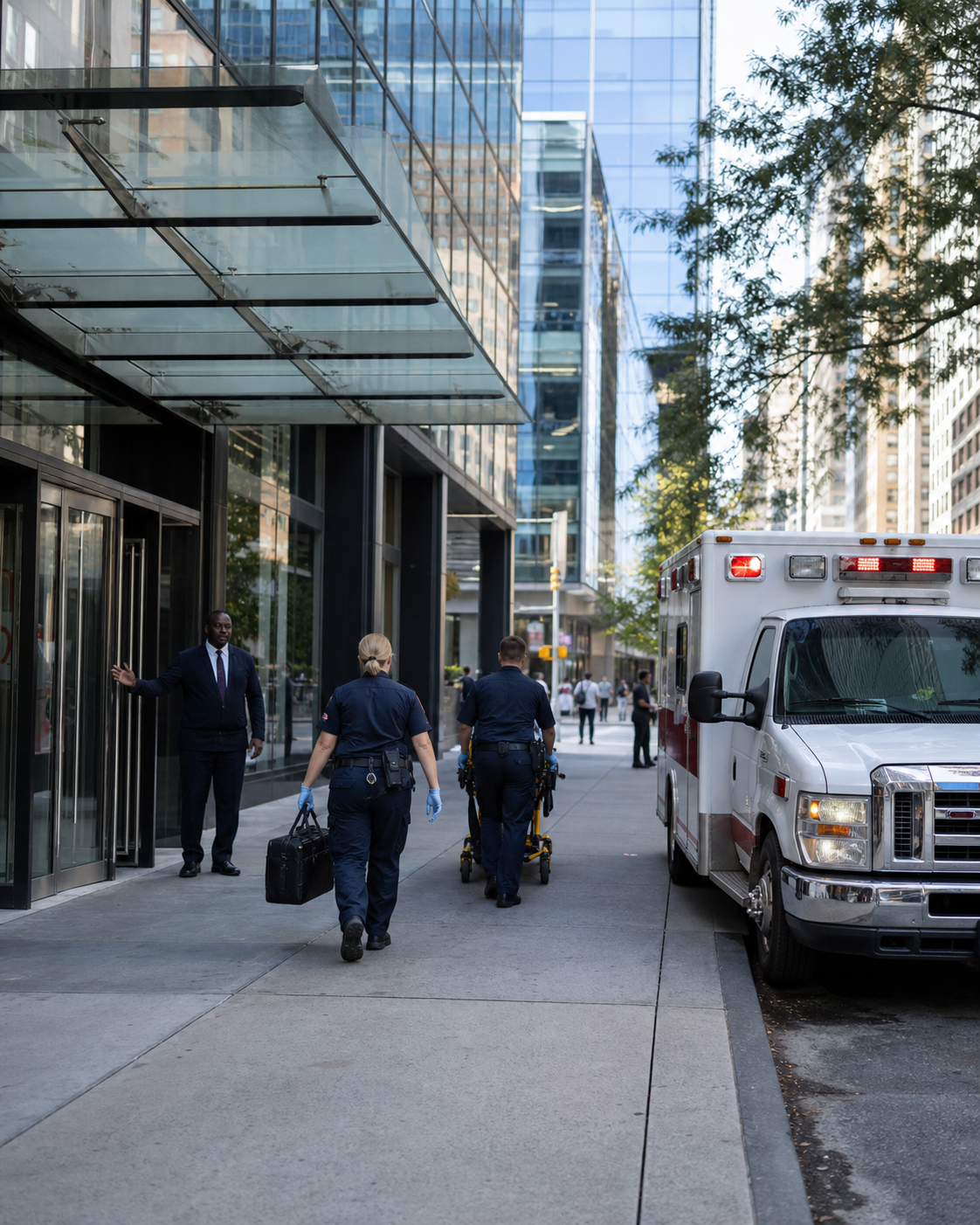
An ambulance response in a Manhattan building can move quickly. Security personnel may need to direct emergency medical personnel, control an elevator, notify property staff, manage the lobby, and maintain normal building operations—all at the same time.
Accurate documentation helps management understand what occurred and evaluate the building’s response. The report should provide a clear operational timeline without becoming a medical narrative. Guards should record what they observed and did, while avoiding diagnoses, symptoms, medications, photographs, or other private details that are not needed for building operations.
Emergency assistance comes first: call 911 when needed and follow the dispatcher’s instructions. Recordkeeping must not delay assistance.
The following guidance should be adapted to the property’s post orders, incident-reporting procedures, and management instructions.
Focus the Report on the Building’s Response
A useful ambulance-response report answers five operational questions:
- When did each important event occur?
- Where was assistance requested?
- How did emergency personnel reach and leave that location?
- Who was notified, and when?
- Did the incident affect the property or normal operations?
The goal is not to describe the patient’s condition or assess the care provided. Security guards should remain within their assigned role and document objective building-related facts.
Record a Clear Timeline
Times should be recorded as events happen whenever conditions permit. Use one consistent time source, such as the security desk clock or building system clock, and avoid reconstructing exact times from memory unless the report identifies them as approximate.
Useful Times to Record
Depending on the incident and the property’s procedures, the timeline may include:
- Time the security desk received the request for assistance
- Time 911 was called, if security placed or confirmed the call
- Time the guard was dispatched to the requested location
- Time the ambulance or EMS personnel arrived at the property
- Time emergency personnel entered the building
- Time elevator access was provided
- Time emergency personnel reached the requested floor or area
- Time they returned to the lobby or exit
- Time the ambulance departed the property
- Time an elevator, entrance, loading area, or other building function returned to normal
“EMS arrived” can be ambiguous in a large property. A report should clarify whether the time refers to the ambulance reaching the curb, personnel entering the lobby, or the team arriving at the requested floor.
When available and permitted by property policy, a vehicle or unit identifier can help distinguish between multiple responding units. Guards generally do not need to collect the names of individual medical personnel solely for the security report.
Identify the Requested Location—But Only as Precisely as Necessary
Record the location to which emergency personnel were directed. In a commercial property, that might be a tenant suite, office floor, lobby, loading dock, mechanical area, or common corridor. In a residential or hotel property, it may be an apartment, guest floor, amenity space, or public area.
The report can state, for example:
EMS personnel were directed to Suite 1804 using the designated service elevator.
That is more useful operationally than naming the person receiving assistance or describing why the ambulance was requested. If an apartment, room, or suite number is necessary to explain access and response actions, it should remain in the controlled incident record rather than an informal message or publicly visible log.
Properties should define which details belong in a daily activity log and which belong in a restricted incident report. A brief log entry may reference an “ambulance response” and report number, while the incident report contains the fuller operational timeline.
Document Elevator Control and Vertical Access
Elevator coordination is often one of the most important responsibilities during a high-rise ambulance response. Delays can occur when the requested floor is distant, a service car is unavailable, or passenger traffic is heavy.
The guard’s report should document:
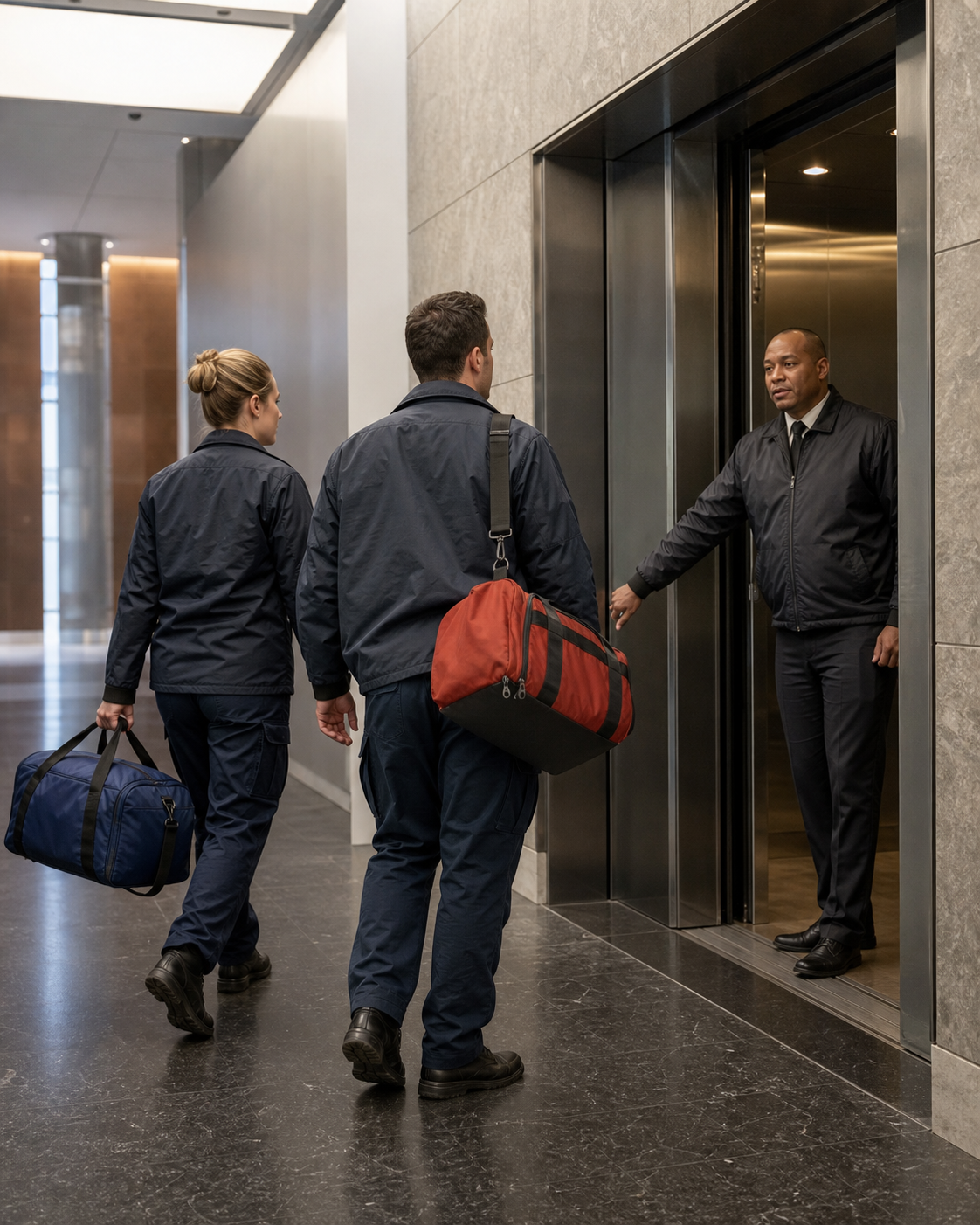
- Which elevator bank or car was used
- Whether a service or passenger elevator was assigned
- When the elevator was placed under control, if applicable
- Who authorized or performed any special elevator operation
- The time emergency personnel entered and exited the elevator
- Any delay, outage, crowding, or access problem
- When the elevator was returned to normal service
Only trained and authorized personnel should operate keys, controls, or special elevator functions. Security staff should follow post orders and directions from building management or emergency responders rather than attempting an unfamiliar override.
If an elevator was held, the report should also note any meaningful effect on the property, such as a temporary queue in the lobby or redirection of tenants to another bank. Avoid exaggeration: “Passenger traffic was redirected to the north bank for approximately eight minutes” is more informative than “The lobby became chaotic.”
Create a Verifiable Notification Record
A notification record shows how information moved through the property. For each notification, document:
- Time
- Person or role contacted
- Method used, such as radio, telephone, text, or in person
- Brief purpose or instruction received
Relevant contacts may include the security supervisor, property manager, building engineer, residential manager, hotel manager, tenant representative, or another post assigned to open an entrance or elevator.
For example:
2:11 p.m. — Security supervisor notified by radio that EMS had entered through the main lobby.
2:13 p.m. — Building engineer notified by telephone to assist with service-elevator access.
Record whether contact was made. If a call went unanswered, write that accurately and note any follow-up attempt. Do not write that a person “was notified” if only a voicemail was left.
For properties that need additional trained personnel on short notice, Guardian also provides emergency security coverage.
Describe Property Conditions Objectively
An ambulance response may affect entrances, elevators, corridors, traffic flow, or access control. Security documentation should identify observable property conditions before, during, and after the response.
Potentially relevant conditions include:
- A blocked or congested entrance
- An elevator outage or delayed car
- An access card or key problem
- A locked door that required authorized assistance
- Furniture or deliveries obstructing a route
- Damage to a door, wall, elevator, or other property
- A spill or potential biohazard requiring the area to be secured and cleaned under property procedures
- Crowd-control measures or temporary rerouting
- A loading-zone or curb-access issue
- Restoration of normal operations
Use neutral, specific language. Instead of writing “the hallway was unsafe,” state what was observed: “Two delivery carts partially obstructed the east corridor and were moved to provide a clear route.”
If property damage is found, document its location and visible condition. Do not automatically attribute damage to the patient, EMS personnel, or another party unless the guard directly observed the action and can describe it factually.
Leave Unnecessary Medical Information Out
Security personnel may overhear medical information or see a person in distress. That does not mean every detail belongs in the report.
Unless a property’s authorized reporting procedure specifically requires a detail for a legitimate operational reason, avoid recording:
- A suspected or confirmed diagnosis
- Detailed symptoms or medical history
- Medications
- Treatment provided by medical personnel
- Speculation about drug or alcohol use
- Photographs or video captured on a personal device
- Names of family members or bystanders who had no operational role
- Graphic descriptions of the person’s condition
- Opinions about whether the ambulance was necessary
A concise statement such as “EMS personnel transported one individual from the requested location” is usually more appropriate than a detailed description of the individual’s condition.
This privacy-conscious approach should not prevent a guard from documenting an immediate safety issue. Threats, violence, hazardous materials, damaged property, or blocked emergency access may require factual reporting because they affect people or the building. The distinction is between recording an operationally relevant hazard and collecting unnecessary medical details.
Separate Direct Observations From Information Reported by Others
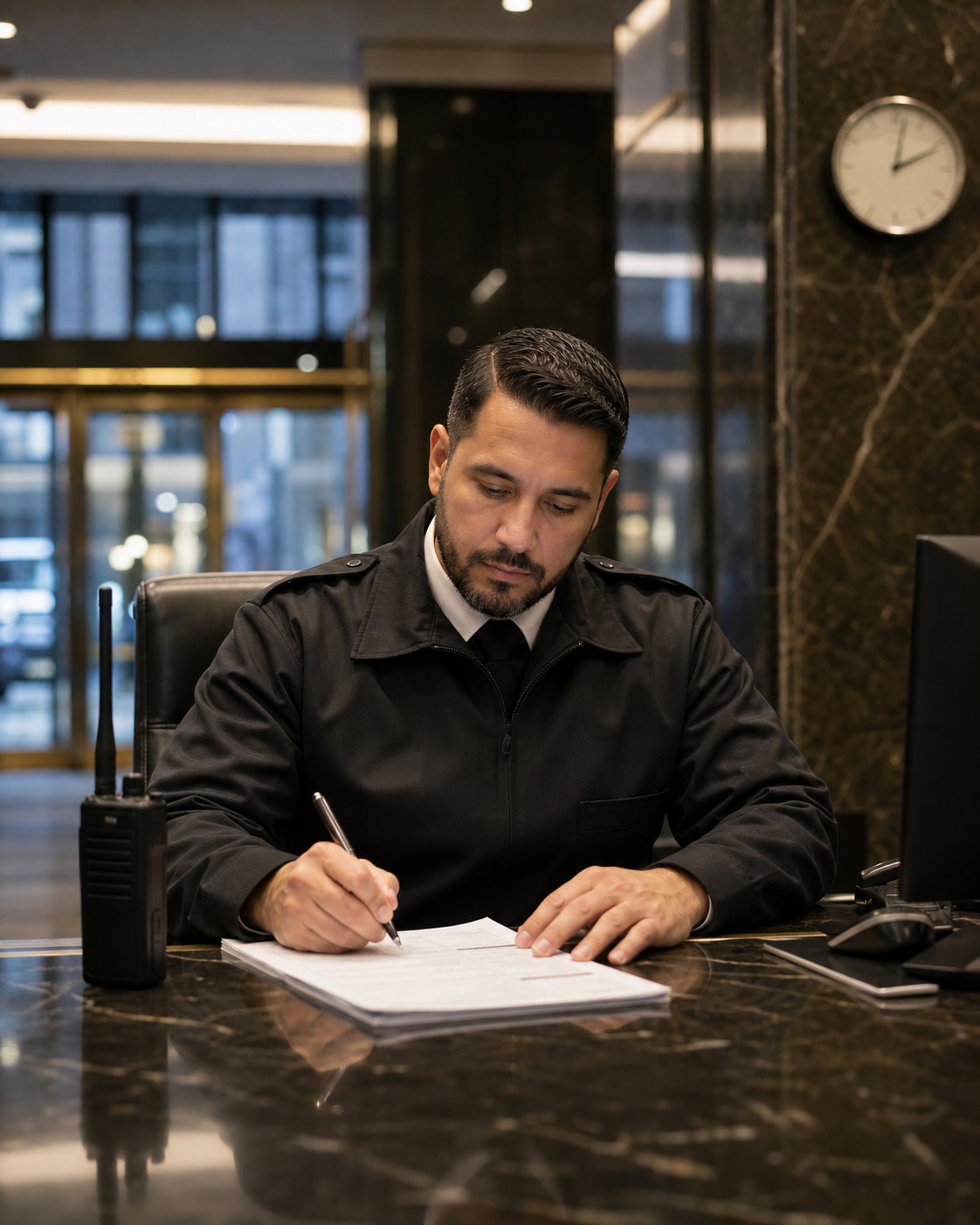
A strong incident report makes the source of information clear.
- Direct observation: “At 3:22 p.m., I observed EMS personnel enter the west service elevator.”
- Information from another person: “At 3:18 p.m., the lobby concierge advised by radio that EMS had arrived at the east entrance.”
- Approximate or uncertain information: “At approximately 3:25 p.m., based on the security desk clock…”
Avoid assumptions about intent, fault, medical status, or the sequence of events. If the guard did not see something happen, the report should not present it as a firsthand fact.
Use a Simple Ambulance-Response Report Structure
A consistent template can improve report quality across shifts and posts.
1. Basic Incident Information
- Date and report number
- Property and post
- Reporting guard
- Type of incident: ambulance or EMS response
- Requested building location
2. Chronological Actions
List dispatch, arrival, access, elevator control, notifications, movement through the property, departure, and restoration times in order.
3. Property Impact
Describe access issues, elevator delays, congestion, damage, obstructions, cleanup needs, or other operational effects.
4. Follow-Up
Record unresolved maintenance issues, reports sent to management, restricted areas, footage-preservation requests made through authorized channels, or other assigned follow-up. Guards should not copy or distribute surveillance footage unless authorized under property procedures.
5. Review
Before submitting the report, confirm that it is factual, readable, complete, and free of unnecessary medical details. Corrections should follow the property’s reporting system rather than concealing or overwriting the original entry.
Prepare Before the Next Response
Good reporting begins with clear post orders and practical preparation. Management should make sure assigned officers know:
- Which entrance emergency personnel should use
- How responders will be met and directed
- Which elevators may be used
- Who is authorized to control elevator functions
- The notification order for day, night, and weekend shifts
- Where access keys or credentials are maintained
- Which details belong in the activity log versus an incident report
- Who receives completed reports
- How reports and related records are secured
Staffing and procedures should match the property. Guardian provides security guard services as well as programs tailored to commercial office security, hotel security, and residential security in New York City.
Strengthen Your Property’s Emergency Response Documentation
A well-trained security team can support emergency access while protecting building operations and individual dignity. Reports should establish a reliable timeline, explain access and elevator actions, document notifications, and identify property impacts—without turning the security log into a medical record.
To discuss security staffing, post orders, or emergency coverage for a New York City property, call or text Guardian ISI at (212) 602-1695 or request coverage online.
Frequently asked questions
Should a security guard record the patient’s name during an ambulance response?
Usually, the operational report can identify the requested location and actions taken without naming the person. Guards should follow the property’s authorized reporting policy and avoid collecting personal details that are not necessary.
What arrival time should be entered in the report?
Specify the event being timed, such as when the ambulance reached the property, when EMS entered the lobby, or when personnel reached the requested floor. Recording separate times prevents ambiguity.
Should elevator delays be documented?
Yes. Note the elevator used, the duration and cause of any observed delay, how access was managed, and when the elevator returned to normal service. Avoid guessing about causes that were not confirmed.
Can a guard describe the person’s medical condition?
The report generally should not include diagnoses, detailed symptoms, medications, treatment, or speculation. Document only information needed to explain an immediate safety issue or the building’s operational response.
What if the guard receives information from another employee?
Identify the source and method of communication. For example, state that the concierge reported EMS arrival by radio rather than presenting the arrival as the guard’s direct observation.
Should security take photographs during the response?
Guards should not use personal devices to photograph a person receiving medical assistance. Any property documentation or surveillance review should follow management authorization and the building’s established procedures.