

The NYPD’s Midtown North CompStat report is an important source of local crime data for Manhattan property owners, managers, retailers, hotels, and office operators. It provides a regularly updated snapshot of reported major offenses in the Midtown North Precinct, officially designated as the 18th Precinct.
Because the NYPD updates CompStat information frequently—and may revise preliminary figures—the most responsible way to use the “latest” report is to review the current dated PDF on the NYPD Midtown North Precinct page. Readers should confirm the report’s week-ending date before comparing it with an earlier period.
CompStat does not predict whether a particular building will experience an incident. It does, however, help Manhattan decision-makers identify reported-crime patterns, ask better security questions, and determine whether existing procedures still fit current conditions.
What Is a CompStat Report?
CompStat is the NYPD’s data-driven system for tracking reported crime and supporting operational accountability. People sometimes call it a “Cop Stat” report, but CompStat is the official term.
A precinct-level CompStat report typically compares reported offenses across several time frames, including:
- The most recent reporting week
- The previous comparable week
- A rolling 28-day period
- Year-to-date totals
- The same periods in the previous year
- Longer-term historical comparisons
The report generally includes the seven major index crimes: murder, rape, robbery, felony assault, burglary, grand larceny, and grand larceny auto. Depending on the NYPD’s current reporting format, it may also show selected additional offenses and enforcement information.
CompStat figures represent incidents reported to and classified by the NYPD. They are not a complete measure of every safety concern, quality-of-life condition, medical emergency, fire risk, or unreported event in a neighborhood.
Understanding the Latest Midtown North Report
Midtown North is a complex operating environment. The precinct includes dense commercial corridors and major destinations around Times Square, Rockefeller Center, Radio City Music Hall, Fifth Avenue, and portions of the Theater District. Daily conditions can be affected by commuters, tourists, shoppers, hotel guests, deliveries, demonstrations, special events, and overnight activity.
When reviewing the latest report, focus on the following points rather than a single headline percentage.
Confirm the Report Date
CompStat is updated on a recurring schedule. A downloaded or forwarded PDF may no longer be current. Check the “week to date,” “28 days,” and “year to date” date ranges printed on the report itself.
Look at Counts as Well as Percentages
A large percentage change can result from a small number of additional incidents, especially within a short weekly period. Conversely, a modest percentage increase in a high-volume category may represent many incidents.
Review both the raw incident count and the percentage change before drawing conclusions.
Compare More Than One Time Frame
One week can be influenced by weather, holidays, large events, reporting delays, or a small cluster of incidents. The 28-day and year-to-date comparisons usually provide better context for operational planning.
If the weekly, 28-day, and year-to-date figures move in different directions, the situation may require further monitoring rather than an immediate conclusion that crime is broadly rising or falling.
Pay Attention to Offense Type
Different reported offenses call for different property-level responses. For example:

- Grand larceny: Review bag-storage practices, employee awareness, package handling, access to restricted areas, and surveillance coverage.
- Robbery: Assess opening and closing procedures, cash controls, employee reporting protocols, and exterior awareness.
- Felony assault: Revisit de-escalation procedures, lobby staffing, incident escalation, and coordination with law enforcement.
- Burglary: Inspect doors, locks, alarms, roof or cellar access, loading areas, and after-hours authorization procedures.
- Grand larceny auto: Evaluate garage controls, key management, vehicle-release procedures, and curbside monitoring.
CompStat can point to questions that deserve attention, but a building-specific assessment is still necessary.
Why the Midtown North CompStat Report Matters
It Provides Local Context
Citywide crime figures may not describe conditions around a particular Midtown property. Precinct-level reporting offers a more relevant starting point for understanding reported incidents in the surrounding command.
Even so, Midtown North covers many blocks and property types. Precinct data should not be treated as proof that the same pattern exists at every address.
It Supports Better Security Staffing Decisions
Office occupancy, retail traffic, hotel arrivals, construction activity, and special events can change a property’s exposure throughout the day. CompStat data can be considered alongside internal incident logs, visitor volume, tenant concerns, and building operations when reviewing guard schedules.
A data-informed review may identify a need for different post hours, stronger loading-dock control, more visible lobby coverage, or temporary staffing during a major event. It does not necessarily mean that every property needs more guards.
It Helps Teams Update Site Procedures
Security plans can become outdated when they are not tested against current operating conditions. Reviewing the latest precinct data gives management teams a reason to revisit:
- Lobby access and visitor verification
- Employee and vendor credentials
- Deliveries and package handling
- Loading-dock and service-entrance controls
- Opening and closing procedures
- Key and access-card management
- Incident documentation and escalation
- Emergency contacts and law-enforcement coordination
For buildings with complex tenant populations, professional commercial office security can help turn general risk information into practical post orders and daily procedures.
It Encourages Measured, Documented Decisions
CompStat is most useful when it informs a repeatable review process. Property teams can document the report date, note relevant changes, compare them with internal incidents, and record any operational adjustments.
This approach is more reliable than reacting to a single news story or social media post.
What CompStat Cannot Tell You
A CompStat report has important limitations. It does not show every detail needed to evaluate an individual property, including:
- Whether an incident occurred inside a building, on the sidewalk, or elsewhere in the precinct
- A property’s access-control weaknesses
- Unreported theft, harassment, or suspicious behavior
- Fire and life-safety readiness
- Employee compliance with security procedures
- Camera blind spots or equipment condition
- The quality of incident documentation
- Risks created by temporary construction or vacant space
CompStat also should not be used to profile individuals or justify discriminatory treatment. Security decisions should be based on behavior, authorized access, documented procedures, and site-specific risks.
Turning Precinct Data Into a Property Security Plan
1. Review Internal Incident Records
Compare the latest CompStat periods with your building’s reports. Look for repeated locations, times, access points, and incident types. Consistent internal documentation is often more actionable than precinct-wide totals alone.
2. Walk the Property at Different Times
A daytime assessment may miss overnight delivery activity, poor exterior lighting, unsecured service entrances, or closing-time vulnerabilities. Review public entrances, loading areas, stairwells, roofs, garages, mechanical spaces, and vacant floors as appropriate.
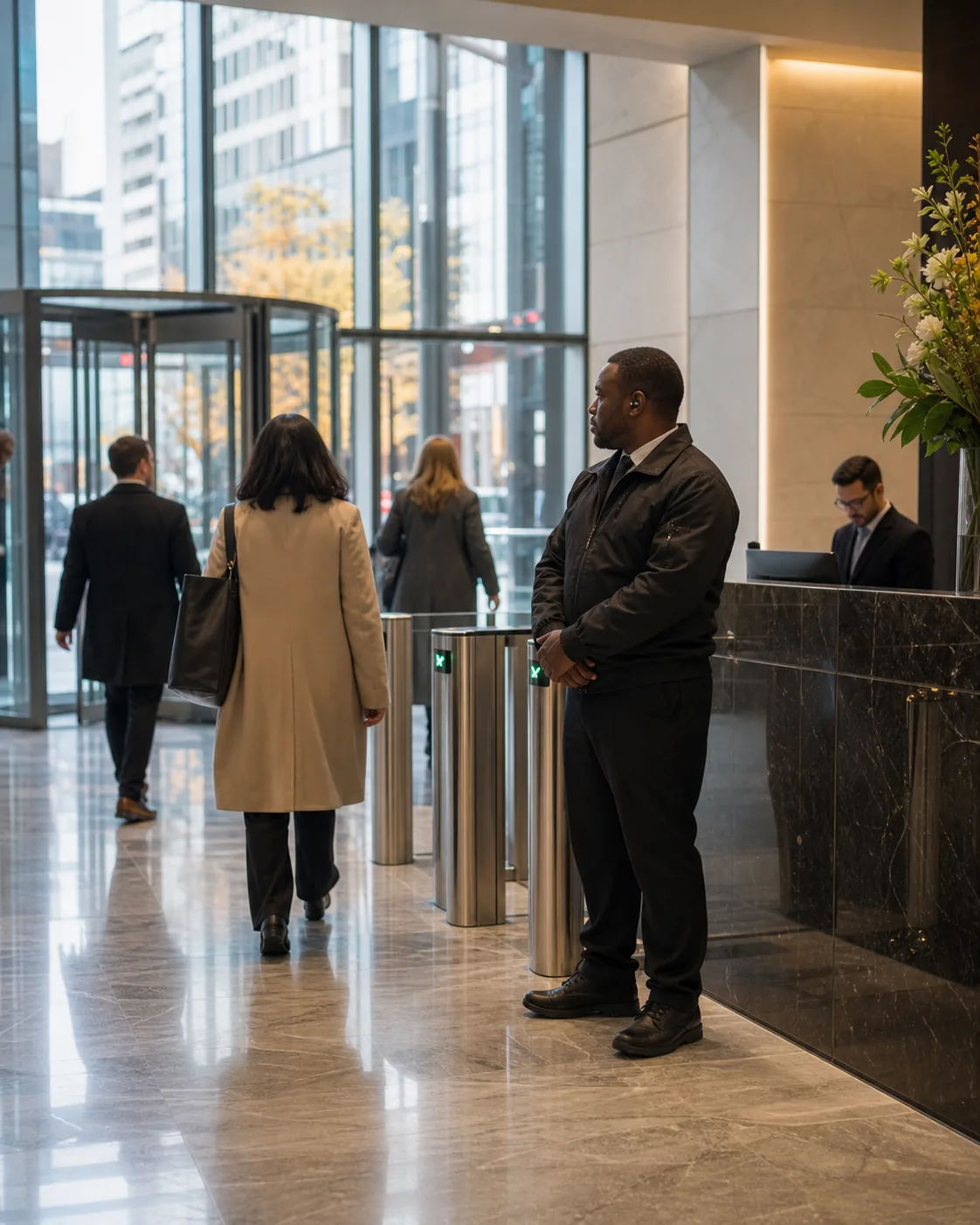
3. Reassess Guard Posts and Duties
Post orders should clearly explain who may enter, how visitors are verified, when an incident must be escalated, and how officers communicate with management and emergency services.
Managers considering security guard coverage should evaluate both officer placement and assigned responsibilities. Visibility alone is not a substitute for clear procedures, supervision, and reporting.
4. Coordinate Security With Fire-Life-Safety Planning
Crime prevention is only one part of building preparedness. Properties should separately review their applicable fire-safety staffing, emergency action procedures, and required building systems with qualified professionals and the relevant authorities.
Guardian ISI can also discuss fire guard services and fire and life safety director staffing where those services are appropriate for the property.
5. Prepare for Temporary Changes
Major events, demonstrations, tenant move-ins, system outages, renovations, and holiday traffic can create short-term needs that are not visible in CompStat totals. A written contingency plan can identify contacts, alternate entrances, restricted areas, and staffing triggers in advance.
If an unexpected gap develops, emergency security coverage may help a property respond while management works on a longer-term solution.
Use the Report as a Starting Point, Not a Verdict
The latest Midtown North CompStat report is valuable because it gives property leaders a consistent source of official, locally focused crime data. Its greatest value comes from combining that information with building-specific observations, incident records, occupancy patterns, and professional judgment.
Guardian ISI helps Manhattan properties assess security staffing and operational coverage based on actual site needs. To discuss coverage in Midtown North, call or text [(212) 602-1695](tel:+12126021695) or request coverage online.
Quick planning checklist
| Review point | What to confirm |
|---|---|
| Date | Check the report period and matching comparison periods |
| Context | Read counts alongside percentages and site incident records |
| Action | Assign an operational review and record its outcome |
Related Guardian services
Review Commercial Office Security and Security Guard Services to connect these procedures with the appropriate staffing and site responsibilities.
Official references
Frequently asked questions
Is it called Cop Stat or CompStat?
CompStat is the official term. It refers to the NYPD’s data-driven system for tracking reported crime and supporting operational accountability.
How often is the Midtown North CompStat report updated?
The NYPD publishes recurring precinct crime statistics, but posting schedules and report formats can change. Always check the week-ending date printed on the latest official report.
What area does Midtown North cover?
The Midtown North Precinct, also known as the 18th Precinct, covers a busy section of Midtown Manhattan that includes major commercial, entertainment, retail, and tourism destinations. Consult the official NYPD precinct map for exact boundaries.
Does an increase in one week mean a neighborhood is becoming less safe?
Not necessarily. Weekly counts can fluctuate, especially when the underlying numbers are small. Review the raw totals, 28-day results, year-to-date figures, and longer-term context.
Can CompStat determine how many security guards a building needs?
No. CompStat provides useful local context, but staffing decisions should also consider the property’s layout, hours, occupancy, internal incidents, access points, tenant needs, and existing systems.
Where can I find the latest Midtown North CompStat report?
Visit the official NYPD Midtown North Precinct webpage and open its crime statistics or CompStat resources. Confirm the reporting dates because previously downloaded PDFs may be outdated.