

Building compliance in Midtown Manhattan is more than a checklist. Commercial properties must coordinate security procedures, fire-life-safety responsibilities, access control, emergency planning, staff training, vendor activity, and documentation—often in buildings with multiple tenants and heavy daily foot traffic.
Security consulting can help property owners and managers evaluate how these responsibilities function in practice. The objective is not to replace legal counsel, licensed design professionals, or New York City authorities. It is to identify operational gaps, clarify responsibilities, and build procedures that staff can follow consistently.
Why Midtown Manhattan buildings present distinct challenges
Midtown properties operate in a demanding environment. Office towers, hotels, retail spaces, residential buildings, and mixed-use properties may share entrances, loading areas, mechanical spaces, and emergency systems. High visitor volume and frequent contractor activity add further complexity.
Common challenges include:
- Multiple tenants with different operating hours and security expectations
- Crowded lobbies and high volumes of visitors, deliveries, and vendors
- Shared responsibility among ownership, property management, tenants, and contractors
- After-hours access to office floors and restricted spaces
- Construction, renovation, or impairment work occurring in occupied buildings
- Staff turnover that creates inconsistencies in post procedures
- Emergency plans that are documented but not regularly practiced
A practical compliance review should account for the property's occupancy, use, staffing model, physical layout, current systems, and applicable agency requirements.
What does building compliance security consulting cover?
The scope depends on the property. Security-focused consulting generally examines the people, procedures, records, and physical controls that support a building's safety obligations.
Security staffing and post orders
Consultants can review whether each security post has a defined purpose and whether written post orders match actual building operations. This may include lobby coverage, loading dock procedures, patrol routes, incident escalation, key control, and after-hours access.
Useful post orders should tell personnel what to do, who to notify, and how to document an event. Generic instructions copied from another property may overlook important site-specific conditions.
Fire-life-safety staffing and responsibilities
Certain New York City buildings or occupancies may require personnel with specific FDNY qualifications or defined emergency duties. The applicable requirements vary according to factors such as building use, occupancy, fire protection systems, and current conditions.
A review may examine:
- Whether required certificates or qualifications are current and appropriate for assigned duties
- How designated personnel receive and document training
- Coverage plans for absences, overnight periods, and weekends
- Procedures for alarms, evacuations, shelter-in-place events, and system impairments
- Coordination among security, engineering, management, and tenant representatives
Property teams should confirm legal requirements with the relevant authority having jurisdiction and qualified professionals. Learn more about fire-life-safety director coverage and fire guard services.
Access control and visitor management
Access systems are only effective when procedures support them. A consultant may assess visitor registration, tenant authorization, identification checks, credential issuance, lost-card handling, elevator access, and entry to restricted areas.

The review should also consider exceptions. Deliveries, event guests, temporary employees, cleaners, contractors, and emergency responders may require different workflows. These workflows should remain secure without obstructing legitimate building operations.
Incident reporting and recordkeeping
Incomplete reports make it difficult to identify recurring risks or demonstrate that personnel followed established procedures. A sound reporting process should capture relevant facts without encouraging speculation.
Consultants may evaluate:
- Daily activity logs
- Incident and accident reports
- Patrol verification records
- Visitor and contractor records
- Training acknowledgments
- Equipment inspection or turnover logs
- Escalation and notification records
Retention requirements can vary by document type and circumstance. Building management should establish retention practices with appropriate legal, insurance, and compliance guidance.
Compliance on paper versus readiness in practice
A policy manual does not necessarily show that a building is prepared. Operational readiness depends on whether employees understand the plan and can apply it during an actual event.
Warning signs of a paper-only program include:
- Staff members giving different answers about the same procedure
- Emergency contacts that are outdated or difficult to locate
- Post orders that do not reflect current tenant operations
- Access privileges that remain active after a worker leaves
- Incident reports lacking times, actions, or notification details
- No clear process for replacing a required or critical staff member
- Contractors entering restricted areas without documented authorization
Interviews, observations, document reviews, and scenario-based discussions can reveal these gaps before an emergency or agency inspection brings them to light.
A practical review process for Midtown properties
1. Define the property and its operating conditions
Document the building's use, occupancy patterns, public areas, tenant mix, operating hours, active construction, critical systems, and recurring events. Mixed-use buildings may require separate procedures for different areas.
2. Identify applicable requirements
Create a requirements register based on current permits, plans, certificates, agency records, lease responsibilities, insurance conditions, and professional guidance. Do not assume that procedures from another property apply to your building.
Security consultants can help organize operational requirements, but formal legal interpretations and technical determinations should come from the appropriate agencies and licensed professionals.
3. Observe actual operations
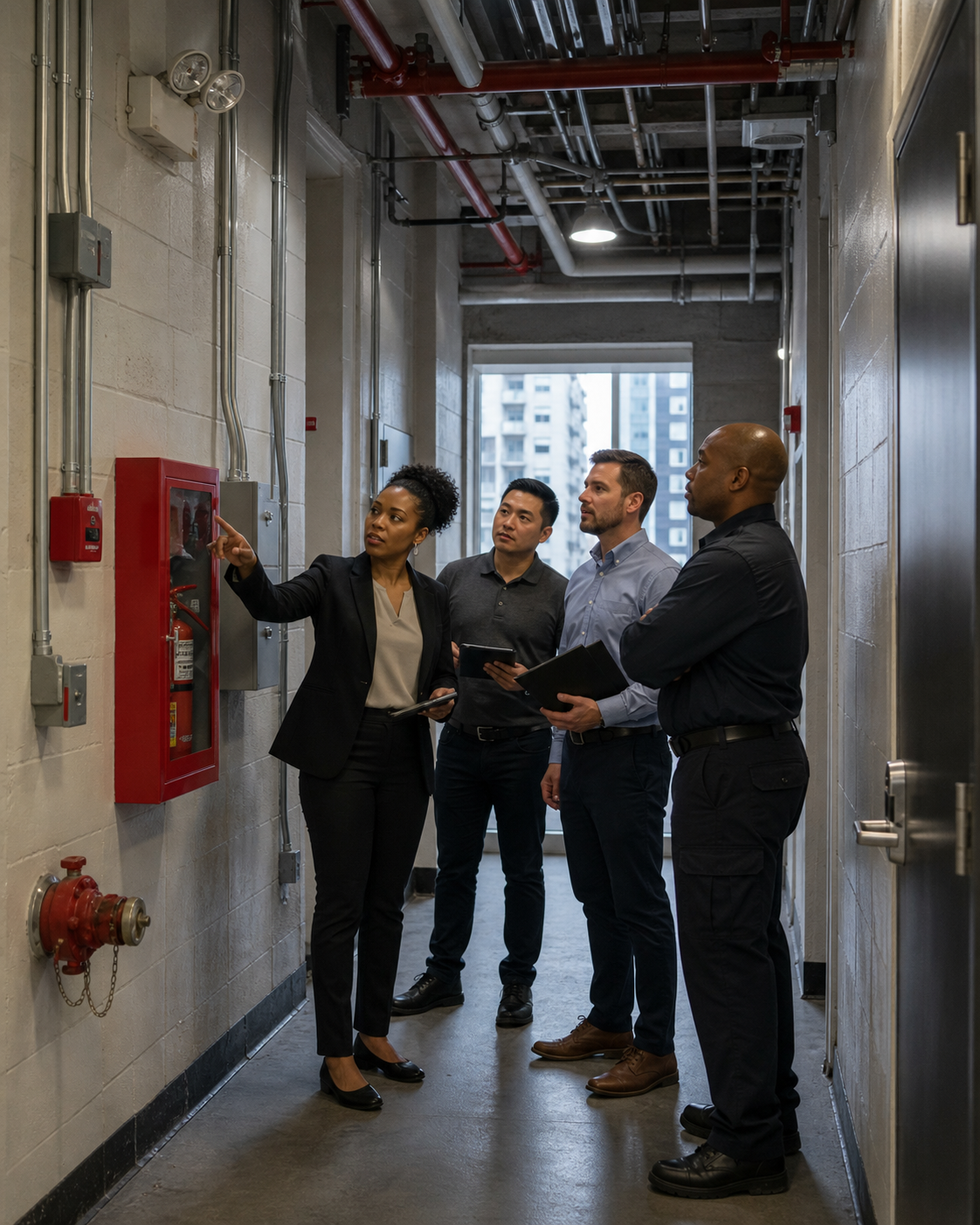
Walk the property during relevant shifts. Examine how guards handle visitors, deliveries, key transfers, alarms, loading dock traffic, and contractor access. Night and weekend conditions may differ substantially from weekday lobby operations.
For an office property, a focused commercial office security assessment can connect these observations to a workable staffing and coverage plan.
4. Compare policies with actual practices
Review post orders, emergency procedures, staffing records, training documents, and incident reports. Compare what the documents require with what personnel actually do.
5. Prioritize corrective actions
Not every issue carries the same urgency. A useful action plan separates immediate life-safety concerns from documentation updates, training needs, system improvements, and longer-term capital projects. Each item should have an owner, target date, and verification method.
6. Reassess after operational changes
Renovations, new tenants, revised entry layouts, staffing changes, and major events can affect existing procedures. Compliance and readiness should be reviewed whenever building conditions materially change—not only after an incident.
Questions to ask a security consultant
Before selecting a consultant or security provider, ask:
- Will the assessment be specific to our occupancy and building operations?
- Does the scope cover both written procedures and on-site practices?
- How will findings be prioritized?
- Will recommendations identify the responsible department or stakeholder?
- Can the provider support implementation, training, or temporary coverage?
- Which findings require confirmation by an agency, attorney, engineer, or other licensed professional?
Clear boundaries matter. A reputable consultant should not guarantee agency approval or present operational advice as a substitute for official legal or technical determinations.
When urgent coverage may be necessary
A staffing absence, system impairment, construction condition, or unexpected event may require prompt action. The appropriate response depends on the specific condition and any direction from the FDNY, Department of Buildings, property professionals, or other authorities.
If your building needs short-notice security or fire watch support, review Guardian's emergency coverage options. Property teams should provide accurate details about the condition, location, schedule, and any instructions issued by an authority.
Build a more reliable compliance program
Effective building compliance connects written requirements with daily behavior. For Midtown Manhattan properties, that means establishing clear responsibilities, site-specific procedures, dependable documentation, and coverage plans that reflect how the building actually operates.
Guardian ISI can help you discuss security and fire-life-safety coverage needs for your property. Call or text [212-602-1695](tel:+12126021695) or request coverage online. For questions about your property's legal obligations, consult the relevant New York City agency and qualified legal or technical professionals.
Put the review into practice
- Walk the building with the people responsible for security and operations, comparing actual conditions with written procedures.
- Assign each corrective action an owner and a completion date.
- Test the revised procedures on a later shift and record any remaining gaps.
Official references
Frequently asked questions
What is building compliance security consulting?
It is an operational review of security staffing, procedures, access controls, emergency responsibilities, and documentation. It supports—but does not replace—legal, engineering, or agency guidance.
Can a security consultant certify that a Midtown building is compliant?
Not generally. Only the appropriate authority or qualified professional can make determinations within its jurisdiction. A consultant can identify gaps and help management organize corrective actions.
How often should building security procedures be reviewed?
Review them periodically and after material changes such as renovations, new tenants, revised entrances, staffing changes, system modifications, or significant incidents.
Does every Manhattan building need a fire-life-safety director or fire guard?
No single requirement applies to every property. Duties and qualifications depend on the building, occupancy, systems, current conditions, and applicable FDNY rules or orders.
What records should a property keep?
Relevant records may include post orders, daily logs, incident reports, patrol records, training acknowledgments, access records, and qualification documents. Retention practices should be confirmed with appropriate compliance and legal advisers.