

Unauthorized visitors can create safety, privacy, and liability concerns for Manhattan office buildings, residential properties, hotels, and mixed-use developments. Yet an effective response is rarely as simple as physically removing someone from the premises.
Professional security guards generally use a hands-off, de-escalation-first approach. They verify whether a visitor has legitimate business in the building, communicate the property’s access rules, notify management, and call the NYPD when necessary. Physical contact is not a routine access-control tool and may be appropriate only in limited circumstances—such as when reasonably necessary to protect the guard or another person from imminent harm—subject to New York law, training, and company policy.
What Counts as an Unauthorized Visitor?
An unauthorized visitor is someone who does not have verified permission to enter or remain in a controlled part of a property. Depending on the building, this could include:
- A person without a valid appointment or host confirmation
- A former employee whose credentials have been deactivated
- A delivery worker attempting to bypass the designated receiving area
- Someone following an authorized occupant through a locked entrance
- A visitor entering a tenant-only floor or restricted back-of-house area
- A person who was admitted for a legitimate reason but refuses to leave after that purpose ends
- An individual subject to a building-issued restriction or other documented access instruction
Not every unfamiliar person is a threat. Visitors may have entered the wrong lobby, misunderstood delivery procedures, or received incomplete instructions. Guards should assess behavior and authorization objectively rather than relying on appearance, clothing, language, or other personal characteristics.
How Security Guards Respond Step by Step
1. Observe Before Approaching
The guard first evaluates what is happening. Relevant details can include where the person entered, whether credentials were presented, whether anyone is expecting them, and whether their behavior suggests confusion, noncompliance, or an immediate safety threat.
Whenever possible, the guard should maintain a safe distance, preserve an exit route, and use available resources such as access-control records or security cameras. Observing first helps prevent a routine misunderstanding from escalating.
2. Make a Professional, Non-Accusatory Contact
A calm greeting is often more effective than a confrontation. The guard may ask:
- “How can I help you?”
- “Who are you visiting today?”
- “May I see your building credential or visitor pass?”
- “Would you please wait here while I contact your host?”
The objective is to determine whether the person is authorized—not to provoke an argument or conduct an improvised interrogation.
3. Verify Authorization
Verification procedures vary by property, but they may involve:
- Checking a government-issued ID when the building’s established policy requires it
- Reviewing an approved visitor list
- Calling the tenant, resident, employee, or property manager
- Confirming a delivery through the loading dock or messenger center
- Checking whether an access credential is active
- Issuing a time-limited visitor pass after approval
Buildings should give guards clear written post orders explaining who can authorize entry, what identification is accepted, and how exceptions are handled. Security staff should not invent new access requirements during an encounter.
4. Explain the Rule and Offer a Lawful Alternative
If authorization cannot be confirmed, the guard should state the rule clearly and respectfully. For example, the visitor may be directed to contact their host, use a designated delivery entrance, wait in a public reception area, or return after an appointment is confirmed.
Clear options reduce frustration. They also show that the guard is enforcing a consistent building procedure rather than making a personal decision about the visitor.
5. Ask the Person to Leave or Remain Outside the Controlled Area
When entry is denied, the guard can give a direct verbal instruction not to enter the restricted area. If an unauthorized person is already inside, the guard may ask them to leave and indicate the proper route.
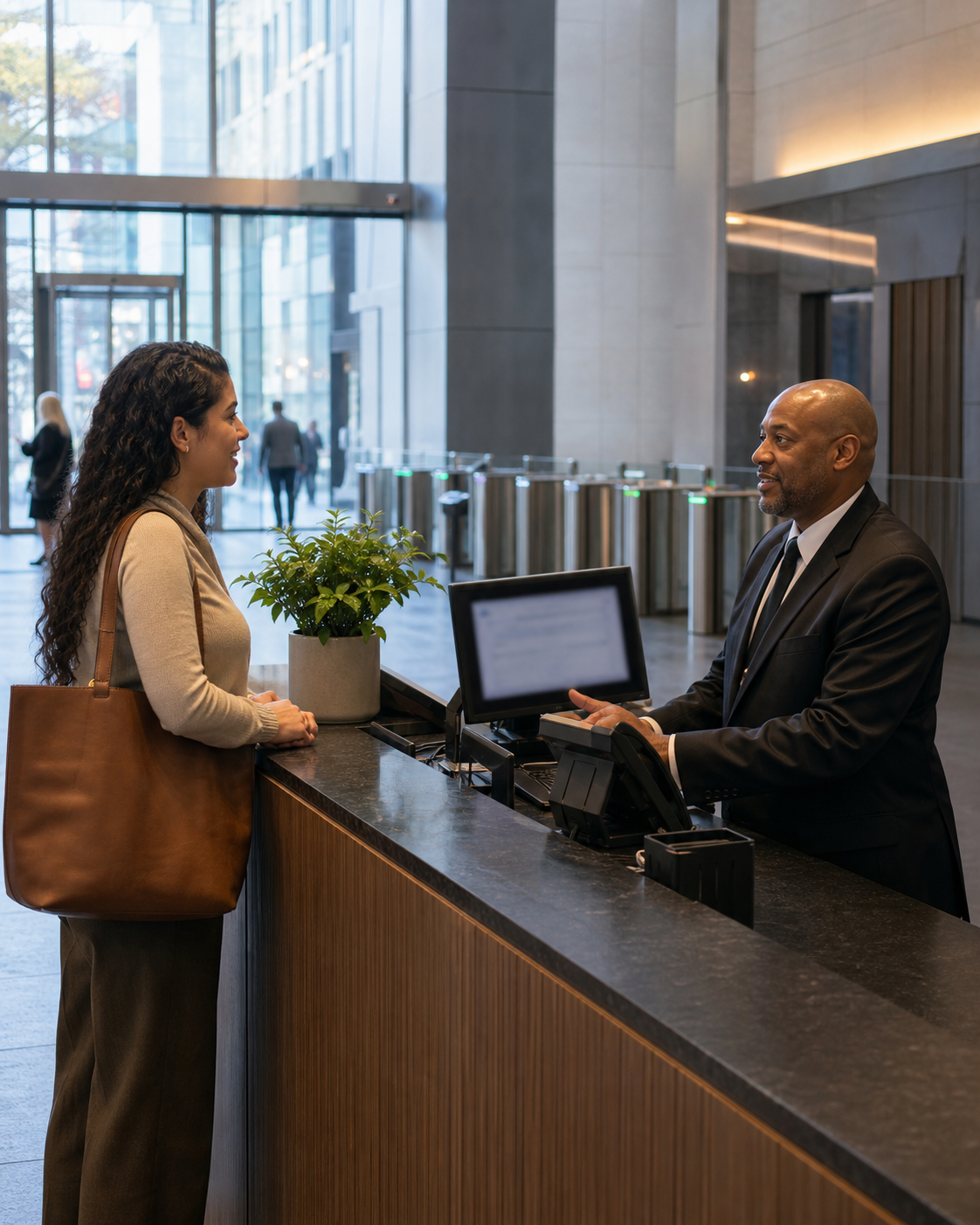
The guard should avoid blocking required emergency egress or creating a physical confrontation. If the person refuses to comply, the next step is usually notification and escalation—not grabbing, pushing, or dragging the person out.
6. Escalate According to the Building’s Plan
Depending on the circumstances, escalation may include notifying:
- A security supervisor
- Property management
- The tenant or resident involved
- Building engineering or operations personnel
- The NYPD
- 911 when there is an immediate threat, violence, a weapon, a medical emergency, or another urgent danger
Guards are not police officers simply because they work in uniform. Their role is generally to observe, deter, communicate, preserve safety, and request assistance from law enforcement when the situation exceeds their authority or training.
Why Guards Generally Avoid Physical Contact
A hands-off approach protects visitors, occupants, guards, and property owners. Unnecessary physical contact can cause injuries, escalate emotions, interfere with evidence, and expose everyone involved to avoidable risk.
Security guards generally should not put their hands on a person merely because that person lacks authorization, argues about a rule, or refuses an initial request to leave. Physical force is not a substitute for communication, access-control design, management support, or police assistance.
Limited circumstances may justify reasonable physical action, including the immediate defense of the guard or another person. Any use of force must be evaluated under applicable New York law—including the justification principles in New York Penal Law Article 35—as well as the facts, the guard’s training, and employer policy. The response should be proportionate to the threat and stop when the immediate danger ends.
This is a fact-specific area of law, so buildings and security providers should obtain legal guidance when developing use-of-force and incident-response policies. This article is general operational information, not legal advice.
De-Escalation Techniques Guards Can Use
Good de-escalation is structured rather than passive. A trained guard can:
- Speak slowly and maintain a neutral tone
- Keep a safe reactionary distance
- Avoid insults, threats, sarcasm, or unnecessary commands
- Acknowledge frustration without promising unauthorized access
- Repeat the building rule and available options
- Avoid surrounding the person unless safety requires additional personnel
- Move uninvolved occupants away from the encounter
- Request a supervisor early when tension is increasing
- Call 911 rather than attempting to manage an imminent violent threat alone
A guard should not pursue someone into an unsafe location merely to continue an argument about access. Containment, observation, camera monitoring, and accurate updates to responding officers may be safer.
When the NYPD Should Be Contacted
A building may request police assistance when a person refuses to leave after clear notice, bypasses security, threatens occupants, damages property, assaults someone, displays a weapon, or otherwise creates a situation beyond the guard’s safe control.
For an immediate threat or crime in progress, call 911. For a non-emergency matter, the appropriate response may depend on building policy and current NYPD procedures.
When speaking with dispatchers or officers, guards should report observable facts rather than conclusions. Useful information includes:
- The building address and exact location inside the property
- A factual description of the person and behavior
- The direction of travel
- Whether threats, injuries, or weapons were observed
- What instructions were given and how the person responded
- Whether video or witnesses are available
Terms such as “suspicious” are less useful than specific facts such as “attempted to enter through a locked door three times” or “stated that he would strike the receptionist.”
Documentation After the Incident
Accurate incident reports help management understand what happened and identify weaknesses in building procedures. A report should ordinarily include:
- Date, time, and exact location
- Names or identifiers of involved personnel
- How the visitor entered or attempted to enter
- Questions asked and verification steps completed
- Instructions given to the visitor
- The visitor’s statements and actions, quoted accurately when possible
- Notifications to supervisors, management, or the NYPD
- Any injuries, property damage, or use of force
- Relevant camera locations and access-control records
- The final disposition of the incident
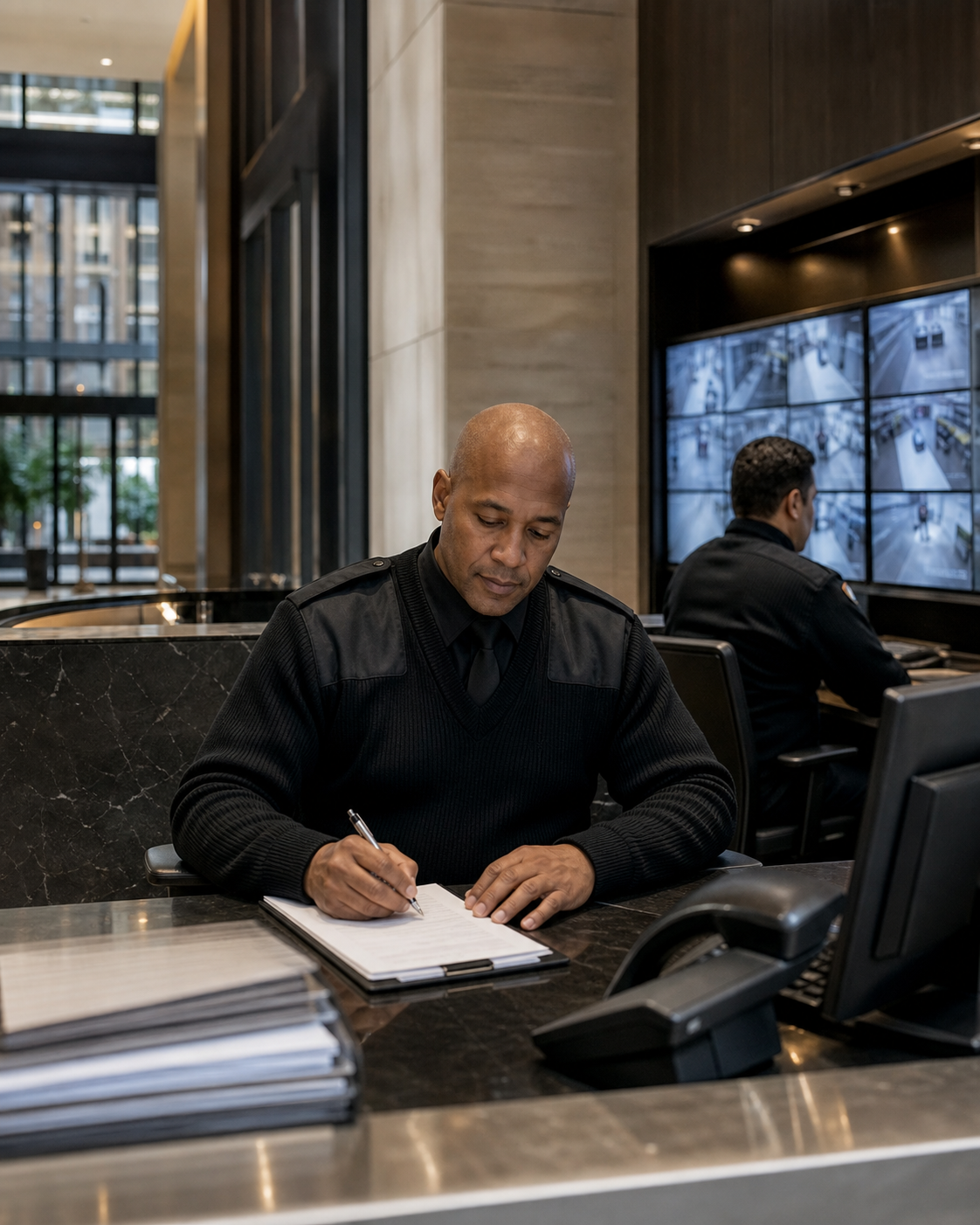
Reports should distinguish direct observations from information supplied by witnesses. Guards should avoid speculation, biased language, or unsupported claims about a person’s motives.
Building Procedures That Make Encounters Safer
Even skilled guards cannot compensate for unclear access policies. Property managers can reduce unauthorized-entry incidents by establishing:
Written Visitor Rules
Post orders should define lobby procedures, tenant approvals, after-hours access, contractor entry, deliveries, restricted floors, credential failures, and escalation contacts.
Reliable Host Verification
Guards need an up-to-date tenant directory and a dependable way to contact authorized hosts. Personal phone numbers should be handled according to the property’s privacy procedures rather than disclosed to visitors.
Tailgating Controls
Turnstiles, controlled doors, visitor passes, and attentive lobby staffing help prevent people from following authorized occupants into secured areas. Guards should also know what to do if someone bypasses a checkpoint without creating a dangerous chase.
Clear Emergency Protocols
Routine access controls must not obstruct emergency evacuation or required egress. Security, property management, and fire-life-safety personnel should understand their respective responsibilities during emergencies.
Site-Specific Training
Training should cover de-escalation, anti-bias expectations, disability accommodations, report writing, emergency communications, and the property’s limits on physical intervention. Scenario-based exercises can expose gaps before a real incident occurs.
Choosing Security Coverage for an NYC Building
An effective access-control program depends on more than placing a guard at a desk. The security provider should understand the property’s tenant mix, visitor volume, delivery patterns, after-hours operations, sensitive areas, and emergency procedures.
Guardian ISI provides security guard services for New York City properties, including tailored commercial office security and residential security. Coverage can be structured around the building’s written procedures, risks, and operating schedule.
If your Manhattan property needs ongoing protection or short-notice staffing, call or text (212) 602-1695 or request security coverage online.
Prepare the desk before an access dispute
- Confirm current host contacts and authorization rules.
- Identify the safe waiting area and available escalation support.
- Review how to record exceptions and report urgent threats.
Official references
Frequently asked questions
Can an NYC security guard physically remove an unauthorized visitor?
Physical removal should not be the routine response to an access dispute. Guards generally use verbal direction, de-escalation, management notification, and police assistance. Limited reasonable force may be justified to protect the guard or another person from imminent harm, depending on the facts, New York law, training, and company policy.
What should a guard do if a visitor refuses to leave?
The guard should repeat the instruction clearly, maintain a safe distance, notify a supervisor or property manager, observe the person, and contact the NYPD when appropriate. The guard should call 911 if there is an immediate threat, violence, a weapon, or another urgent danger.
Can a security guard ask a visitor for identification?
A guard may request identification as part of an established building access policy. The property should clearly define when ID is required, what forms are accepted, how information is handled, and what alternatives are available if authorization cannot be confirmed.
Are security guards in NYC the same as police officers?
No. Private security guards do not receive general police powers simply because they are licensed or wear a uniform. Their usual functions include access control, observation, deterrence, communication, incident reporting, and contacting law enforcement when needed.
How should guards document an unauthorized-visitor incident?
Reports should record the time, location, observed behavior, verification attempts, exact instructions given, notifications made, witness information, available video, and outcome. Reports should use objective facts rather than assumptions about intent.
How can property managers reduce unauthorized entry?
Use clear visitor policies, dependable host verification, working access-control systems, anti-tailgating procedures, current post orders, and site-specific guard training. Management should also review incidents regularly and correct recurring access gaps.