
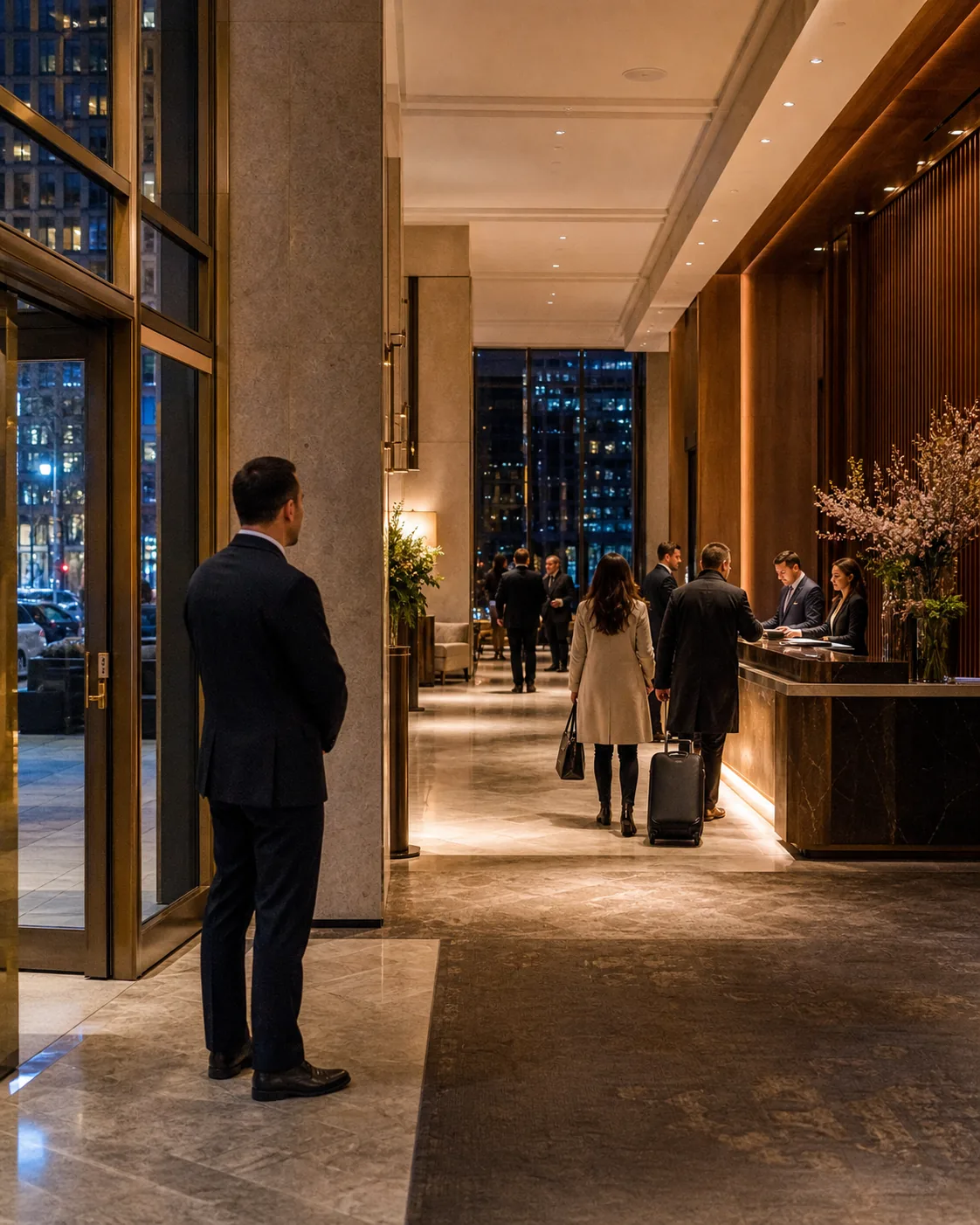
A hotel security assessment should account for something few other property types face: the building must remain welcoming and accessible while protecting guests, employees, vendors and assets around the clock. In Manhattan, that challenge is intensified by dense pedestrian traffic, frequent deliveries, public-facing food and beverage spaces, special events and complex vertical layouts.
A useful assessment does more than identify broken cameras or recommend additional guards. It examines how people enter, move through and leave the property; whether staffing matches actual activity; and how the hotel would respond to a fire alarm, medical incident, disruptive person or other emergency.
What Should a Hotel Security Assessment Cover?
The assessment should evaluate physical conditions, technology, daily operations and staff responsibilities together. A strong lock or camera cannot compensate for a door that is routinely propped open, just as a written emergency plan is of limited value if employees do not know their roles.
The review should cover at least:
- Guest, employee, vendor and contractor entrances
- Lobby activity and front-desk visibility
- Guest-room floors, elevators and stairwells
- Loading docks, service corridors and receiving procedures
- Restaurants, bars, ballrooms and meeting areas
- Parking, baggage storage and back-of-house spaces
- Key, credential and access-card management
- Camera placement, monitoring and incident retrieval
- Overnight staffing and escalation procedures
- Fire-life-safety and emergency response coordination
- Incident reporting, shift handoffs and recordkeeping
Assessors should review conditions at different times rather than relying solely on a scheduled daytime walkthrough. A lobby during morning checkout may present very different concerns than the same space after midnight or during a large event.
Assessing Hotel Access Control
Access control in a hotel is not simply a matter of locking exterior doors. The objective is to distinguish among guests, employees, vendors, event attendees and members of the public without creating unnecessary friction.
Start With the Property Perimeter
Walk the entire exterior and document every possible entry point, including secondary doors that may receive less attention than the main entrance. Look for:
- Doors that do not close or latch consistently
- Propped-open service entrances
- Poorly illuminated approaches
- Landscaping, equipment or structures that obstruct sightlines
- Easy movement from public areas into staff-only spaces
- Emergency exits being used as informal employee entrances
The review should also consider nearby conditions. Subway entrances, nightlife venues, construction projects and high-volume pedestrian routes can influence activity around a Manhattan hotel.
Trace Routes From Public to Restricted Areas
A person entering the lobby may also be able to reach elevators, restrooms, event spaces, restaurants or service corridors. Assess whether the building layout makes unauthorized movement easy and whether employees have clear procedures for responding.
Useful questions include:
- Can someone reach guest-room floors without passing an observable position?
- Are elevators controlled by room key, credential or staff oversight where appropriate?
- Can event attendees enter guest-only areas?
- Are stairwell reentry and emergency egress functions operating as intended?
- Are housekeeping closets, mechanical rooms and administrative offices secured?
- Can employees identify expired, shared or improperly used credentials?
Access restrictions must not interfere with required emergency egress or accessibility. Any changes to locks, doors, elevators or life-safety systems should be reviewed by the appropriate qualified professionals.
Review Loading and Vendor Access
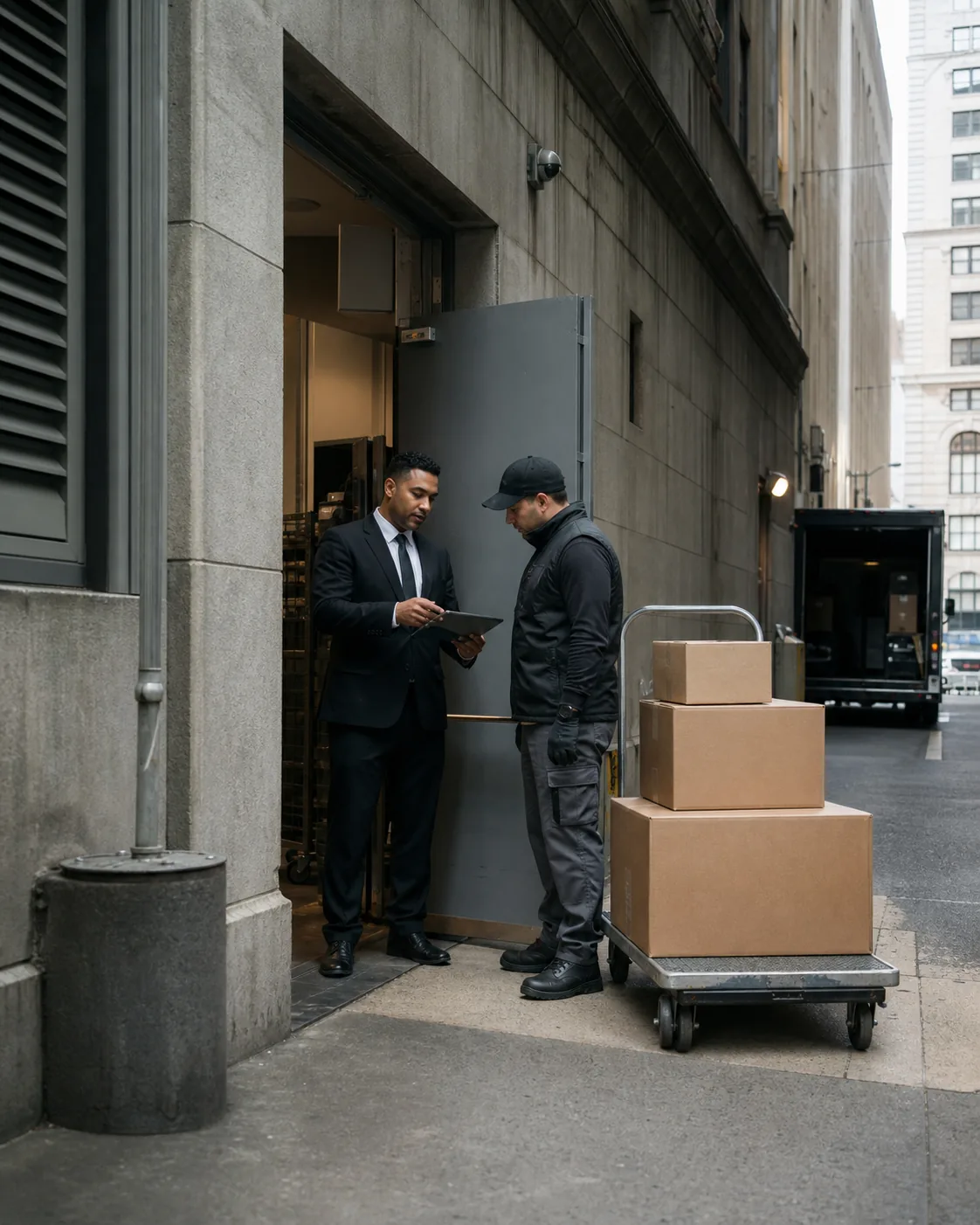
Loading docks and service entrances deserve the same attention as the lobby. A hotel may receive food, linens, packages, maintenance supplies and event materials throughout the day.
The assessment should examine delivery schedules, vendor identification, vehicle controls, package handling and the route from receiving to storage. When possible, vendors should enter through designated locations and remain within the areas required for their work. Exceptions should be documented and communicated to the appropriate department.
Match Security Staffing to Hotel Activity
A staffing assessment should begin with duties and risk periods, not an assumed number of posts. The right deployment depends on the property's size, layout, amenities, operating hours, event schedule and history of incidents.
Potential assignments may include:
- Lobby presence and guest assistance
- Patrols of guest floors and common areas
- Loading-dock or service-entrance coverage
- Camera and alarm monitoring
- Ballroom and event support
- Overnight response
- Executive or VIP arrival coordination
- Relief coverage for breaks and unexpected absences
Professional hotel security services should complement—not confuse—the responsibilities of management, front-desk staff, engineering and housekeeping.
Evaluate Coverage by Time and Location
Review occupancy patterns, check-in and checkout peaks, restaurant closing times, banquet schedules and overnight conditions. A post that is valuable during an evening event may be unnecessary the next morning, while the loading dock may require greater attention during scheduled delivery windows.
The assessment should also identify single points of failure. If one officer is responsible for the lobby, patrols and incident response, what happens when that person assists a guest on another floor? Relief procedures and supervisor availability should be clear.
Define Responsibilities and Escalation
Written post orders should explain what personnel are expected to observe, document and report. They should also establish when to contact hotel management, building engineering, emergency services or another designated party.
Important topics include:
- Handling lost keys and access credentials
- Responding to guest welfare concerns
- Managing disruptive or intoxicated individuals
- Preserving privacy while documenting incidents
- Coordinating with front-desk and housekeeping teams
- Responding to unattended property or suspicious activity
- Protecting an incident scene without obstructing emergency responders
Training should reflect actual hotel scenarios rather than generic instructions. Supervisors should periodically verify that post orders still match the building and its operations.
Review Cameras, Alarms and Communications
Technology is most useful when someone is responsible for monitoring, responding and maintaining it. During an assessment, test workflows rather than merely counting devices.
For video systems, examine whether cameras provide useful views of entrances, elevator lobbies, cash-handling areas, receiving locations and other priority zones. Confirm that authorized employees can retrieve footage when needed and that system time settings are accurate. Retention practices should align with the hotel's operational, privacy and legal guidance.
For communications, determine whether employees can promptly reach security from guest floors, service areas and event spaces. Radios and other devices should be tested in stairwells, basements, mechanical areas and other locations where coverage may be inconsistent.
Assess Fire-Life-Safety and Emergency Planning
Hotel emergency planning involves many departments. Security personnel may assist with communication, access for responders, crowd direction and documentation, but their responsibilities should be coordinated with hotel management and the property's designated fire-life-safety personnel.
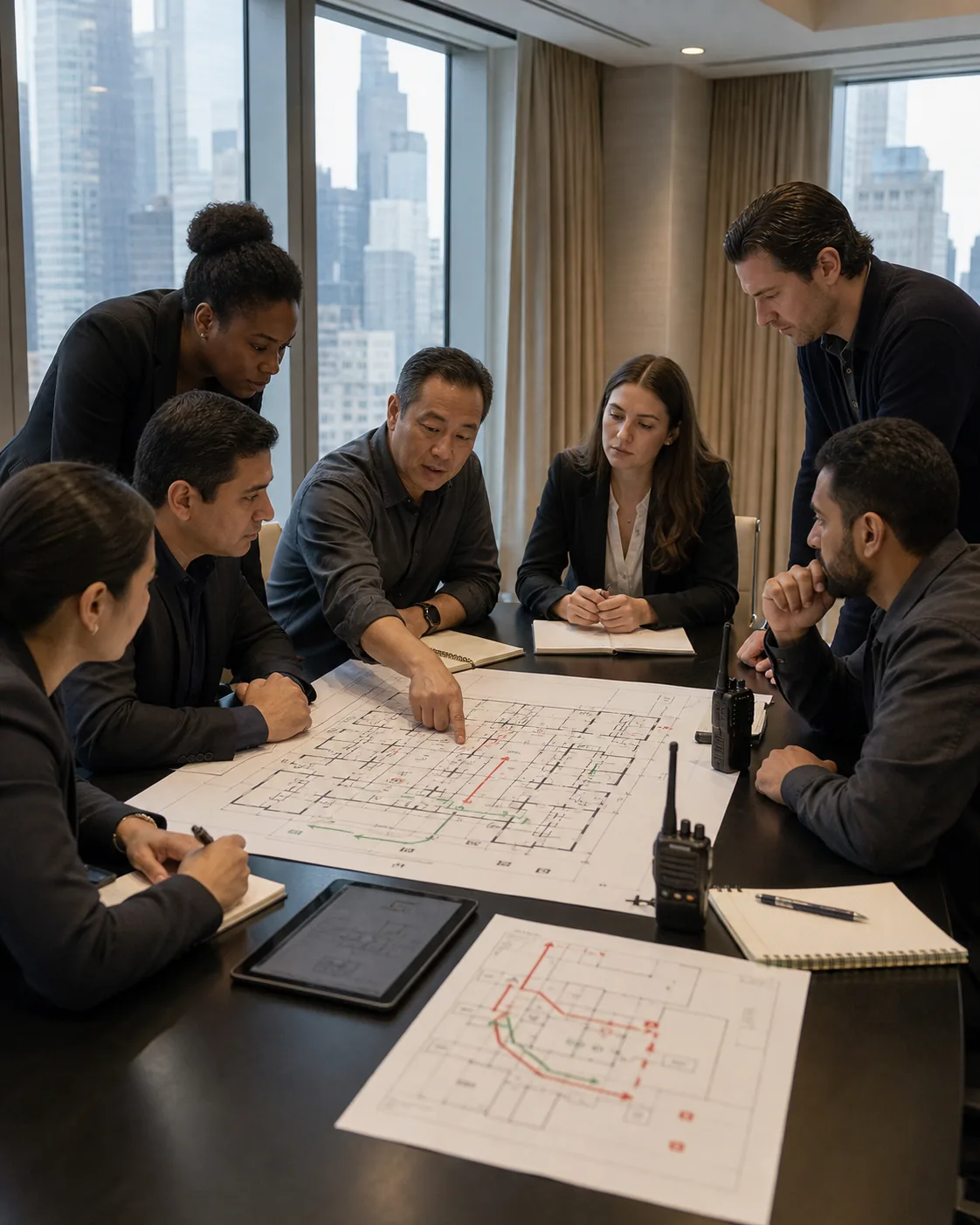
Depending on the building, occupancy and systems, New York City requirements may call for specific plans, procedures, staffing or certificates of fitness. Property leaders should confirm applicable obligations with qualified fire-life-safety professionals and the relevant authorities rather than relying on a generic checklist.
Guardian can help properties evaluate needs related to fire-life-safety directors and other building coverage.
Plan for Multiple Scenarios
Emergency planning should address more than fire. Relevant scenarios may include:
- Medical emergencies
- Fire alarms or smoke conditions
- Power, elevator or building-system failures
- Severe weather and flooding
- Threatening or disruptive individuals
- Suspicious packages
- Missing or vulnerable guests
- Demonstrations or street activity affecting entrances
- Evacuation, shelter-in-place or partial relocation decisions
Plans should identify who has decision-making authority, how employees receive instructions, who contacts emergency services and where responders will be met. Alternate communication methods are important if normal phone, radio or network systems fail.
Test the Plan Through Drills and Exercises
A tabletop exercise allows department heads to work through a realistic scenario without disrupting hotel operations. Participants can identify unclear responsibilities, outdated contact lists and practical conflicts between departments.
Exercises should involve relevant representatives from security, management, front office, engineering, housekeeping, food and beverage, human resources and events. Record lessons learned, assign corrective actions and update plans when operating conditions change.
Turn Findings Into an Action Plan
An assessment is valuable only if findings lead to improvements. Organize recommendations by risk, operational impact, responsible department and target completion date.
A practical action plan may separate items into:
- Immediate corrections: Repairing a door that does not latch, updating an emergency contact list or stopping unsafe credential-sharing practices.
- Near-term operational changes: Revising post orders, adjusting patrol times or formalizing vendor check-in.
- Capital projects: Replacing access-control equipment, improving lighting or redesigning a monitoring position.
- Ongoing measures: Training, testing, incident review and periodic reassessment.
After implementation, conduct a follow-up review to verify that changes work during real operating conditions. Incident trends, staffing changes, renovations and new amenities may all create reasons to reassess the property.
Request a Hotel Security Assessment or Coverage
Guardian ISI helps Manhattan hotel leaders evaluate security staffing, access points, operational vulnerabilities and emergency coverage. Whether you need planned security guard coverage or help filling an unexpected gap through emergency coverage, the next step should begin with your property's actual layout and operations.
Call or text (212) 602-1695, or request coverage online.
Frequently asked questions
How often should a hotel conduct a security assessment?
A comprehensive review can be scheduled periodically and after major operational changes, renovations or serious incidents. Hotels should also use routine inspections to identify emerging problems between formal assessments.
Should an assessment include both public and back-of-house areas?
Yes. Lobbies and guest floors are important, but loading docks, service corridors, staff entrances, storage rooms and mechanical areas can present equally significant vulnerabilities.
Does a hotel security assessment require adding more guards?
Not necessarily. Findings may support schedule adjustments, clearer post orders, better access procedures, equipment repairs or staff training. Any staffing recommendation should be tied to specific duties and operating conditions.
What records are useful during the assessment?
Incident reports, staffing schedules, post orders, delivery logs, floor plans, access records, event calendars and maintenance reports can help reveal recurring patterns and coverage gaps.
Can Guardian provide short-notice hotel security coverage?
Coverage depends on timing, staffing availability and assignment requirements. Call or text (212) 602-1695 or submit a coverage request so the team can review the property's needs.