

A hotel patrol checkpoint system is most useful when its layout encourages meaningful coverage—not simply fast scans. On a typical Manhattan hotel guest floor, placing NFC tags inside the exit stairwells at opposite ends of the corridor can help guide the security officer across the entire floor while keeping the technology out of guests’ direct view.
One possible design places approved checkpoints near opposite exit stairs. Confirm the layout, safe re-entry, and patrol route first; two scans alone do not prove that the officer observed the full corridor.
Why NFC Tag Placement Matters
NFC patrol tags record when an authorized device reaches a designated checkpoint. However, a scan alone does not establish what the officer observed or how carefully the area was inspected. The value of the system depends heavily on where the checkpoints are installed and how patrol expectations are documented.
Poorly planned tags may allow an officer to complete a route while covering only a small portion of the floor. Thoughtful placement can instead support:
- End-to-end guest-floor coverage
- More consistent patrol routes
- Time-stamped checkpoint records
- Better visibility into missed or incomplete rounds
- Clearer expectations for security personnel
NFC data should supplement—not replace—officer observations, incident reports, supervision, and follow-up.
Place Checkpoints at Opposite Exit Stairwells
Many hotel guest floors have two exit stairwells located at or near opposite ends of the corridor. These are often identified as Exit A and Exit B. Installing a checkpoint inside each stairwell creates two separated destinations for the patrol officer.
Example: Exit A to Exit B
Consider a guest floor with Exit A at the east end and Exit B at the west end:
- The security officer enters the floor and walks to Exit A.
- The officer opens the exit door and scans the NFC tag mounted just inside the stairwell.
- The officer returns to the guest corridor and proceeds toward Exit B.
- While crossing the floor, the officer observes the corridor, guest-room doors, elevator lobby, service areas, and other locations included in the hotel’s patrol instructions.
- At Exit B, the officer opens the door and scans the second tag inside that stairwell.
- Any unusual condition is reported according to hotel procedures rather than merely noted through the checkpoint system.
Separated checkpoints can encourage wider coverage when the approved route follows the corridor. Check for shortcuts and confirm the actual path during supervision.
Keep NFC Tags Out of Guest-Facing Areas
Hotel management is understandably concerned about the overall appearance of guest floors. A visible NFC sticker, QR code, or patrol checkpoint in a carefully designed corridor can look overly institutional and may invite unnecessary guest interaction.
Mounting the tags just inside the Exit A and Exit B stairwells can preserve the appearance of public areas. Stairwells normally receive less guest traffic, yet they remain accessible to officers conducting scheduled rounds.
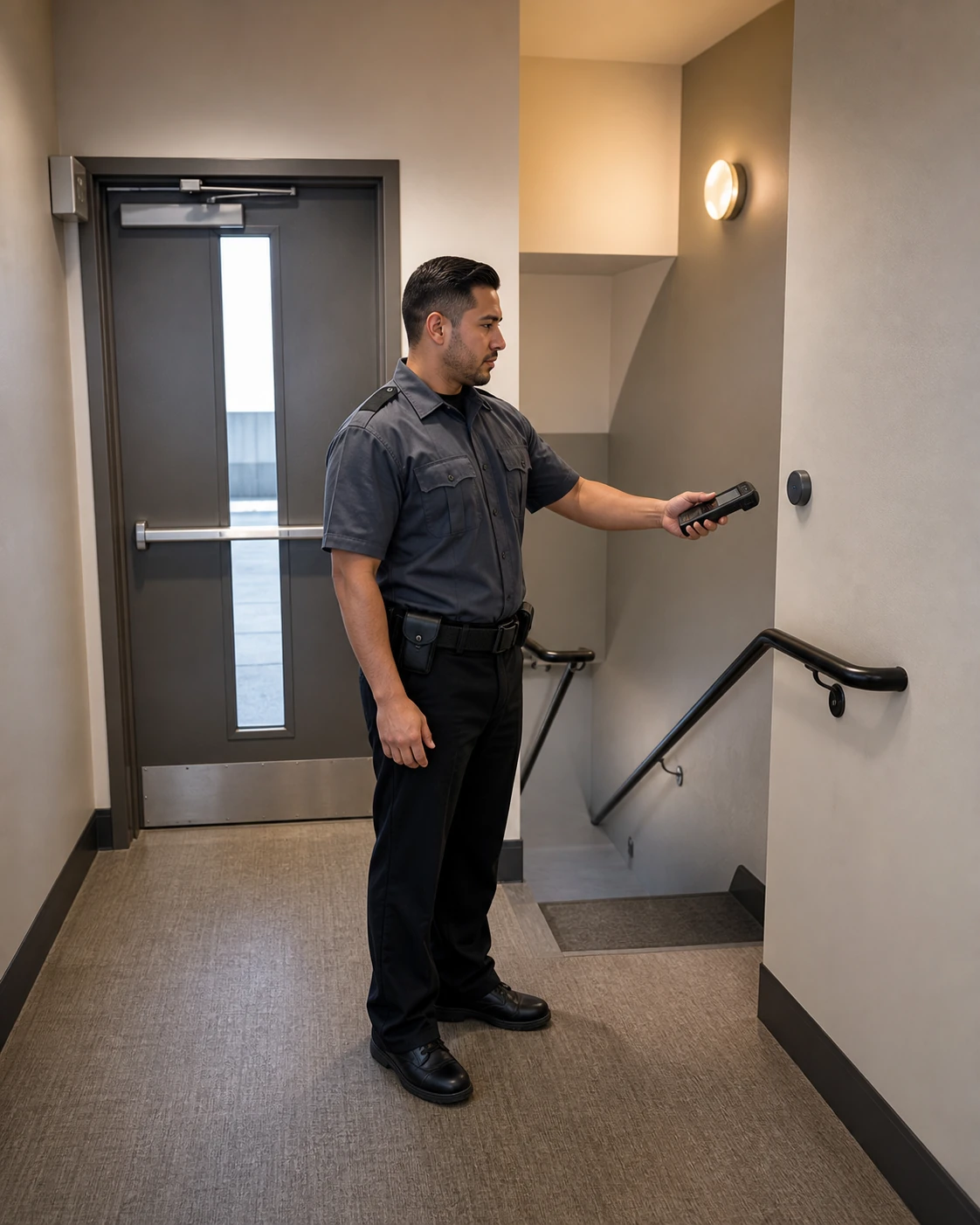
The tags should not be treated as secret from the security team. Officers need clear route instructions, training, and reliable access. The goal is to keep the hardware discreet from the general public—not to make checkpoints difficult for authorized personnel to find.
Coordinate Placement With Hotel and Life-Safety Teams
Before installing any NFC checkpoint, hotel management should review the proposed position with its engineering, security, and fire-life-safety personnel. Installation must not interfere with required signs, door operation, locking hardware, inspections, or safe egress.
Practical placement considerations include:
- Confirm that the officer can safely re-enter the floor; do not prop a fire door to complete a scan.
- Do not mount a tag on panic hardware, door closers, latches, or moving components.
- Do not cover exit markings, inspection labels, instructions, or other required information.
- Avoid any installation method that could damage a fire-rated door or assembly.
- Position the tag where an officer can scan it without holding an exit door open unnecessarily.
- Confirm that the tag can be read through the officer’s approved device and case.
- Select a surface and mounting method suitable for stairwell conditions.
- Document the exact checkpoint location for training and future replacement.
Property-specific requirements vary. Hotel leadership should obtain approval from the appropriate building and life-safety representatives before attaching equipment in or around an exit enclosure.
Design the Route Around Observation, Not Just Scanning
A complete patrol is more than a trip between two NFC tags. Written post orders should explain what the officer is expected to observe while crossing the guest floor.
Depending on the hotel’s needs, the patrol may include checking for:
- Unusual noise, disturbances, or calls for assistance
- Propped, damaged, or unsecured doors
- Obstructions or visible hazards in corridors
- Unauthorized activity in service or guest areas
- Water leaks, smoke, unusual odors, or other conditions requiring escalation
- Housekeeping carts or stored items that management wants addressed
- Conditions at elevator lobbies and other designated common areas
Security personnel should report urgent concerns immediately under the hotel’s escalation procedures. A checkpoint scan should never delay an emergency response.
Prevent Shortcut Routes
Checkpoint locations should be tested as an actual walking route. If an officer can use a service passage, internal stair connection, or another shortcut to scan both tags without observing the main corridor, the layout may not achieve management’s goal.
During a site walk, hotel management and the security supervisor should confirm:
- The intended order of checkpoints
- The path officers are expected to follow
- The areas that must be visually observed
- Reasonable timing between scans
- Exceptions for guest assistance, incidents, and emergencies
- The procedure for failed, damaged, or unreachable tags
Patrol data should be reviewed in context. Extremely short scan intervals, repeated missed checkpoints, or identical timing patterns can justify a supervisory review, but they should not be treated as automatic proof of misconduct.

Maintain and Audit the Checkpoints
NFC tags are generally low-maintenance, but hotels should still test them regularly. Renovations, repainting, cleaning, impact, moisture, or device changes can affect whether a checkpoint remains usable.
A simple audit should verify that:
- Each tag is still securely mounted.
- Exit A and Exit B are correctly labeled in the patrol software.
- The assigned mobile device reads both tags consistently.
- Timestamps appear in the expected reporting system.
- Officers know how to report a failed scan.
- Replacement tags are mapped to the correct floor and exit.
Hotels with similar floor plans should use a consistent naming structure, such as “Floor 12 – Exit A” and “Floor 12 – Exit B.” Clear naming helps supervisors identify missed locations without confusing one guest floor with another.
Build a Practical Hotel Patrol Program
Where the layout and approved access arrangements support it, one option is a checkpoint near each of the two opposite exit stairs. This protects the visual quality of guest-facing corridors while encouraging the security officer to walk from one end of the floor to the other.
The final design should reflect the property’s actual layout, operating procedures, emergency plans, and management priorities. Guardian ISI can help hotel teams assess patrol routes, establish checkpoint locations, and coordinate dependable hotel security coverage in New York City.
To discuss guest-floor patrols or request security coverage, call or text (212) 602-1695 or request coverage online.
Related Guardian services
For guest-floor patrol staffing, explore Hotel Security. The Virtual Security Director program addresses broader hotel security leadership and review.
Frequently asked questions
Where should NFC patrol tags be placed on a hotel guest floor?
A practical layout is one tag just inside Exit A and another just inside Exit B at the opposite end of the floor. The exact positions should be approved by hotel security, engineering, and fire-life-safety personnel.
Why place hotel NFC tags inside stairwells?
Stairwell placement keeps the checkpoints out of guest-facing corridors while leaving them accessible to trained security officers. Tags must not interfere with exit signs, doors, hardware, or safe egress.
How does Exit A and Exit B placement improve patrol coverage?
Separated checkpoints encourage the officer to walk the length of the guest corridor instead of scanning several tags in one area. Post orders should also define what the officer must observe along the route.
Does an NFC scan prove that a floor was fully inspected?
No. A scan confirms that a device reached a checkpoint at a recorded time. It should be evaluated alongside incident reports, officer observations, patrol timing, and supervisory review.
Should NFC patrol tags be visible to hotel guests?
They generally do not need to be prominent in public areas. Discreet placement inside approved stairwell locations can preserve the hotel’s appearance, while officers should receive clear instructions about every checkpoint.
How often should hotel NFC checkpoints be tested?
Hotels should test them on a regular schedule and after renovations, painting, cleaning, device changes, or reported scan failures. Each tag should also be verified against the correct floor and exit name in the patrol system.