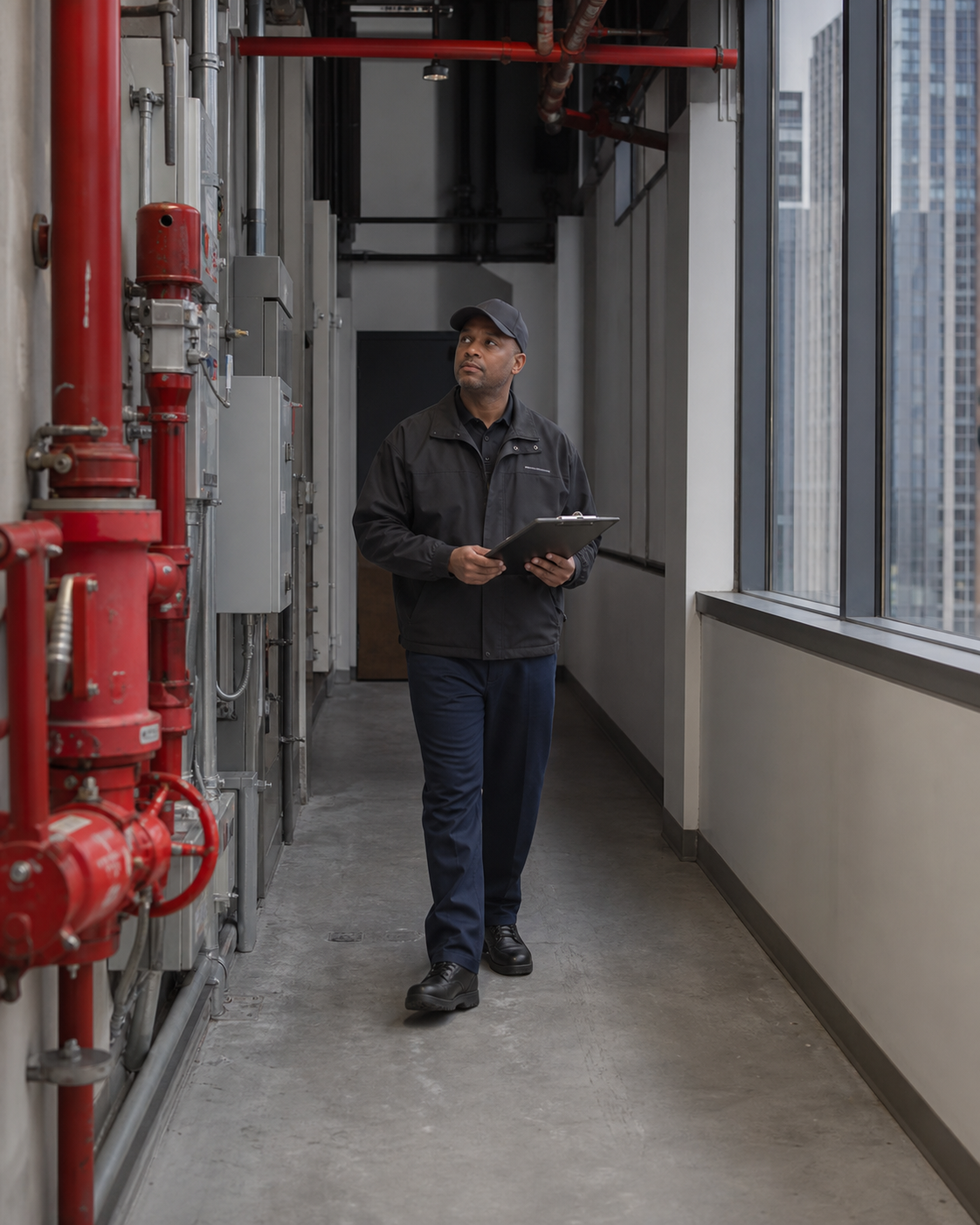
FDNY requires a fire watch when a required fire-protection system is out of service. The applicable qualification, permitted exceptions, coverage, and relief arrangements must be confirmed for the condition. Construction activity and torch operations can create a different set of fire-watch responsibilities.
That distinction is central to understanding F-01 vs. F-60 fire guard coverage in NYC. An F-01 Certificate of Fitness is associated with fire-protection-system impairments, while an F-60 Certificate of Fitness applies to specified torch-operation fire watches. Choosing correctly requires looking at the location, the work underway, the affected systems, and the instructions issued for the property.
This guide provides a practical comparison for property managers, building owners, contractors, and facilities teams. Final requirements should always be confirmed with the FDNY, the project’s fire safety personnel, and other authorities responsible for the site.
F-01 vs. F-60 fire guard NYC: the short answer
The two certificates address different operating conditions:
- F-01 — Citywide Fire Guard for Impairment: Generally used when a required fire-protection system is out of service or impaired at a property.
- F-60 — Fire Guard for Torch Operations: Used for the torch-operation fire watches identified in FDNY guidance.
The certificate should match the actual assignment. An F-01 should not automatically be treated as a substitute for an F-60 during torch work, and an F-60 should not automatically be assumed to cover every impairment assignment in an occupied commercial property.
Some situations involve both construction activity and a system impairment. In those cases, do not choose based only on the words “construction” or “out of service.” Review the site conditions and obtain direction from the responsible fire safety professional or FDNY.
What is an F-01 fire guard?
The F-01 Certificate of Fitness is formally associated with citywide fire guard duties for impairment. It is commonly relevant when a required fire-protection system cannot provide its normal level of protection.
Examples may include an impairment involving a:
- Fire alarm system
- Automatic sprinkler system
- Standpipe system
- Fire pump or related equipment
- Other required fire-protection feature
An impairment may be planned, such as during testing, repair, or renovation, or unplanned because of a malfunction, leak, power issue, or equipment failure. The required personnel, any permitted exception, and the number of guards depend on the systems affected, the duration and extent of the impairment, building occupancy, occupied areas, and instructions from the applicable authority.
Typical F-01 responsibilities
The exact post orders vary, but an F-01 fire guard may be expected to:
- Patrol assigned areas on the required schedule
- Watch for smoke, fire, unsafe activity, or changing conditions
- Maintain required patrol or fire-watch records
- Keep exits, stairs, and designated access routes unobstructed
- Know how to report a fire or other emergency promptly
- Follow the building’s impairment and notification procedures
- Remain on duty until properly relieved or the assignment is ended
A fire guard observes and reports hazards; the guard does not repair the impaired equipment. Restoration work should be handled by appropriately qualified fire-alarm, sprinkler, or other fire-protection contractors.
What is an F-60 fire guard?
The F-60 Certificate of Fitness covers fire guard duties for torch operations. It is commonly associated with hot work that can produce flames, heat, or sparks, including qualifying torch operations at construction locations.
Potential activities include:
- Welding
- Brazing or soldering with torch equipment
- Torch-applied roofing
- Cutting or heating with fuel-gas equipment
- Other permitted torch operations
- Other torch assignments for which FDNY requires F-60 coverage
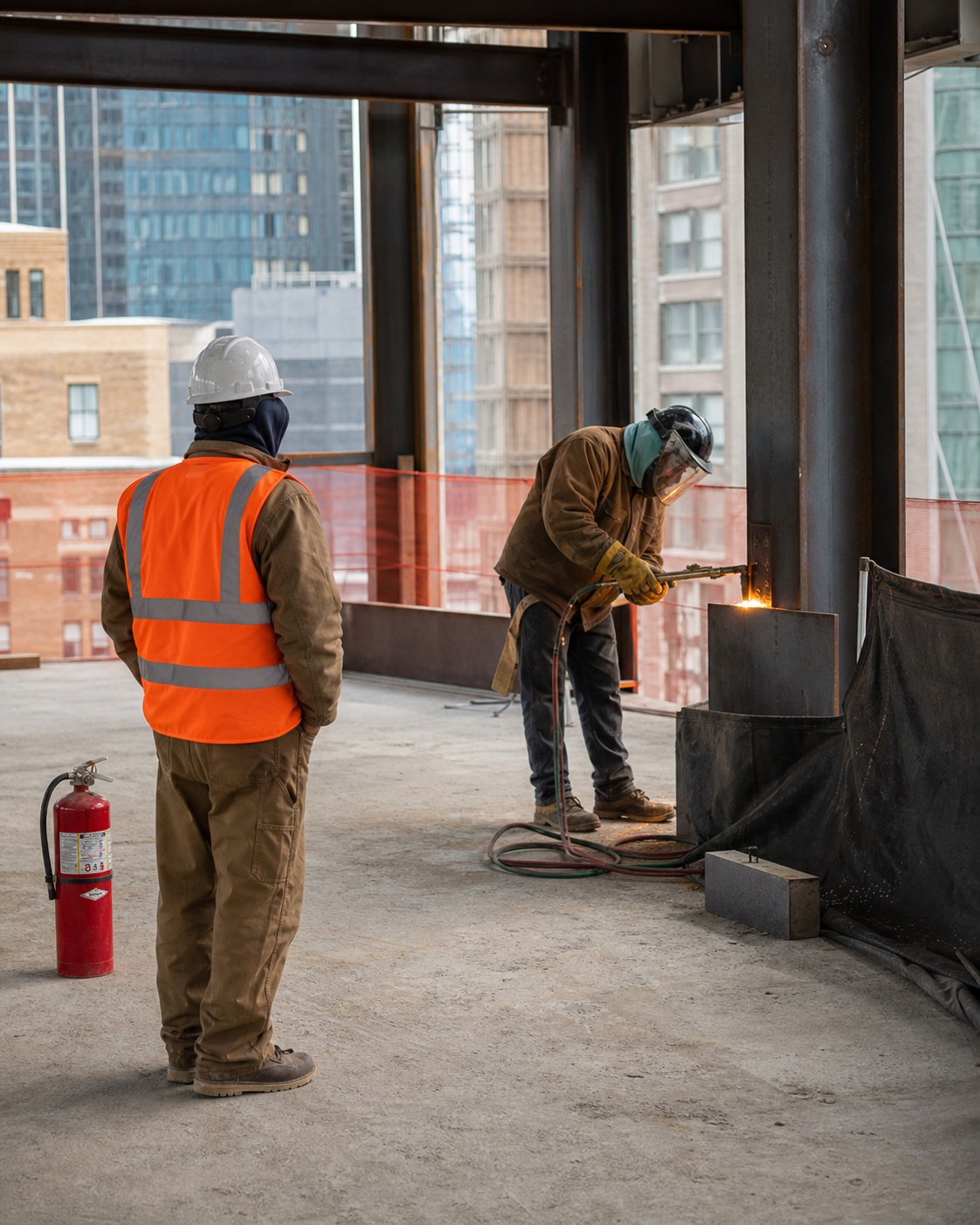
An F-60 fire guard may be needed even when the building’s fire-protection systems are operating normally. In that situation, the risk comes from the work itself rather than an equipment impairment.
FDNY identifies F-60 fire watches for torch operations at construction sites, on rooftops or in torch-applied roofing work, and in buildings where the operator holds a citywide torch permit. Confirm other hot-work and construction assignments separately.
Typical F-60 responsibilities
Depending on the site and operation, an F-60 fire guard may:
- Inspect the work area for combustible materials and ignition hazards
- Monitor the area while torch or hot work is underway
- Watch adjacent spaces where heat or sparks could travel
- Verify that required portable fire extinguishers are accessible
- Maintain separation between the operation and avoidable hazards
- Continue monitoring for the required period after work stops
- Follow the site’s hot-work permit and fire-safety procedures
- Initiate emergency notifications if smoke or fire is discovered
An F-60 certificate does not replace other requirements that may apply, including permits, supervision by an appropriate Certificate of Fitness holder, site-specific fire safety plans, or required construction fire safety personnel.
Key differences between F-01 and F-60 coverage
| Question | F-01 | F-60 |
|---|---|---|
| Primary purpose | Fire watch during a fire-protection-system impairment | Fire watch for torch operations |
| Typical trigger | Alarm, sprinkler, standpipe, or related system is out of service | A torch operation subject to an F-60 fire-watch requirement |
| Common setting | Occupied commercial, residential, retail, hotel, or mixed-use property | Construction, renovation, roofing, demolition, or hot-work area |
| Main hazard | Reduced automatic detection, notification, or suppression capability | Ignition from flame, heat, sparks, or construction activity |
| Interchangeable? | Not automatically | Not automatically |
The correct certificate is determined by the work and hazard—not simply by the type of building.
Which coverage does your property need?
Choose F-01 coverage when the main issue is an impairment
F-01 coverage may be appropriate when a building’s required fire-protection system is wholly or partially out of service. Common examples include overnight alarm repairs, sprinkler shutdowns during tenant work, or an unexpected system failure awaiting service.
Before requesting coverage, gather:
- The system and area affected
- Whether the impairment is full or partial
- The anticipated start time and duration
- Which floors or tenant spaces remain occupied
- Any instructions from FDNY, the impairment coordinator, building management, or fire safety staff
- Required patrol routes, logs, and communication procedures
Confirm F-60 coverage for torch-operation fire watch
F-60 coverage applies to specified torch operations; it should not be treated as a general credential for every construction-site watch. The contractor or site fire safety personnel should identify the operation, work location, permit conditions, and required watch period.
Useful information includes:
- The type of hot work or construction activity
- Exact work areas and adjacent exposures
- Daily work hours
- Whether work will occur on multiple floors
- Who supervises the operation
- Whether the watch must continue after hot work ends
Treat mixed conditions as a site-specific question
A renovation project can involve an impaired sprinkler zone and active torch work at the same time. Do not assume that one fire guard or one certificate automatically satisfies both needs.
Ask the responsible parties to clarify:
- Which hazards require coverage
- Which Certificate of Fitness applies to each post
- Whether simultaneous posts are needed
- The required patrol boundaries
- When each assignment begins and ends
Common coverage mistakes to avoid
Requesting “a fire guard” without identifying the certificate
The dispatch request should state whether F-01, F-60, or another qualification is required. Vague requests can cause delays when coverage is urgently needed.
Underestimating the duration of an impairment
Repairs and inspections may take longer than expected. Plan for shift relief so the property does not have a gap in required coverage.
Assuming one guard can monitor an unlimited area
Staffing depends on the size and layout of the premises, occupied areas, hazard locations, and instructions issued for the site. A large or complex property may need multiple posts.
Treating a Certificate of Fitness as the entire compliance plan
The individual fire guard’s certificate is only one component. Permits, impairment procedures, fire safety plans, supervision, recordkeeping, and notifications may also apply.
Ending coverage without clear authorization
A system appearing to be operational does not necessarily mean the impairment process is complete. Building management should confirm that restoration, testing, and required notifications have been completed before releasing fire guards.
How to prepare for planned or emergency coverage
For planned work, arrange coverage before the shutdown or hot work begins. Provide written post orders, floor plans when available, emergency contacts, and a clear sign-in location.
For an unexpected impairment:
- Follow the property’s emergency and impairment procedures
- Contact the appropriate fire-protection service provider
- Make required notifications
- Identify affected areas and occupied spaces
- Request appropriately certified personnel
- Keep a record of dispatch, arrival, patrols, and relief
Guardian ISI provides fire guard services for planned assignments and urgent property needs. For time-sensitive outages, review our emergency coverage options.
Request qualified NYC fire guard coverage
The safest approach is to describe the actual condition rather than guessing which certificate applies. Tell the provider whether you have a system impairment, construction activity, torch work, or overlapping conditions—and share any written direction received for the site.
To discuss F-01 or F-60 staffing, call or text Guardian ISI at (212) 602-1695. You can also request fire guard coverage online. For general questions, visit our contact page.
Guardian can help review the assignment details and identify appropriately credentialed personnel, but the FDNY and other authorities having jurisdiction determine the property’s legal and operational requirements.
Official references
- FDNY F-01: Citywide Fire Guard for Impairment
- FDNY F-60: Fire Guard for Torch Operations
- FDNY hot-work permits and qualifications
Frequently asked questions
What is the main difference between an F-01 and F-60 fire guard in NYC?
F-01 is associated with fire watch during an impairment of a required fire-protection system. F-60 covers the specified torch-operation fire watches identified by FDNY.
Can an F-60 fire guard cover a sprinkler or fire alarm impairment?
Not automatically. The required certificate depends on the site, hazard, and instructions for the assignment. Construction sites with impairments should obtain site-specific direction rather than assuming F-60 covers every condition.
Do I need an F-60 fire guard whenever contractors are working?
No. Ordinary contractor activity does not necessarily trigger F-60 coverage. Confirm whether the actual torch operation requires F-60 coverage under FDNY guidance; other construction and hot-work duties can have different requirements.
How many F-01 fire guards does a building need?
There is no single number for every property. Staffing depends on factors such as the affected system, building size and layout, occupied areas, impairment extent, patrol requirements, and instructions from the applicable authority.
Can fire guard coverage end as soon as repairs are finished?
Coverage should end only after building management confirms that required restoration, testing, documentation, and notifications are complete and that the fire watch can be discontinued.
Can Guardian provide emergency F-01 or F-60 coverage?
Guardian can help arrange appropriately credentialed personnel based on availability and assignment details. Call or text (212) 602-1695 or submit an online coverage request as soon as the need is identified.