
New York City’s public-safety data offers a useful lesson for commercial property managers: security resources are most effective when they are directed by documented risks rather than habit alone.
For Manhattan owners and managers, well-designed security patrols and response procedures can connect observed conditions with staffing decisions, corrective work, and management review. Citywide figures provide context, but the property’s own records are essential to deciding where coverage is needed.
What “data-driven” means for private security patrols
A data-driven patrol program does not require complex predictive software. It begins with consistent records about what is happening at the property, where it occurs, and when it is most likely to occur.
Useful information may include:
- Incident reports and guard tour records
- Access-control alerts and visitor-management records
- Repeatedly found-open or unsecured doors
- Unauthorized entry attempts and tailgating
- Package theft, vandalism, trespassing, or suspicious activity
- Tenant, employee, guest, and contractor complaints
- Elevator, loading dock, garage, and perimeter incidents
- Dates and times when staffing or building activity changes
Property managers can use these records to distinguish an isolated event from a recurring vulnerability. For example, repeated door alarms at the same service entrance may indicate a hardware problem, a contractor-management issue, or a need for more frequent checks during deliveries.
Security records should be handled according to the property’s privacy, retention, and access policies. Patrol decisions should be based on documented behavior and location-specific risks—not assumptions about a person’s race, ethnicity, age, disability, housing status, or other protected characteristic.
Six lessons for stronger patrol planning
1. Identify recurring locations and times
Start by sorting recent incidents by location, day, and time. A simple spreadsheet may reveal concentrations that are not obvious when reports are reviewed individually.
Common Manhattan trouble spots include:
- Side and service entrances
- Loading docks and freight areas
- Parking or bicycle-storage areas
- Stairwells and mechanical floors
- Vacant tenant spaces
- Publicly accessible lobbies and restrooms
- Areas affected by scaffolding or construction
Patterns may also follow the building schedule. Risks can increase during morning deliveries, shift changes, tenant events, overnight cleaning, contractor work, or the period immediately after the lobby desk closes.
2. Adjust routes according to documented risk
A patrol route should not remain unchanged simply because it is familiar. If reports show repeated activity in one area, managers can increase checks there while maintaining adequate coverage elsewhere.
Adjustments may include:
- Changing the order and timing of rounds
- Adding checks during vulnerable hours
- Varying patrol timing so rounds are less predictable
- Requiring confirmation that specified doors are secured
- Coordinating lobby, loading dock, and mobile patrol responsibilities
- Establishing temporary patrol priorities during construction or special events
Routes should still be realistic. Assigning too many checkpoints may encourage rushed inspections and poor documentation. The objective is meaningful observation, not simply accumulating scans.
3. Track conditions that precede larger incidents
Not every security concern is a crime. An open door, broken lock, obstructed camera, or malfunctioning intercom may be an operational issue—but it can also create an opportunity for unauthorized access.
Guard reports should distinguish between:
- An observed condition
- The immediate action taken
- The person or department notified
- Whether the issue was corrected
- Any follow-up still required

This structure helps management address causes instead of repeatedly documenting the same symptom.
4. Review reports for patterns, not just completeness
A signed report does not necessarily mean the information was useful. Supervisors and property managers should review reports for recurring locations, repeated names or descriptions when lawfully relevant, delayed notifications, unresolved maintenance conditions, and inconsistent responses.
A practical weekly review can ask:
- What happened more than once?
- Where and when did it happen?
- Was the approved response followed?
- Is a physical repair or policy change needed?
- Should the patrol plan or post orders be updated?
Reports should use objective language. Guards should record observable facts—such as conduct, direction of travel, clothing, statements, and actions—rather than unsupported conclusions.
5. Add patrols during vulnerable periods
More patrol activity is not always better. Additional coverage is most useful when it corresponds to a documented risk or temporary operational change.
A Manhattan property might add or reposition patrols during:
- Overnight or early-morning hours
- Tenant move-ins and move-outs
- Large meetings or public events
- Loading and delivery windows
- Construction shutdowns
- Access-control or camera outages
- Holidays and periods of low occupancy
- A recent series of similar incidents
If an unexpected absence, system outage, or urgent concern creates a temporary gap, emergency security coverage can help management maintain critical posts while a longer-term plan is arranged.
6. Measure whether the strategy is working
Patrol performance should not be judged only by whether a serious incident occurred. A property can also track operational indicators such as:
- Frequency of unsecured-door findings
- Number and type of unauthorized access attempts
- Time between an incident and required notification
- Percentage of patrols completed as assigned
- Repeated maintenance or access-control deficiencies
- Number of incidents by location and time period
- Closure rate for follow-up items
- Tenant or staff complaints related to security conditions
These measures require context. An initial increase in reports may mean guards are documenting conditions more consistently—not that the property has become less secure. Managers should compare trends over time and review both the numbers and the underlying narratives.
Patrol procedures need a clear response framework
Finding a problem is only the first step. Guards also need written instructions describing what they are authorized and expected to do.
Effective response procedures generally address:
- When to observe, approach, or maintain distance
- When to notify building management or a security supervisor
- When to call 911 or request emergency assistance
- How to handle access denials and visitor disputes
- How to preserve a scene and protect relevant records
- What information belongs in an incident report
- How to escalate unresolved hazards or equipment failures
- Who communicates with tenants, employees, vendors, or ownership
The appropriate response depends on the post, the property, the guard’s training, and the circumstances. Private security personnel do not replace the NYPD, FDNY, EMS, or other public authorities. Post orders should define those boundaries and prioritize life safety.
Technology can support patrols—but not replace judgment
Guard-tour systems, access-control platforms, cameras, and incident-management tools can provide useful records. They can confirm that a location was visited, flag an alarm, or help a supervisor compare activity across shifts.
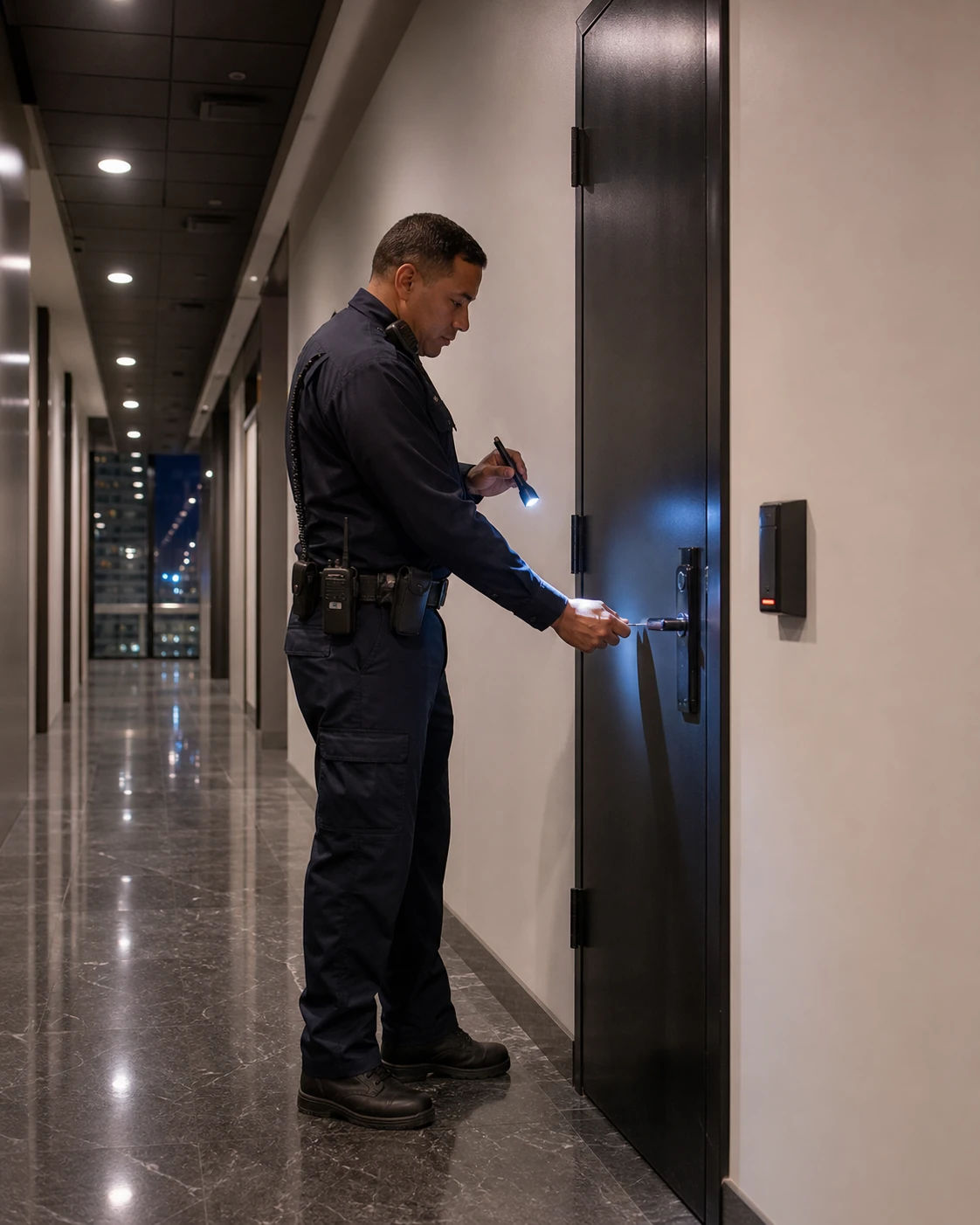
Technology alone cannot determine whether a door actually latched, assess a developing dispute, notice an unusual odor, or explain why the same condition keeps returning. The strongest programs combine appropriate technology with trained personnel, clear post orders, supervision, and management follow-through.
When evaluating a system, ask whether it helps the team:
- Capture accurate timestamps and locations
- Notify the correct person promptly
- Retrieve reports for trend review
- Protect sensitive information
- Assign and close follow-up actions
- Separate meaningful exceptions from routine activity
A practical monthly review for property managers
A short, structured meeting can keep patrol strategy aligned with changing building conditions. Each month, review:
- Incidents and unusual-condition reports from the prior period
- Repeated findings by location, shift, and category
- Outstanding repairs or access-control issues
- Patrol completion and supervisory observations
- Upcoming events, vacancies, projects, or schedule changes
- Required updates to post orders and notification lists
- Results of the previous month’s patrol adjustments
Document any changes, assign responsibility, and set a review date. This creates a feedback loop: observe, report, analyze, adjust, and verify.
Build a patrol strategy around your property
A Midtown office tower, SoHo retail property, mixed-use building, and active construction site do not have the same exposure or operating rhythm. Patrol routes and response procedures should reflect the site’s entrances, occupancy, public access, tenant activity, technology, and known vulnerabilities.
Guardian ISI can help Manhattan owners and managers assess security posts, establish site-specific patrol priorities, and arrange professional security guard services for commercial properties. For office environments, learn more about commercial office security.
To discuss planned or urgent coverage, call or text [(212) 602-1695](tel:+12126021695) or request security coverage online.
A practical operating checklist
| Stage | What to confirm |
|---|---|
| Find the pattern | Review location, shift, condition, and recurrence |
| Assign the response | Name the owner and record the patrol or repair change |
| Check the outcome | Compare similar periods and verify unresolved items |
Related Guardian services
Review Security Guard Services and Commercial Office Security to connect these procedures with the appropriate staffing and site responsibilities.
Frequently asked questions
What are data-driven security patrols?
Data-driven patrols use incident reports, guard-tour records, access alerts, complaints, and observed conditions to determine where and when security checks should receive greater attention.
How often should property managers review security incident reports?
Supervisors should review urgent reports immediately. A weekly pattern review and a more structured monthly assessment can help identify recurring locations, times, and unresolved conditions.
Should security patrol routes always follow the same schedule?
No. Core areas may require consistent checks, but timing and route order can be adjusted according to documented risks. Some variation can also make patrols less predictable.
What should a guard document after finding an unsecured door?
The report should identify the location, time, observed condition, immediate action, notifications made, whether the door was secured, and any repair or follow-up still needed.
How can a property manager measure patrol effectiveness?
Useful measures include recurring incidents by location, unsecured-door findings, response and notification times, patrol completion, unresolved deficiencies, and whether targeted problems decrease after changes are made.
Do private security guards replace police or emergency responders?
No. Private guards support property-level observation, access control, reporting, and response procedures. Emergencies and suspected crimes may require the NYPD, FDNY, EMS, or another appropriate public authority.