
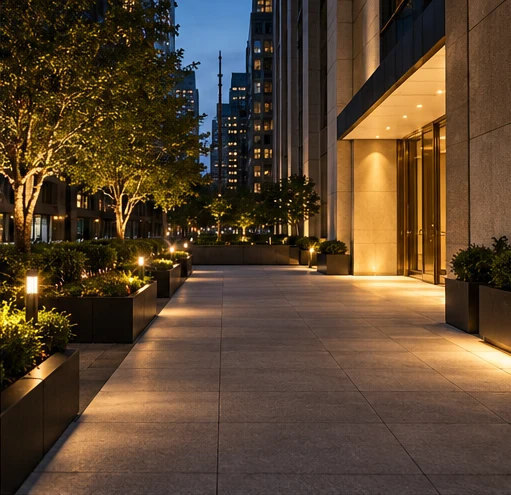
A useful dusk walkthrough answers a narrow question: can a person complete an ordinary arrival task under the conditions actually observed? It should produce a repeatable description rather than a general statement that an entrance is dark. The same doorway can look different from the street, the desk and the exit side.
This worksheet supports the after-dark lighting review. It is for observation and reporting. It does not replace required inspections, photometric measurements, emergency-lighting tests or professional accessibility assessments. Staff should stay on authorized routes and stop if the review would expose them to an unsafe condition.
Prepare a bounded observation route
Select the route with management before starting. Identify property-owned fixtures, public lighting and any areas controlled by a tenant. Confirm the reviewer can remain in normal pedestrian areas without entering a roadway, climbing or accessing equipment. Arrange coverage so the review does not leave a required post unattended.
Write the start point, end point and expected arrival activity. A hotel guest approaching with luggage may look for a door and address; a service visitor may need to read a delivery instruction. Keep the review focused on those tasks. Do not add a simulated emergency or a test of restricted access to a routine lighting walk.
- Observer and review date
- Route identifier and direction of travel
- Weather and visible surface conditions
- Time at each observation point
- Current use of the route and relevant operating state

Describe the condition without diagnosing it
Record what appears on, off, flickering or obscured from the safe observation point. Note whether a bright background makes a sign difficult to distinguish or a change in light occurs at the doorway. Describe the exact task affected and whether the issue persists when viewed from the other ordinary approach direction.
Avoid statements such as “failed ballast” or “timer defective” unless the qualified technician supplies that finding. An observer can report that a fixture appeared off at two recorded times. Facilities can compare that evidence with the intended schedule and controls. DOE's exterior-lighting controls guidance provides technical planning context for that separate review.
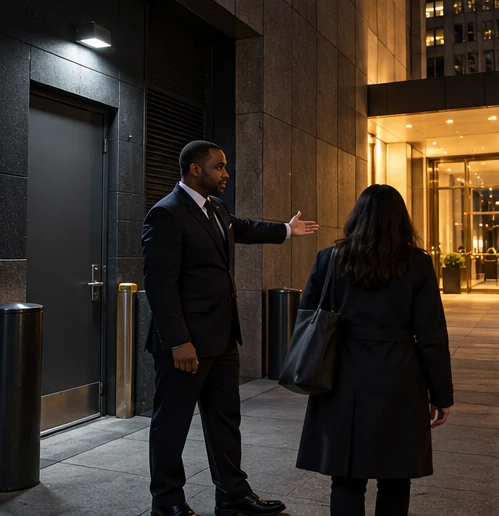
Capture context carefully
If photography is authorized, capture a wide view locating the issue and a closer view of the relevant object. Do not collect faces, room information, license plates or neighboring interiors unnecessarily. Retain images only through the property's approved process. A camera's automatic exposure may materially alter apparent brightness, so the written observation remains important.
Use consistent reference points such as the entrance name and a fixture label already assigned by facilities. Do not invent asset numbers that could be mistaken for official labels. When the exact fixture is unclear, mark the location on an approved simple route sketch and ask facilities to resolve the asset reference.
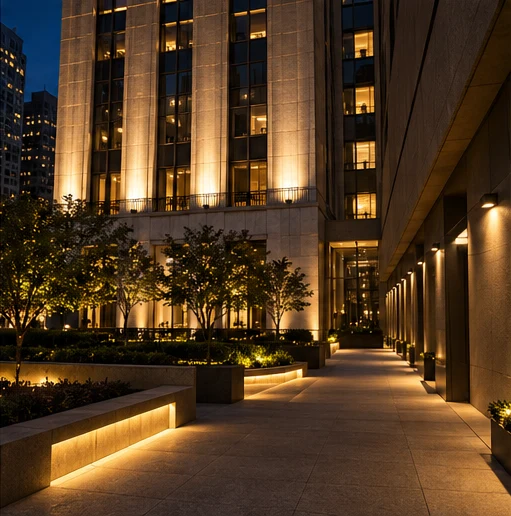
Route findings by consequence
Escalate an immediate hazard through the property's urgent process. Do not wait until the walkthrough ends to report a condition affecting safe movement. For ordinary defects, create a specific maintenance ticket with the location, task, evidence and requested assessment.
Keep glare separate from a suspected outage. DOE's glare discussion supports treating discomfort and visibility as distinct concerns. The glare report guide helps describe the viewpoint without choosing an engineering fix.
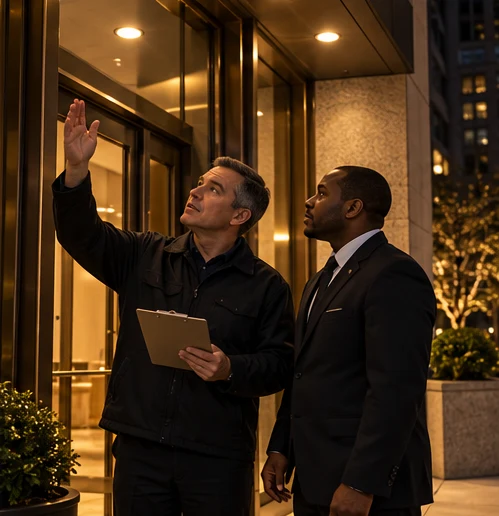
End with a repeatable check
Record who received each finding and what happens next. If no issue was observed, say which route, time and conditions were checked; do not label the whole property safe or compliant. A limited observation supports a limited conclusion.
For a return visit, repeat the same route under comparable conditions and document any differences. Rain, seasonal foliage, temporary signage or a changed entrance schedule can alter the observation. Bring unresolved findings back into the main review plan so that the next shift receives an assigned task rather than an unexplained photograph.