
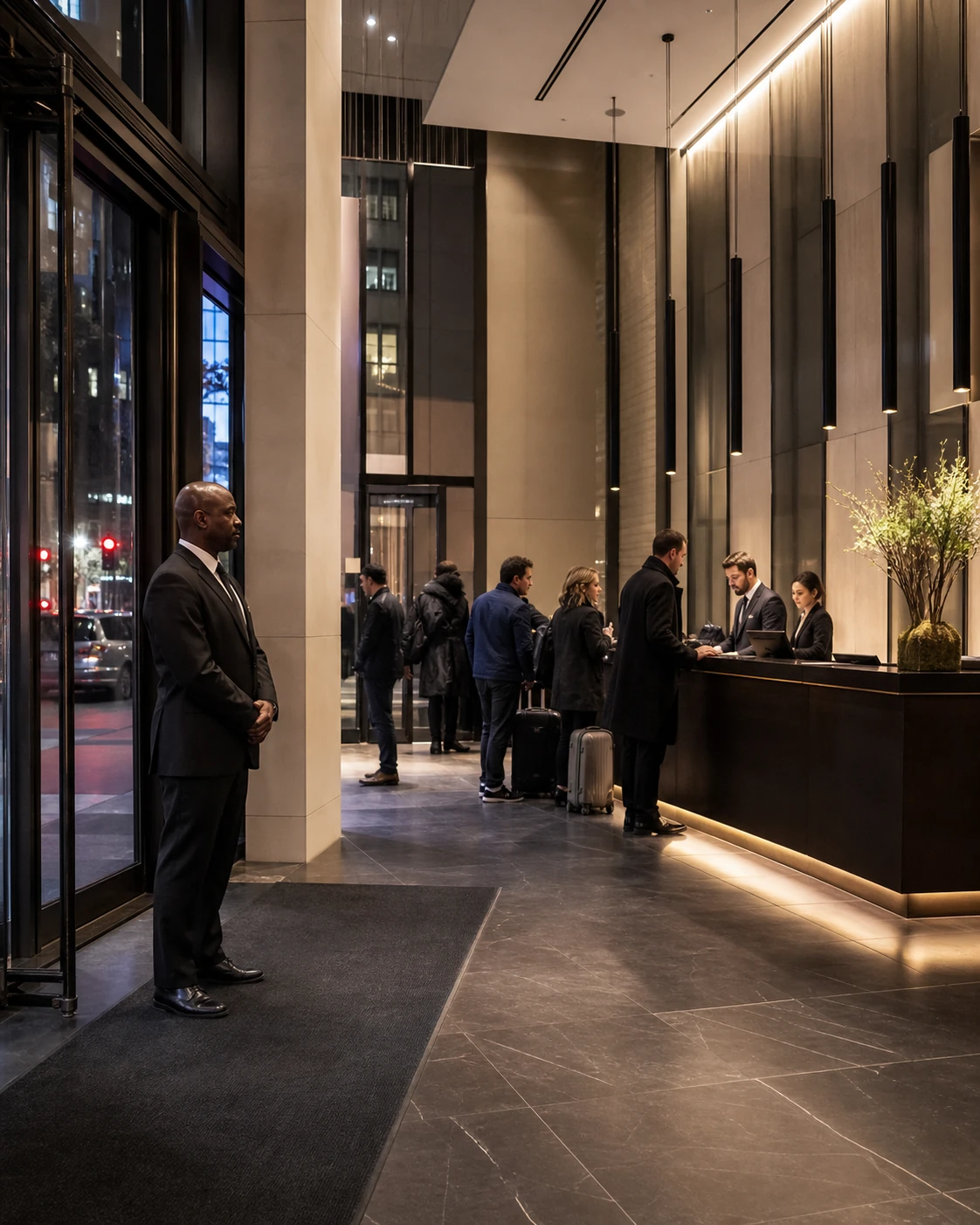
New York City hotels operate around the clock, often with multiple entrances, public-facing areas, overnight staff, contractors and hundreds of occupied rooms. Their security plans must address more than theft prevention: employee safety, guest incidents, emergency response, fire-life-safety coordination and documentation all matter.
The NYC Safe Hotels Act—Local Law 104 of 2024—added citywide licensing and operating requirements that affect hotel owners and operators. Many provisions took effect in 2025, making 2026 an important year for reviewing ongoing compliance rather than treating the law as a one-time project.
This checklist summarizes key operational issues, but it is not legal advice. Requirements can depend on room count, staffing arrangements, collective bargaining agreements, building characteristics and subsequent rules or amendments. Confirm current obligations with the NYC Department of Consumer and Worker Protection, the FDNY and qualified legal counsel.
What the Safe Hotels Act covers
The law established a licensing framework for hotel operators and set standards addressing front-desk coverage, security at larger hotels, employee panic buttons, human-trafficking awareness, room cleanliness and the direct employment of certain workers.
The Act is only one part of NYC hotel compliance. A hotel may also have obligations under the Fire Code, Building Code, employment laws, accessibility requirements and New York State security guard regulations.
Do all NYC hotels need a security guard around the clock?
No. The Safe Hotels Act's continuous on-site security guard requirement applies to hotels with more than 400 guest rooms while any guest room is occupied. Operators should verify how rooms are counted and whether any current rule or exception affects their property.
Hotels below that threshold should not assume that no security coverage is needed. A smaller hotel may still benefit from scheduled guards based on its location, entrances, event calendar, bar or restaurant operations, prior incidents, insurer expectations and overnight risk profile.
2026 NYC hotel security and safety checklist
Use this checklist to assign responsibility and identify missing evidence. Each completed item should have an owner, a review date and supporting documentation.
| Review item | Practical action | Evidence to retain |
|---|---|---|
| Hotel license | Confirm the operator holds the required DCWP license and calendar its renewal date. | License, application records and renewal reminders |
| Legal applicability | Document room count, operating entity, staffing model and any applicable exception. | Written applicability review and counsel guidance |
| Front-desk coverage | Maintain continuous front-desk coverage, including a compliant overnight arrangement. | Schedules, time records and escalation procedures |
| Large-hotel guard coverage | If the statutory threshold applies, maintain the required continuous on-site guard coverage. | Post orders, schedules, time records and incident logs |
| Guard credentials | Verify that assigned guards and the security provider hold the New York credentials appropriate to the work. | Registration checks, vendor license and training records |
| Panic buttons | Issue devices to covered employees and maintain a reliable response protocol. | Device inventory, test logs, training acknowledgments and response records |
| Human-trafficking training | Provide required awareness training to relevant employees. | Curriculum, attendance records and refresher dates |
| Direct employment | Review whether covered core employees must be employed directly by the hotel operator. | Contracts, payroll records and written exception analysis |
| Guest-room and common-area standards | Establish cleaning, inspection and documentation procedures consistent with the law. | Housekeeping records, inspection forms and guest requests |
| Emergency coordination | Connect security procedures with fire, evacuation, medical and shelter-in-place plans. | Emergency plans, drills, rosters and corrective actions |
| Complaints and retaliation | Provide a reporting path and prohibit retaliation for raising compliance concerns. | Policy, complaint log and investigation records |
| Ongoing auditing | Review performance after incidents and at scheduled intervals. | Audit reports, meeting minutes and corrective-action logs |
1. Confirm licensing and operating responsibility
The hotel operator should confirm that its DCWP hotel license is active and that the legal name on the license matches the entity operating the property. License renewal should be placed on a compliance calendar well before the expiration date.
Management agreements can create confusion about responsibility. Ownership, the hotel operator, the brand and third-party managers should document who is accountable for:

- License applications and renewals
- Required staffing and payroll records
- Security contracts and guard supervision
- Panic-button administration
- Employee training
- Guest complaints and incident records
- Communications with city agencies
A contract may allocate tasks, but it does not necessarily transfer a statutory obligation. Legal counsel should review any uncertainty.
2. Validate continuous front-desk coverage
The Safe Hotels Act requires continuous front-desk coverage. Overnight, a security guard trained to recognize human trafficking and able to assist guests may provide this coverage instead of front-desk staff. Hotels should test whether their staffing plan works during overnight breaks, callouts, emergencies and periods when one employee must leave the desk to assist a guest.
A practical written procedure should identify:
- Who covers the desk during breaks or unexpected absences
- How overnight employees summon assistance without abandoning the lobby
- Who controls guest-room keys and access credentials
- How staff verify visitors and delivery personnel
- When an issue must be escalated to security or management
- How coverage is documented
Continuous desk coverage and security guard coverage are not interchangeable. Where the law requires a guard, assigning a front-desk employee unrelated security duties may not satisfy that requirement.
3. Review guard coverage and post orders
Hotels subject to the large-property requirement should confirm that at least one security guard provides continuous coverage while any guest room is occupied. A risk assessment may justify additional personnel during events, demonstrations, high-occupancy periods or overnight hours.
Every assignment should have site-specific post orders covering:
- Lobby, entrance and loading-area patrols
- Guest-floor access and elevator controls
- Staff-only and back-of-house areas
- Key and access-card incidents
- Intoxicated or disorderly individuals
- Missing guests and welfare checks
- Domestic violence or harassment reports
- Medical emergencies and naloxone availability, where applicable
- Coordination with NYPD, FDNY and EMS
- Evidence preservation and incident reporting
Guard schedules should include a relief plan. A nominal 24-hour post is not continuous coverage if meal periods, lateness or callouts leave it unattended.
Guardian ISI provides hotel security services and can help operators evaluate fixed posts, overnight coverage and event-related staffing.
4. Make panic buttons part of a response system
A panic button is useful only when pressing it produces a prompt, understood response. Core employees whose duties involve entering occupied guest rooms should receive the appropriate device at no cost, along with practical instruction on when and how to use it.
Hotels should test:
- Whether the device works in guest rooms, corridors, stairwells and service areas.
- Where the alert appears and whether it identifies the employee's location.
- Who receives the alert on every shift.
- What the responder must do before entering a room.
- When staff should call 911 rather than attempt an intervention.
- How activations, false alarms and equipment failures are recorded.
Response procedures should protect the employee without pushing another worker into an unsafe confrontation. Depending on the circumstances, the correct response may be to withdraw, protect the area and call emergency services.
5. Verify guard and vendor qualifications
New York State regulates security guard personnel and companies that furnish guard services. Before retaining a vendor, review the credentials applicable to the assignment rather than relying solely on a certificate of insurance.
Vendor due diligence should address:
- Current company licensing where required
- Active guard registrations and required training
- General liability and workers' compensation coverage
- Supervisor availability around the clock
- Callout and replacement procedures
- Background-screening practices consistent with applicable law
- Incident-report quality and record retention
- Confidentiality and guest-privacy expectations
- Clear limits on force, searches and room entry
If a hotel uses directly employed guards, management should verify that its employer registrations, training administration and supervision model satisfy New York State requirements.
6. Review direct-employment rules before outsourcing
Hotels with at least 100 guest rooms generally must directly employ core housekeeping, front-desk and front-service workers, or use the permitted single-operator arrangement. Security employees are excluded from the statutory definition of core employees; this specific outsourcing restriction does not prohibit contracted security guards.
Review actual duties, applicable transition provisions, contracts and other employment obligations before choosing a staffing arrangement. Obtain property-specific legal guidance when roles overlap.
7. Train employees to recognize and escalate concerns
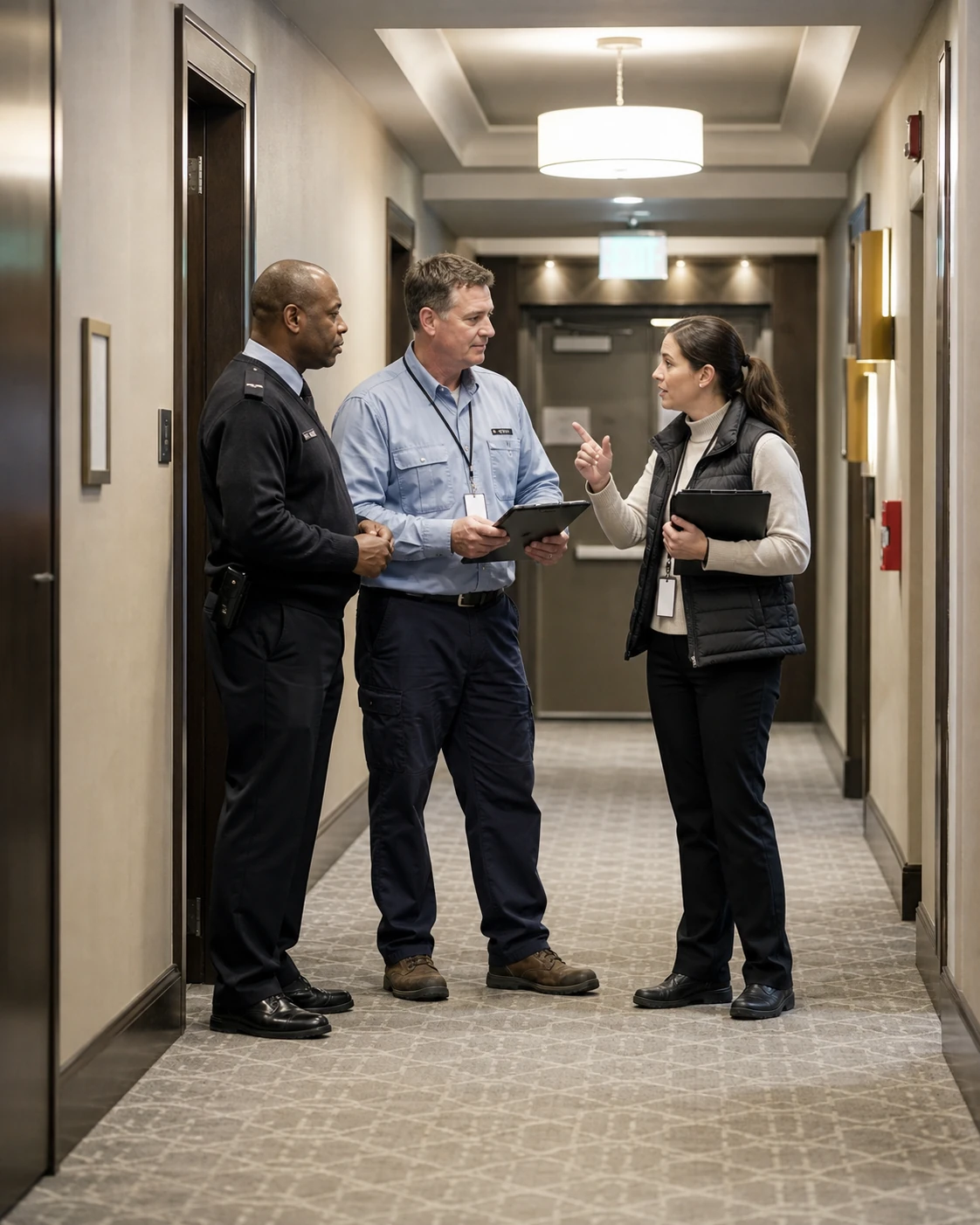
Required human-trafficking awareness training should be paired with a broader reporting process. Employees may observe warning signs, but they should not investigate, detain or confront guests on their own.
Training should explain how to report suspected exploitation, threats, stalking, weapons, guest distress and unauthorized room access. It should also cover privacy, non-discrimination and the danger of drawing conclusions based on appearance, nationality or occupation.
Managers should maintain attendance records and schedule refreshers for new hires, transfers and overnight teams.
8. Integrate security with fire-life-safety planning
The Safe Hotels Act does not replace FDNY requirements. A property's required plans, staffing and Certificates of Fitness depend on factors such as occupancy classification, fire-protection systems and building configuration.
Hotel management should confirm that security personnel understand:
- Who assumes command during an alarm or emergency
- How to contact the property's designated fire-life-safety personnel
- Which entrances must remain accessible to first responders
- Why fire doors, exits and stairwells cannot be obstructed
- How elevator recalls or shutdowns affect patrols
- Where guests requiring assistance may be located
- How accountability is handled after an evacuation
Hotels that require dedicated personnel should use appropriately qualified fire and life safety directors. If an impairment creates a fire-watch obligation, confirm qualification requirements with the impairment coordinator, including the limited initial-period exception described by FDNY; learn more about NYC fire guard coverage.
9. Audit incidents, records and handoffs
Hotel records should show what actually happened, not merely what policy required. Review a sample of overnight logs, panic-button tests, guard tours, staffing records and incident reports each quarter.
Look for recurring weaknesses such as:
- Uncovered breaks or late guard relief
- Repeatedly propped staff entrances
- Incomplete guest-floor patrols
- Unresolved panic-button faults
- Reports that omit times, locations or witnesses
- Security and front-desk logs that conflict
- Emergency contacts that are no longer current
Corrective actions should name an owner and deadline. Significant incidents warrant an after-action review involving operations, security, engineering and fire-life-safety leadership.
Building a defensible 2026 compliance file
A concise compliance file should include the current hotel license, applicability analysis, room-count documentation, staffing schedules, guard credentials, vendor contracts, panic-button tests, training records, policies, incident reports and completed corrective actions.
Keep records according to current legal requirements and the hotel's approved retention policy. Sensitive employee, guest and investigative information should be access-controlled rather than placed in a general operations folder.
Request NYC hotel security coverage
Guardian ISI helps Manhattan hotel operators plan dependable guard coverage, write assignment-specific post orders and prepare for overnight, event and emergency staffing needs.
Call or text (212) 602-1695, or request hotel security coverage online. For an urgent callout or unexpected staffing gap, review our emergency security coverage options.
Related Guardian services
Review Hotel Security and Fire & Life Safety Directors to connect these procedures with the appropriate staffing and site responsibilities.
Official references
Frequently asked questions
What are the main NYC hotel security requirements in 2026?
Key Safe Hotels Act obligations include DCWP licensing, continuous front-desk coverage, panic buttons for covered employees, human-trafficking awareness training and security guard coverage for hotels above the law's large-hotel threshold. Direct-employment and recordkeeping rules may also apply.
Does every NYC hotel need a security guard 24 hours a day?
No. The Safe Hotels Act's continuous guard requirement applies to hotels above its specified room-count threshold, commonly summarized as more than 400 guest rooms. Smaller hotels may still need coverage based on risk, contracts, insurance requirements or other obligations.
Can a front-desk employee serve as the required security guard?
Hotels should not assume front-desk coverage satisfies a separate guard requirement. Security personnel must have the applicable New York State credentials, and the hotel's staffing arrangement must satisfy the current law.
Who should receive a hotel panic button?
Core employees whose duties involve entering occupied guest rooms must receive panic buttons at no cost. Maintain a tested response procedure.
Does Safe Hotels Act compliance satisfy FDNY requirements?
No. The Act does not replace Fire Code obligations, required emergency plans, Certificates of Fitness or building-specific fire-life-safety staffing. Hotels should review those requirements separately with the FDNY and qualified professionals.
Can NYC hotels outsource their security guards?
Security employees are excluded from the Act’s core-employee definition. Its core-worker outsourcing restriction therefore does not itself bar contracted guards. Check actual duties, licensing, contracts, and other applicable requirements.