

Managing security across a New York City property portfolio requires more than responding to incidents as they occur. Property managers must understand how people, procedures, physical conditions, and security technology work together—and where gaps could expose tenants, visitors, employees, or assets to avoidable risk.
Security risk assessments for property management companies in NYC provide a structured way to identify those gaps and prioritize practical improvements. A useful assessment does not rely on generic checklists or recommend expensive equipment by default. It evaluates how a specific property operates, from lobby access and loading activity to contractor management and overnight coverage.
What Is a Property Security Risk Assessment?
A security risk assessment is a systematic review of a property's potential threats, vulnerabilities, existing safeguards, and operational needs. Its purpose is to help management decide which risks require attention and which improvements are realistic for the building.
The assessment may include:
- Site observations during relevant operating periods
- Interviews with property management, building staff, and security personnel
- Review of incident patterns and recurring complaints
- Examination of entrances, exits, lobbies, loading areas, garages, and amenity spaces
- Review of visitor, vendor, delivery, and contractor procedures
- Evaluation of guard-post responsibilities and escalation protocols
- High-level review of cameras, alarms, intercoms, and access-control practices
- Identification of emergency communication and staffing gaps
A security assessment is not automatically a code inspection, engineering study, cybersecurity audit, or legal compliance review. If the property has concerns involving fire protection systems, structural conditions, privacy obligations, or another specialized area, management should involve the appropriate qualified professional.
Why NYC Properties Need Site-Specific Assessments
A standard security plan rarely works equally well across every building. Even properties on the same Manhattan block can have very different risk profiles.
Mixed and competing uses
Office employees, residents, retail customers, messengers, contractors, food-delivery workers, and event guests may all use the same property. Shared entrances and elevators can make it difficult to maintain access control without disrupting normal operations.
High visitor and delivery volume
A busy lobby can receive hundreds of visitors and deliveries in a day. The assessment should examine whether staff can verify access consistently during peak periods—not merely whether a visitor policy exists on paper.
After-hours operations
Cleaning crews, construction workers, building engineers, tenants, and vendors may need access when management personnel are absent. These periods can create different vulnerabilities than daytime operations and may require separate post orders or staffing decisions.
Public-space exposure
Entrances opening directly onto sidewalks, transit-adjacent locations, public plazas, and ground-floor retail can increase unauthorized-entry, disorder, theft, and crowd-management concerns. The response should remain appropriate to the property rather than treating normal public activity as suspicious.
Construction and temporary conditions
Renovations can change circulation routes, block camera views, create unsecured openings, or bring unfamiliar workers into controlled areas. A property with active work may benefit from dedicated construction security procedures rather than relying entirely on its regular lobby operation.
What a Thorough Assessment Should Examine
Perimeter and entry points
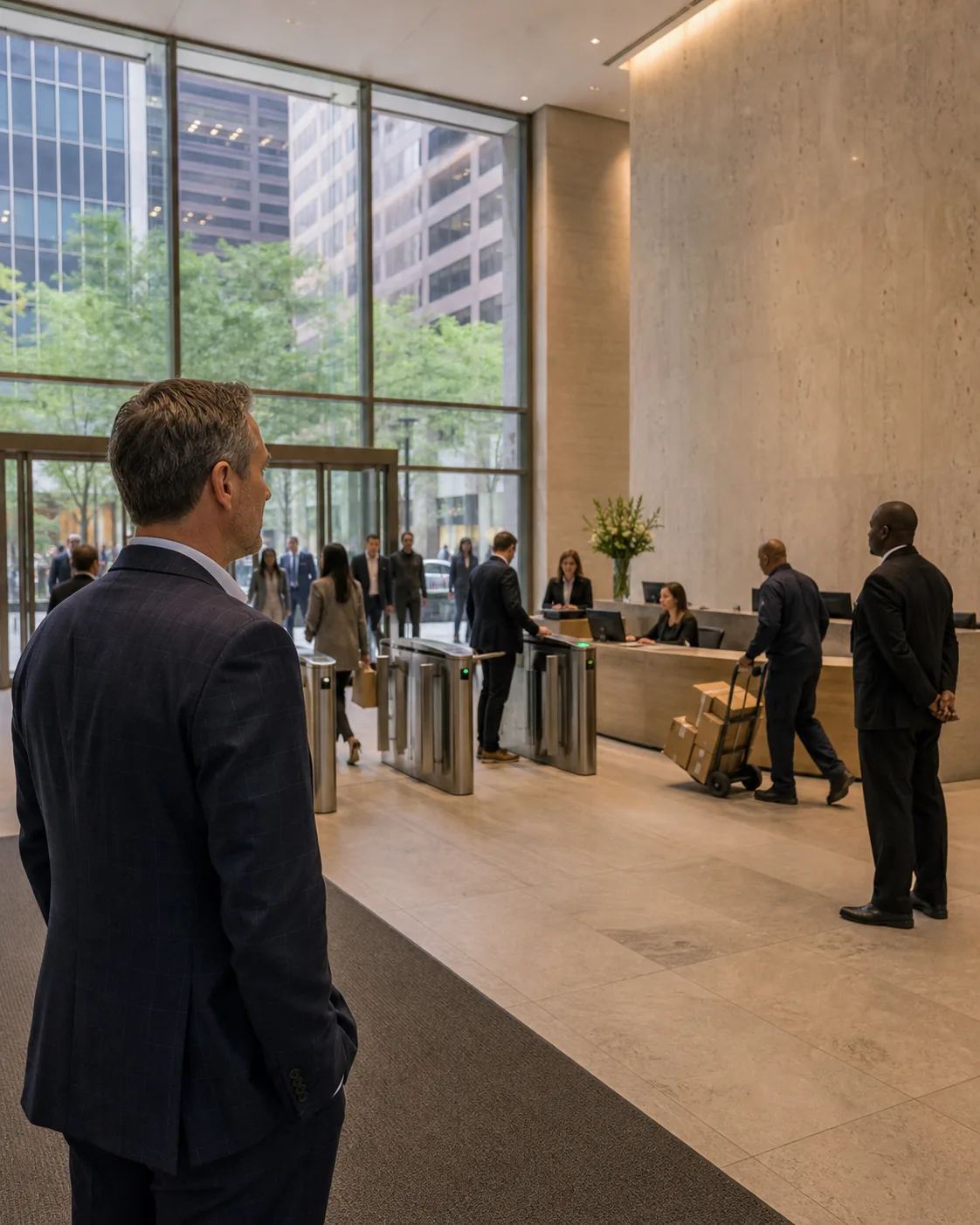
The reviewer should document how people approach and enter the property. This includes main entrances, service doors, loading docks, garage access, roof access, emergency exits, and any connection to adjacent spaces.
Questions may include:
- Are doors secured and monitored as intended?
- Do employees prop open service entrances for convenience?
- Can staff see people approaching the lobby or loading area?
- Are key, card, or credential privileges removed when no longer needed?
- Are deliveries directed to a controlled location?
The goal is not to eliminate every point of access. It is to understand whether each opening has an appropriate purpose, control, and owner.
Lobby and visitor management
An effective lobby process should balance security with tenant experience. Reviewers should observe how personnel handle expected visitors, walk-ins, food deliveries, large groups, and individuals who refuse to follow building procedures.
For properties using security guards, the assessment should compare written post orders with actual working conditions. A guard cannot monitor cameras, answer tenant questions, process visitors, receive packages, and investigate incidents simultaneously without clear priorities and backup procedures.
Security technology
Cameras, access-control systems, alarms, and intercoms can support security, but only when they match the operating environment. An assessment should consider practical questions such as:
- Are important approaches and transaction areas visible?
- Are recorded images useful for reviewing common incidents?
- Who receives alarm notifications, and what happens next?
- Are camera and access-control responsibilities clearly assigned?
- Is there a process for reporting outages or malfunctioning equipment?
Technology should support an operating procedure. It should not be treated as a substitute for supervision, training, or incident response.
Staffing and post orders
The assessment should identify what each security or front-desk position is expected to accomplish. It can then evaluate whether staffing levels, schedules, and instructions support those expectations.
Useful post orders typically address:
- Access and visitor procedures
- Patrol routes and frequencies
- Key and credential control
- Package and delivery handling
- Contractor access
- Incident documentation
- Notifications and escalation
- Emergency responsibilities
- Shift turnover and open-item tracking
Managers of office properties should also consider whether their commercial office security plan reflects current occupancy, hybrid work schedules, and after-hours tenant activity.
Incident reporting and response
Incident logs can reveal recurring conditions that individual reports may not make obvious. The assessment should review relevant events by time, location, type, and contributing factor where reliable information is available.
Management should also examine how reports move from frontline personnel to decision-makers. A report has limited value if hazards are noted repeatedly but no person is responsible for corrective action.
Emergency and fire-life-safety coordination
Security personnel are often expected to support communications, access for responders, crowd direction, and continuity during disruptions. These duties should be coordinated with the property's established emergency and fire-life-safety plans.
Role requirements vary by property and circumstance. Management should verify applicable obligations with qualified professionals and the relevant authorities rather than assuming that a general security position satisfies a specialized fire-life-safety role. If a planned vacancy or unexpected absence creates an operational gap, emergency security coverage may help stabilize the property while a longer-term solution is arranged.
Turning Findings Into a Practical Action Plan
A long list of observations is not enough. The final deliverable should help management make decisions.
Each recommended action should ideally identify:
- The condition: What was observed or reported?
- The risk: What could reasonably happen if the condition remains?
- The current safeguard: What already reduces the risk?
- The recommended improvement: What procedural, physical, staffing, or technological change should be considered?
- The priority: Is action immediate, near-term, or part of longer-range planning?
- The owner: Which person, department, landlord, tenant, or vendor is responsible?
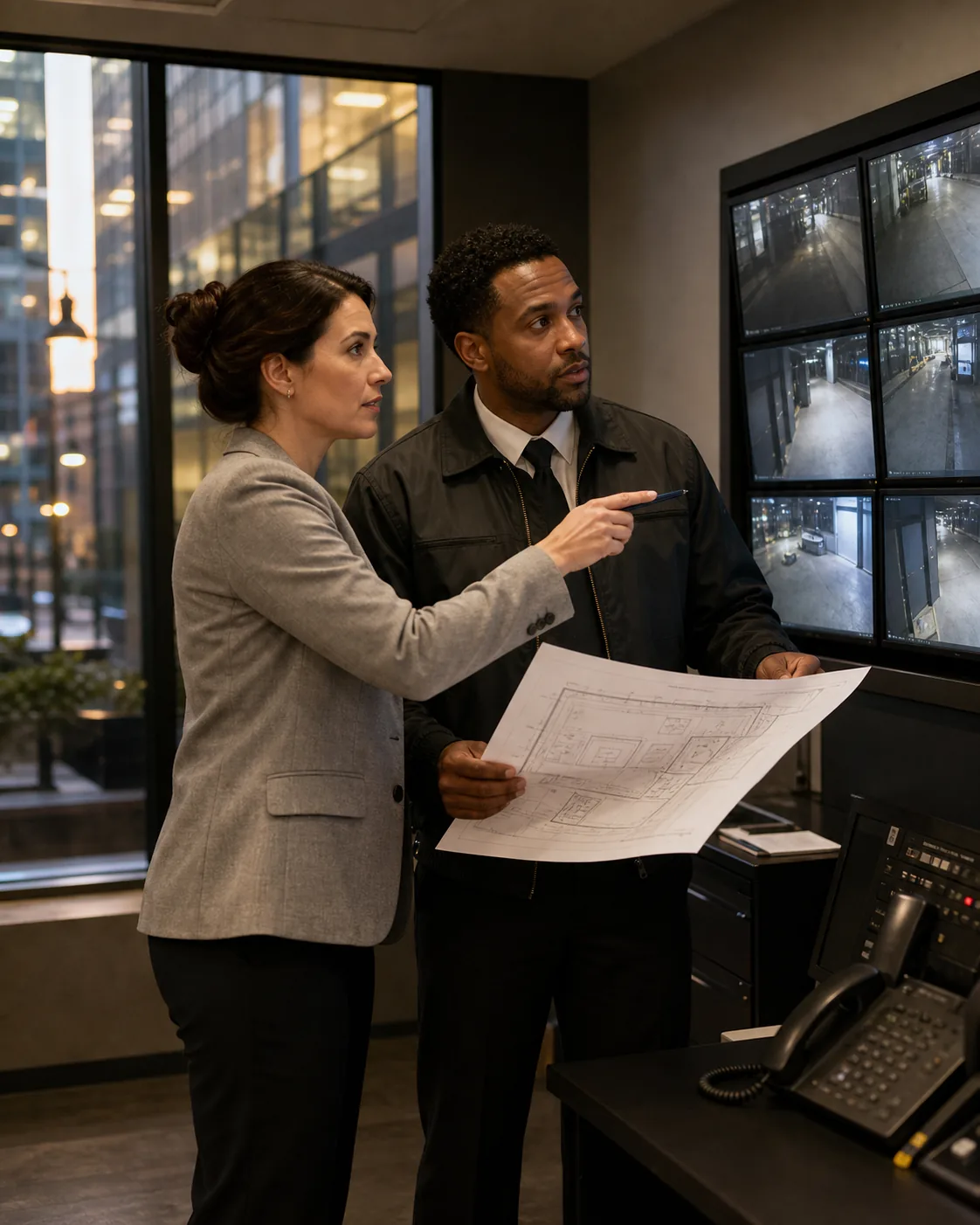
Quick improvements may include updating an emergency contact list, removing obsolete access credentials, clarifying a delivery policy, repairing a door closer, or revising post orders. More complex recommendations—such as redesigning a lobby, replacing an access-control platform, or changing staffing coverage—may require budgeting and coordination with multiple stakeholders.
Common Assessment Mistakes
Property managers can improve the value of an assessment by avoiding several common mistakes:
- Reviewing only during quiet hours: Peak arrivals, loading periods, shift changes, and evenings may reveal different issues.
- Focusing only on equipment: Many vulnerabilities result from unclear procedures, inconsistent supervision, or competing staff duties.
- Ignoring tenant operations: A building-wide plan may fail if tenant events, deliveries, or after-hours access are not considered.
- Treating every observation as equally urgent: Recommendations should be prioritized by credible risk and operational impact.
- Failing to assign ownership: Unassigned corrective actions tend to remain unresolved.
- Completing the report but not retesting: Management should confirm whether implemented changes work under real conditions.
When Should a Property Be Reassessed?
There is no single schedule suitable for every building. Management should consider a new or updated review after significant changes, including:
- A serious incident or recurring pattern of smaller incidents
- Major construction or lobby renovation
- Changes in occupancy, building use, or public access
- Replacement of a security vendor or technology platform
- Opening a new amenity, retail space, or loading operation
- Changes to staffing levels or operating hours
- Tenant complaints indicating a repeated security concern
Periodic reviews are also useful because procedures gradually drift. Doors are used differently, tenant rosters change, credentials accumulate, and temporary workarounds can become permanent practices.
Request a Security Review for Your NYC Property
Guardian ISI helps New York City property managers evaluate security operations and identify practical ways to strengthen coverage. Whether you oversee a Manhattan office building, residential property, mixed-use site, or active construction project, the review should reflect how your property actually operates.
To discuss a security risk assessment or arrange coverage, call or text (212) 602-1695. You can also request coverage online.
Frequently asked questions
What is included in a security risk assessment for an NYC property?
A typical assessment reviews access points, lobby operations, visitor and delivery procedures, staffing, post orders, incident reporting, security technology, and emergency coordination. The exact scope should be tailored to the building.
Is a security assessment the same as a legal or code compliance inspection?
No. A security assessment evaluates operational risk and safeguards. Code, engineering, fire-system, legal, and cybersecurity issues may require separate reviews by appropriately qualified professionals.
How long does a property security assessment take?
Timing depends on the property's size, number of entrances, operating schedule, document availability, and assessment scope. Complex or mixed-use buildings may require observations across multiple shifts.
Should tenants participate in the assessment?
Tenant input can be valuable, especially when tenants operate after hours, host events, receive frequent deliveries, or control parts of the property. Management should define who participates and how findings are shared.
How often should property managers reassess security risks?
Reassessment is useful after major incidents, construction, occupancy changes, vendor transitions, new technology, or changes in building use. Periodic reviews can also identify procedural drift and unresolved corrective actions.