
When government agents arrive at a property, front-desk staff need a clear process for identifying the request, notifying the right decision-maker, and protecting occupant safety. A face covering alone does not establish or disprove official authority.
This guide addresses operational preparation, not a determination that any mask restriction is currently enforceable. City and state measures, agency rules, and court orders can differ. Confirm the current position with counsel before changing access policies.
The New York Attorney General’s workplace guidance currently warns that it has not been updated for recent statutory changes. Read that notice and obtain current advice rather than treating an older guide or headline as a complete statement of the law.
Why the Issue Matters to Manhattan Properties
The controversy is not only about masks. For property teams, the central operational concerns are identity verification, access authorization, documentation, occupant safety, and avoiding unnecessary confrontation.
These issues can arise at:
- Commercial office lobbies and loading entrances
- Hotels and extended-stay properties
- Residential buildings and mixed-use towers
- Retail locations and shopping areas
- Construction sites and contractor entrances
- Privately managed public-facing spaces
A face covering may make visual identification more difficult, but appearance alone does not establish or disprove official authority. Staff should rely on the property’s approved verification and escalation procedures rather than personal assumptions.
What Front-Desk and Security Personnel Should Do
Stay calm and notify the designated contact
The employee receiving the initial request should promptly contact the building’s security supervisor, property manager, legal contact, or other person identified in the response plan. Employees should not debate immigration policy or speculate about an agent’s authority.
Request credentials professionally
If permitted by the property’s policy and legal guidance, staff may ask the visitors to identify themselves, present official credentials, state their agency, and explain whom they are seeking or what area they want to enter. Staff should not touch credentials, physically block agents, or take any action that could be viewed as interference.
Distinguish public and nonpublic areas
A lobby open to the public is different from tenant suites, guest floors, residential hallways, back-of-house areas, mechanical spaces, or access-controlled offices. Properties should clearly identify which areas are public and who may authorize entry into restricted areas.
Refer documents to the appropriate reviewer
Not every official-looking document grants the same authority. Judicial warrants, administrative warrants, subpoenas, and other requests may have different legal effects. Front-line personnel should be trained to route documents to designated management or counsel rather than attempting to make legal determinations themselves.
Do not obstruct or escalate
Guards and building employees should not physically interfere with government personnel, conceal people, destroy records, make false statements, or create a confrontation. If there is uncertainty, staff should document the request, notify the designated decision-maker, and follow counsel-approved procedures.
Build a Written Government-Agent Response Plan
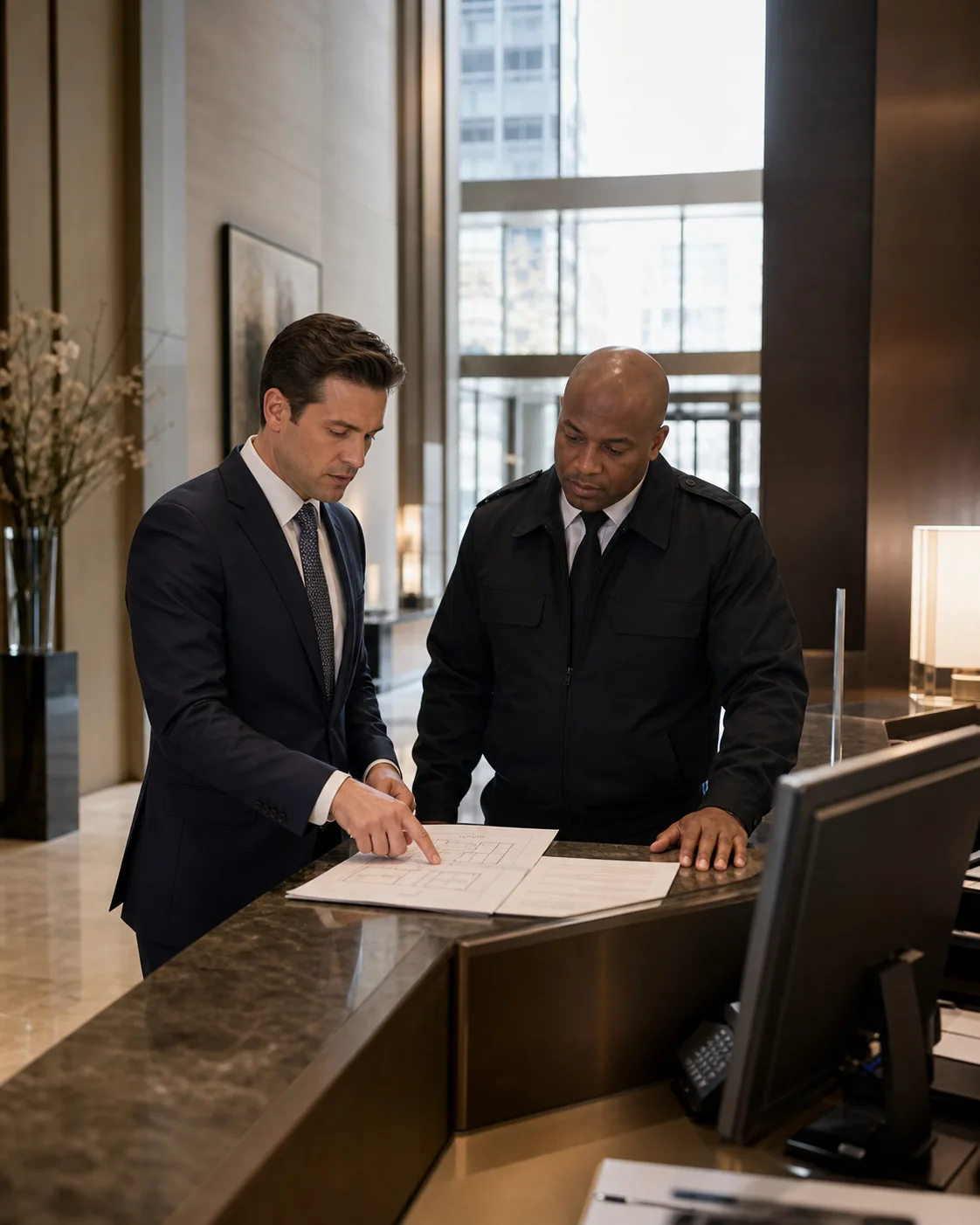
A written plan helps employees respond consistently, regardless of the agency involved. It can also reduce the chance that an untrained employee grants unauthorized access or escalates an otherwise manageable encounter.
The plan should address:
- Who takes charge: Name the on-duty and after-hours contacts authorized to make decisions.
- Credential verification: Establish a professional process for requesting names, agencies, badge or credential details, and contact information where appropriate.
- Access zones: Map public, tenant-controlled, residential, guest-only, and building-restricted spaces.
- Document handling: Explain who reviews warrants, subpoenas, and requests for records.
- Tenant notification: Define when and how tenants, ownership, management, or counsel should be contacted.
- Emergency escalation: Tell staff when to call 911 or request supervisory assistance, particularly if anyone becomes threatening or a medical emergency occurs.
- Reporting: Use a consistent incident-report form and preserve relevant access-control records or video according to established retention policies.
Identification, Masks, and Guard Conduct
A mask can complicate identification, but it should not become the sole focus of the interaction. Security personnel should observe and document objective facts, such as:
- Time and location of arrival
- Number of individuals present
- Agency and names stated by the visitors
- Credentials or documents presented
- Areas for which access was requested
- Names of managers or counsel contacted
- Access granted or declined by an authorized person
- Any safety concern, force, threat, or property damage observed
Reports should use neutral language. For example, “The individual wore a dark face covering and presented a credential identifying the agency as…” is more useful than a conclusion about motive or legality.
Security teams should also understand the limits of photography and recording rules. Properties should consult counsel before directing employees to record agents, publish identifying information, or retain copies of credentials.
Review Privacy and Records Procedures
Government requests may involve tenant lists, visitor logs, surveillance video, access-control data, guest information, or resident records. Staff should not disclose information simply because a request sounds urgent.
Property leadership should determine in advance:
- Who is authorized to release records
- Which requests require legal review
- How urgent preservation requests are handled
- Whether tenants or occupants must be notified
- How incident video and access logs are secured
- How long related records should be retained
Different property types may have different contractual and privacy obligations. Hotels, residential buildings, offices, and healthcare-related tenants should tailor their plans with appropriate counsel.
Train Guards Without Turning Them Into Lawyers
A useful training session should focus on repeatable actions, not constitutional analysis. Guards should know how to:

- Maintain professional access control
- Contact the correct supervisor immediately
- Avoid consent or disclosure beyond their authority
- Preserve safety and emergency access
- Document objective details
- Follow lawful instructions from authorized management
- Avoid physical interference or provocative language
Scenario-based drills can help. Test what happens if agents arrive during the morning rush, at a loading dock, after business hours, or when the primary property manager is unavailable.
Keep Policies Current as the Law Develops
Rules concerning officer identification and face coverings may change through legislation, executive action, agency policy, litigation, or court decisions. Property managers should assign someone to monitor official sources and schedule periodic policy reviews.
Do not rely only on social-media posts, campaign statements, or headlines. Confirm the text, effective date, scope, exceptions, and current legal status of any measure before representing it as binding law.
Strengthen Your Property’s Security Response
Guardian ISI can help Manhattan properties establish dependable lobby coverage, access-control practices, escalation procedures, and incident reporting. Services can be adapted for commercial offices, hotels, residential properties, and other high-traffic locations.
For security coverage or help strengthening front-desk procedures, call or text (212) 602-1695 or request coverage online. For legal decisions involving warrants, immigration enforcement, or government authority, consult qualified counsel.
Official references
Frequently asked questions
Should staff decide whether a mask restriction applies during an encounter?
No. Front-line staff should follow the approved identification and escalation process. Management and counsel should review current laws and court orders before setting policy.
Can a security guard refuse entry because an agent is wearing a mask?
A guard should not make that decision based on a mask alone. Staff should follow the property’s counsel-approved access policy, request identification where appropriate, notify an authorized manager, and avoid obstructing government personnel.
Does an ICE agent need a warrant to enter a private area?
Access depends on the location, consent, the document presented, and other legal circumstances. Public areas and restricted private areas are treated differently. Staff should promptly refer warrants and access requests to designated management or legal counsel.
Should building employees photograph masked agents?
Properties should obtain legal guidance before instructing employees to photograph, record, copy credentials, or publish identifying information. Staff can generally document objective details in an internal incident report under an approved policy.
What should a property response plan include?
It should identify decision-makers, distinguish public and restricted areas, establish credential and document-handling procedures, provide emergency escalation steps, address records requests, and require neutral incident reporting.
Can a private security company provide legal guidance about ICE activity?
A security provider can support access control, staffing, escalation, and reporting procedures, but property owners should rely on qualified attorneys for legal advice about warrants, immigration law, and government authority.